
 Photo: ADY Freight
USER and ETR IA have agreed to actively engage in the development of freight transport along the Asia–Europe route, strengthening logistics links through Romania’s seaports, which are becoming increasingly important in the architecture of Eurasian trade corridors.
The Romanian Freight Forwarders Association (Union of Romanian Freight Forwarding Companies – USER) and the Eurasian Transport Route International Association (ETR IA, the International Association of the Eurasian Transport Route in Azerbaijan) have signed a Memorandum of Understanding dedicated to the development of freight flows on the Asia–Europe axis, using the Middle Corridor as a strategic transit route.
The agreement was signed in Bucharest during the SEEFF* & FIATA REU European Congress by USER President Marius Cae and Emil Mammadov, advisor to the president for Trade and Logistics at the Azerbaijan State Railways (ADY) and representative of ETR IA.
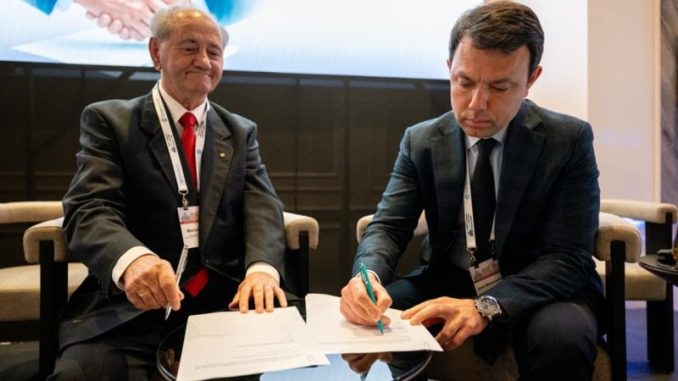 USER President Marius Cae (left) and Emil Mammadov, representative of the Azerbaijan State Railways (right)
The two organizations aim to strengthen bilateral cooperation to create a stable framework for the development of freight transport between Asia and Europe, with a central role assigned to Romania’s logistics infrastructure. In this context, Romanian seaports are targeted as key connection points between maritime and land transport.
The main purpose of the agreement is to analyze and develop transit freight transport, including containerized freight, through Romanian ports and those in the Caspian Sea region, along the Middle Corridor route to Europe and back. At the same time, the parties will seek to identify new trade flows and increase the volume of cargo routed through Romania’s seaports.
Another important objective is the exchange of statistical data on potential cargo flows along this route, with a focus on strengthening the role of Romanian ports in the Eurasian logistics chain. USER and ETR IA will also support the development of a regular feeder line between ports in the Caspian Sea region and Romania, as well as the expansion of container rail connections to European markets.
The cooperation also aims to facilitate faster and more efficient transit of goods and containers, contributing to increased competitiveness of multimodal transport through Romania. Overall, this partnership seeks to optimize logistics flows along the entire Middle Corridor, with a direct impact on the efficiency of transport between Asia and Europe.
 Photo: ADY Freight
Strengthening the role of Romania’s seaports
Following the signing of the agreement, USER and ETR IA will conduct regular consultations, technical negotiations, and information exchanges regarding the development of freight transport on the Asia–Europe route. These activities are primarily aimed at increasing logistics connectivity and more effectively integrating Romania’s seaports into international trade flows.
Under the agreement, each party will promote cooperation with ports, logistics operators, shipping companies, freight forwarders, and organizations interested in the development of the Middle Corridor. This approach aims to expand the network of partnerships and stimulate new trade routes.
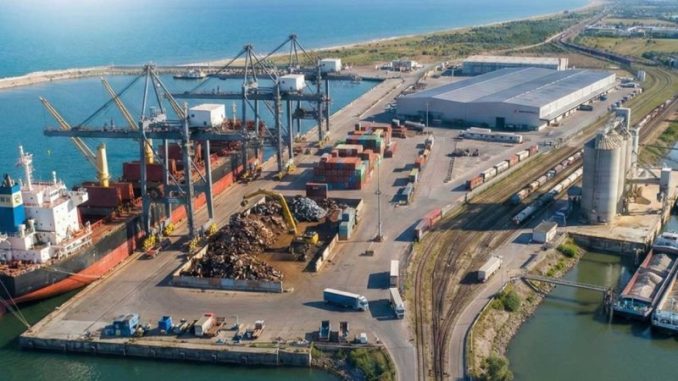 Photo: Port of Constanța/Eurovaldex
The agreement is valid for a period of two years, with automatic renewal for an additional year, and the parties may involve third parties through separate agreements for the implementation of joint projects. These initiatives will be formalized through distinct contracts, depending on the specifics of each logistics project.
The signing of this memorandum is based on the steady growth of freight transport on the Asia–Europe–Asia route, which requires the development of efficient logistics corridors between Romania’s seaports and ports in the Caspian Sea and Black Sea regions, with the aim of diversifying trade routes and improving the operational performance of international transport.
The Role of the Port of Constanța in Asia–Europe Rail Traffic
Data from the United Nations Conference on Trade and Development (UNCTAD) show that maritime transport remains the backbone of global trade, with approximately 80% of the world’s cargo volume transported by sea, reflecting the dependence of trade between Asia and Europe on ocean routes.
In this context, the Port of Constanța, Romania’s largest seaport, serves as a key distribution hub for Central and Eastern Europe, providing direct access to regional markets through the strategic connection of the Rhine–Danube Corridor. In 2025, the port reported a total throughput of 67.6 million tons and over 831,000 TEU.
At the same time, Eurostat and UNCTAD statistics indicate a steady increase in Asia–Europe trade, where containerized flows amount to tens of millions of TEUs annually worldwide, and average logistics distances have risen in recent years to over 5,000 nautical miles per shipment. This trend is putting pressure on traditional maritime chains, particularly in the context of congestion in Western ports and geopolitical instability, leading to the rerouting of some flows toward alternative corridors, including the Middle Corridor and Eurasian rail connections.
In this context, Romania’s seaports, particularly Constanța, are gaining increased strategic relevance as an interface point between maritime transport in the Black Sea region and European rail networks.
With a handling capacity of over 100 million tons annually and expanding infrastructure for container and intermodal terminals, Constanța is positioned as a regional hub for flows between Asia, the Caspian Sea, and Central Europe. Its connectivity to the rail network and the Danube offers a competitive advantage in the region.
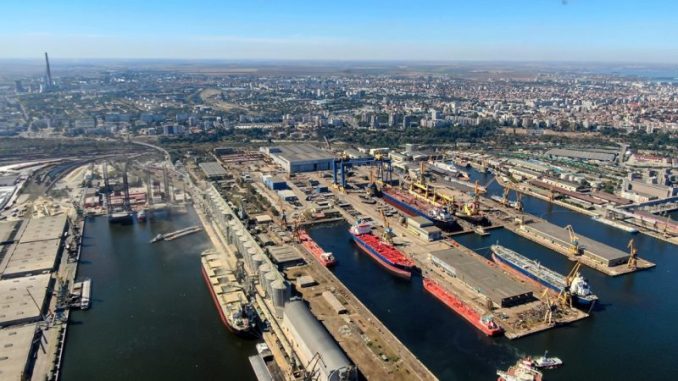 Photo: Port of Constanța
Eurasian rail hub: reconfiguring global routes
On the Asia–Europe rail segment, international data indicate accelerated growth in container transport, driven by significantly reduced transit times—averaging 12–18 days by rail, compared to 30–45 days
by sea. This difference has led to a rebalancing of logistics flows, particularly for high-value-added goods such as electronics, industrial equipment, and automotive components.
At the same time, UNCTAD notes that global trade volume continues to grow moderately, at an annual rate of approximately 2%, which increases pressure on existing logistics infrastructure. In this context, Eurasian rail corridors are becoming a complementary alternative to maritime transport, reducing dependence on congested sea routes and increasing the resilience of supply chains.
For Romania, this dynamic creates a structural opportunity to integrate its seaports into multimodal logistics chains between Asia and Europe. By combining maritime, rail, and river transport, the port of Constanța can become a regional redistribution hub for flows from Central Asia and the Caspian Sea region to European Union markets, thereby strengthening Romania’s position as a key logistics hub on the Eurasian axis.
Share on: 


