
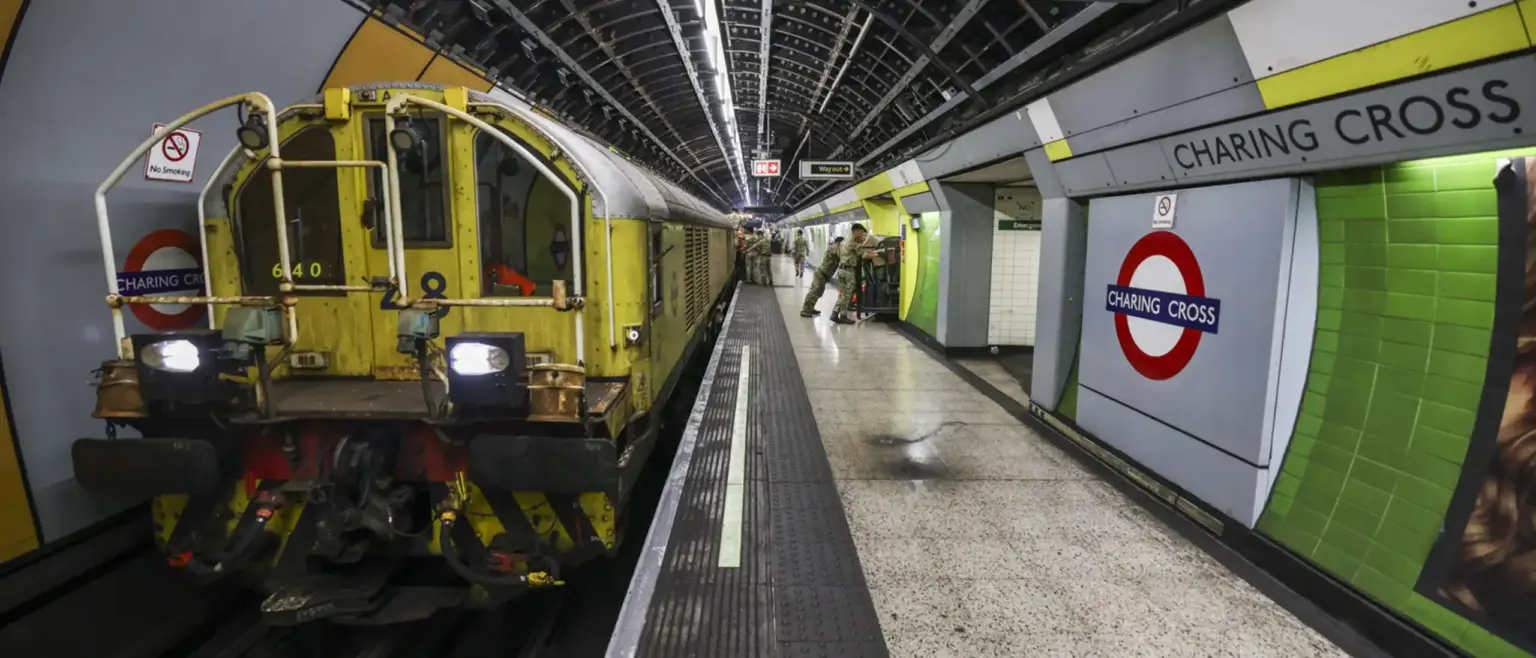
Exercise Arrcade Strike, run by the Allied Rapid Reaction Corps, tested the ARRC’s ability to plan and command large-scale military operations involving around 100,000 personnel drawn from the UK and its NATO allies. From the underground location, the headquarters coordinated activity across land, sea, air, space and cyberspace in a fictional scenario set in 2030, a timeline military planners have identified as a period of heightened risk.
The choice of an underground location was deliberate. A senior commander on the exercise explained that the shift away from traditional above-ground command posts reflects hard lessons from modern conflict. “We have moved from operating in tents and open environments, to commercial buildings, to aircraft hangars, and now to underground locations. Operating below ground significantly reduces our signature, makes us harder to find, and improves our chances of surviving attack.” Russian long-range missiles, drones and electronic surveillance are all capable of detecting and striking a conventional command post within minutes.
General Chris Donahue, Commander of NATO Land Command and US Army Europe and Africa, was direct about the stakes. “A fully enabled Strategic Reserve Corps able to fight and win wars, led by the UK, is not optional. It is essential.”
Up to 500 staff worked in the tunnels, processing more than ten terabytes of data daily. A key enabler was Project Asgard, an AI-powered headquarters platform pulling in data from sensors, satellites and intelligence feeds to support faster decision-making. The Corps commander said the headquarters would “rely on data analytics and AI to ingest, fuse and visualise that data so the staff and I can make good decisions, at the pace of relevance.”
Exercise Arrcade Strike also served as the launch platform for 9 Deep Recce Strike Brigade, the British Army’s newest formation. The unit is designed to find and engage enemy forces at long range, commanding surveillance drones, rocket systems firing to 150km, and one-way attack drones with ranges out to 600km.
The logistics of establishing the command post required considerable ingenuity. Major Joe Harris, Officer Commanding 14 Squadron RLC, described moving all equipment via unmarked civilian vans to Ruislip in the early hours before transferring it onto a specialist Transport for London engineering train and bringing it directly to the Charing Cross platform. A week of construction followed, with 22 Signal Regiment installing communications networks throughout. The team also developed a barcode scanning system to track personnel underground, an innovation Harris suggested could have real-world operational applications.
Personnel maintained cover throughout. Corporal Ismaila Ceesay, an information management specialist from Stratford in east London, described arriving in civilian clothes and changing into uniform only after passing through secure barriers. “I’ve reached into my London roots and adopted a London look to blend in like a local, so no one can suspect I’m anything but a commuter going to work,” he said. Drawing a historical parallel, he noted: “Winston Churchill was hidden underground in London in the Second World War, so it’s nothing new. It worked for him.”
Major Jess Wood, Chief of the Joint Air Ground Integration Centre, said the location had proven its worth. “Underground offers good protection and is very adaptable, so we are able to deliver our frontline from a range of locations. It doesn’t matter where we are based to achieve effect.” The secrecy was not without its lighter moments. “Someone stopped me on my way into work and asked how to get to Heathrow yesterday,” she said.
The ARRC intends to continue rehearsing the underground model across the UK and Europe over the next two years, working toward a fully mission-capable Strategic Reserve Corps by 2030.