
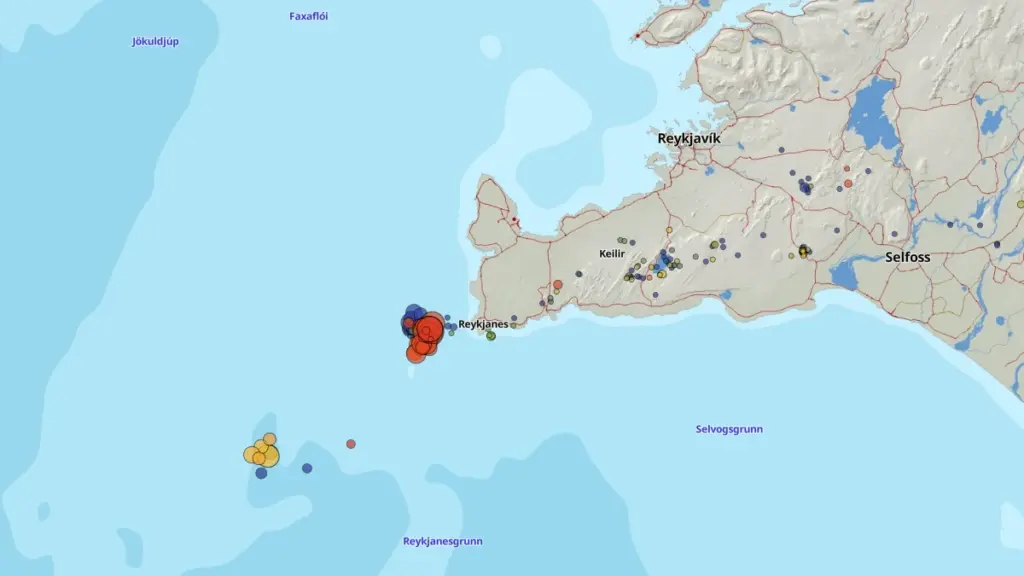
According to an Icelandic Meteorological Office (IMO) specialist note issued at 05:27 UTC on May 25, around 180 earthquakes had been recorded in the swarm, with the largest measuring M3.5. By 08:25 UTC, IMO’s preliminary 48-hour table for Reykjanes Ridge listed 227 events, including 80 below M1, 130 from M1 to M2, 16 from M2 to M3, and 1 above M3.
The strongest event in the sequence thus far — M3.5 — occurred at 05:06 UTC on May 24 at a depth of 5.8 km (3.6 miles), 7.7 km (4.8 miles) north-northeast of Eldey.
Seismicity was concentrated near Eldey and west to northwest of Reykjanestá, with many events at depths of 5.2 km (3.2 miles) to 13.7 km (8.5 miles).
“The most intense activity in this swarm occurred around four and five o’clock this morning, and it has gradually decreased since then,” Bjarki Kaldalóns Friis, natural hazard specialist at IMO, told mbl.is.
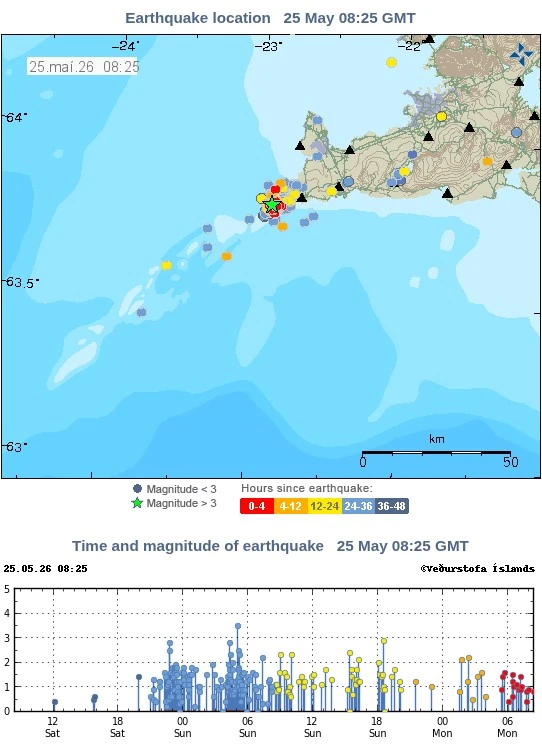 Credit: IMO
“It’s still ongoing, coming and going,” Friis said. “That’s common with these kinds of swarms. We’re not expecting anything in particular, and we don’t know what will happen. We’re simply monitoring the situation and seeing how it develops.”
“This is also located on the tectonic plate boundary, so it is most likely unrelated to the activity occurring in Grindavík.”
IMO said earthquake swarms are common in the area and that similar swarms were recorded there in February and April 2026.
References:
1 Specialist remark – IMO – 05:27 UTC on May 25, 2026
2 200 earthquakes recorded since last night – mbl – May 25, 2026