
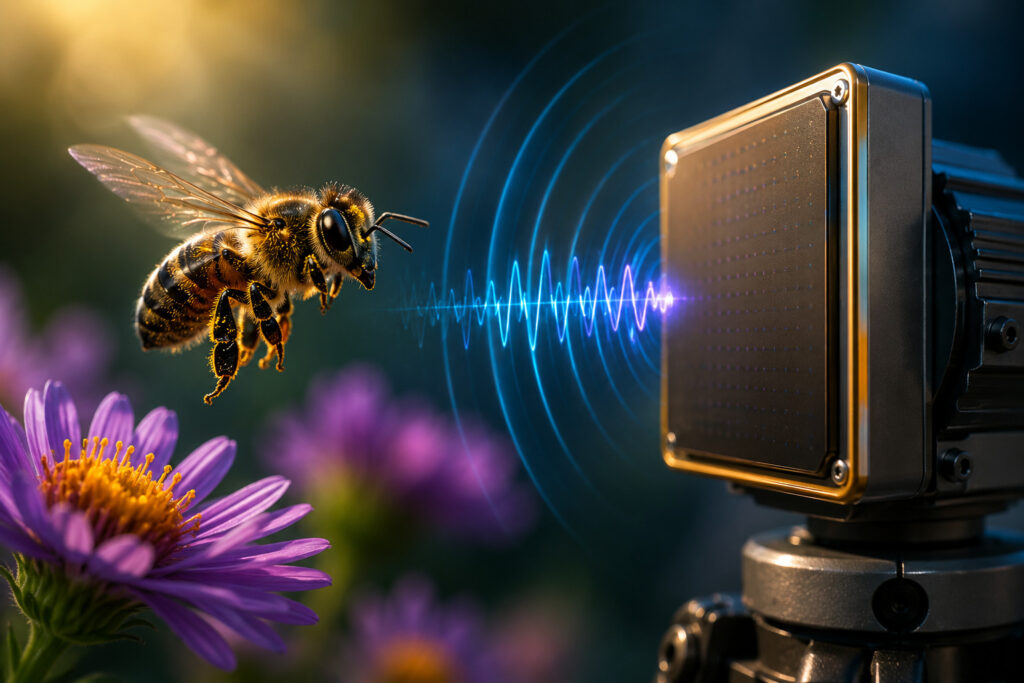
 Just for illustrative purposes. Credit: ZME Science.
Pollinators like bees and butterflies are vanishing across the world due to toxic pesticides and habitat loss, threatening ecosystems and global food security. Over 87% of flowering plants rely on these species for reproduction.
However, monitoring pollinators is still slow, difficult and often destructive. Many insects must be captured, killed and identified by specialists, while camera-based systems struggle with poor lighting, bad weather and cluttered field conditions.\
But what if you could use the same tech used to identify aircraft? It sounds crazy and a bit overkill, but it actually works.
In a new study, researchers in Europe used millimeter-wave radar and machine learning to identify five species of pollinating insects, including honeybees, bumblebees and a common wasp. The system was able to read the faint radar patterns produced by wingbeats, then used those patterns to sort insects by family, genus and species.
The work is still a proof of concept, which has so far only been shown to work in a lab setting. But it points to a possible new way to monitor pollinators at a time when ecologists need better data on insects that help sustain crops, wild plants and food webs.
Counting Insects by Hand
 Dr. Linta Antony, the study’s first author, collecting insects for the study. Credit: Sibin Leo
Pollinators are hard to monitor well. Many are small, fast and difficult to identify without expert knowledge.
Of course, many biologists have upgraded their trusty nets for more modern technology. Some insect surveys regularly use camera-based systems using machine learning to classify insects from images. This only works well to a degree, as the images themselves aren’t always in sharp focus on the insects. Light conditions regularly change, while rain, shadows, leaves and cluttered backgrounds all complicate the task.
Radar offers another route. It’s not a new idea, as scientists have used radar for decades to study insects migrating high in the air, but only for swarms. The new study tackles a harder problem: identifying single insects flying near the ground, more like pollinators moving among flowers.
“Typically, the radar reflection from single insects is very weak,” Adam Narbudowicz, an associate professor of space research and technology at the Technical University of Denmark, told IEEE Spectrum. “It’s probably impossible to detect them just by looking at a single point in time.”
So the team looked for patterns across time. As insects flap their wings, they create tiny shifts in reflected radar signals, known as micro-Doppler signatures. The idea is similar to how a conventional radar can distinguish a drone from a bird by reading subtle movement patterns, not just location.
“In the beginning, we really weren’t sure it would work, as the insects are really small and the micro-Doppler signals we worked with were very weak,” Narbudowicz said.
The Signature in the Wingbeat
 Radar system used to collect data from insects. Credit: Linta Antony.
The researchers collected live insects on the campus of Trinity College Dublin between May and November 2023. They focused on five species: the honeybee Apis mellifera, three bumblebees — Bombus lapidarius, Bombus terrestris and Bombus muscorum — and the common wasp Vespula vulgaris.
Each insect was placed individually in a small plastic cylinder, four centimeters wide and five centimeters tall, set above a millimeter-wave antenna. The radar transmitted a simple 30-gigahertz continuous wave signal and recorded the reflected signal for 60 seconds. Video helped the researchers confirm when the insects were flying or flapping their wings, but the machine-learning system used only the radar data.
The insects were released after recording.
The system did not just measure wingbeat frequency. It extracted more than 70 features from the radar signal, including how the energy spread across frequencies, how the signal changed over time and how regular the wingbeat pattern appeared
First, the model separated bees from wasps. Then it sorted bees into honeybees or bumblebees. Finally, it tried to distinguish the three bumblebee species.
At the broadest level, the model separated the bee family Apidae from the wasp family Vespidae with 96 percent accuracy. At the species level, it correctly classified the five insects with 85 percent accuracy.
 Credit: ZME Science.
“It’s fascinating to see how different species use their wings in different ways, and also that this can be observable in radar signals,” Narbudowicz told IEEE Spectrum. “When looking at raw signals, it’s difficult to capture all the subtle details, but with sufficient machine learning you can distinguish those.”
The longer the insect stayed within the radar beam, the better the system performed. Species-level accuracy rose from 75 percent for a 0.1-second signal to 84 percent for one second and 85 percent for two seconds.
These insects were not flying freely in a meadow. They moved inside a small container, close to the antenna, in an indoor setting. The authors note that some signal features may partly reflect those restricted conditions, including occasional contact with the container walls.
The data set was also small in taxonomic scope: five species, all from one insect order. Natural habitats contain many more species, often with overlapping sizes and behaviors. This is why the authors say field trials with free-flying insects are needed.
Still, the approach has its perks. It does not require good lighting, nor does it depend on a clear photograph. It could, in principle, be built into a fly-through device that briefly guides an insect past a sensor and releases it unharmed.
“The power levels we use are below the levels that could harm insects,” Narbudowicz told IEEE Spectrum. Comparatively, “a traditional insect trap relies on drowning the insect in poisonous cyanide liquid.”
The broader goal is a database of insect radar signatures, paired with environmental data such as temperature and humidity, because those conditions can affect wingbeat patterns. Such a database could help scientists monitor not only pollinators, but also pests and invasive species.
If it works outdoors, the system could turn a familiar technology into a new ecological instrument.
The findings appeared in the journal PNAS Nexus.