
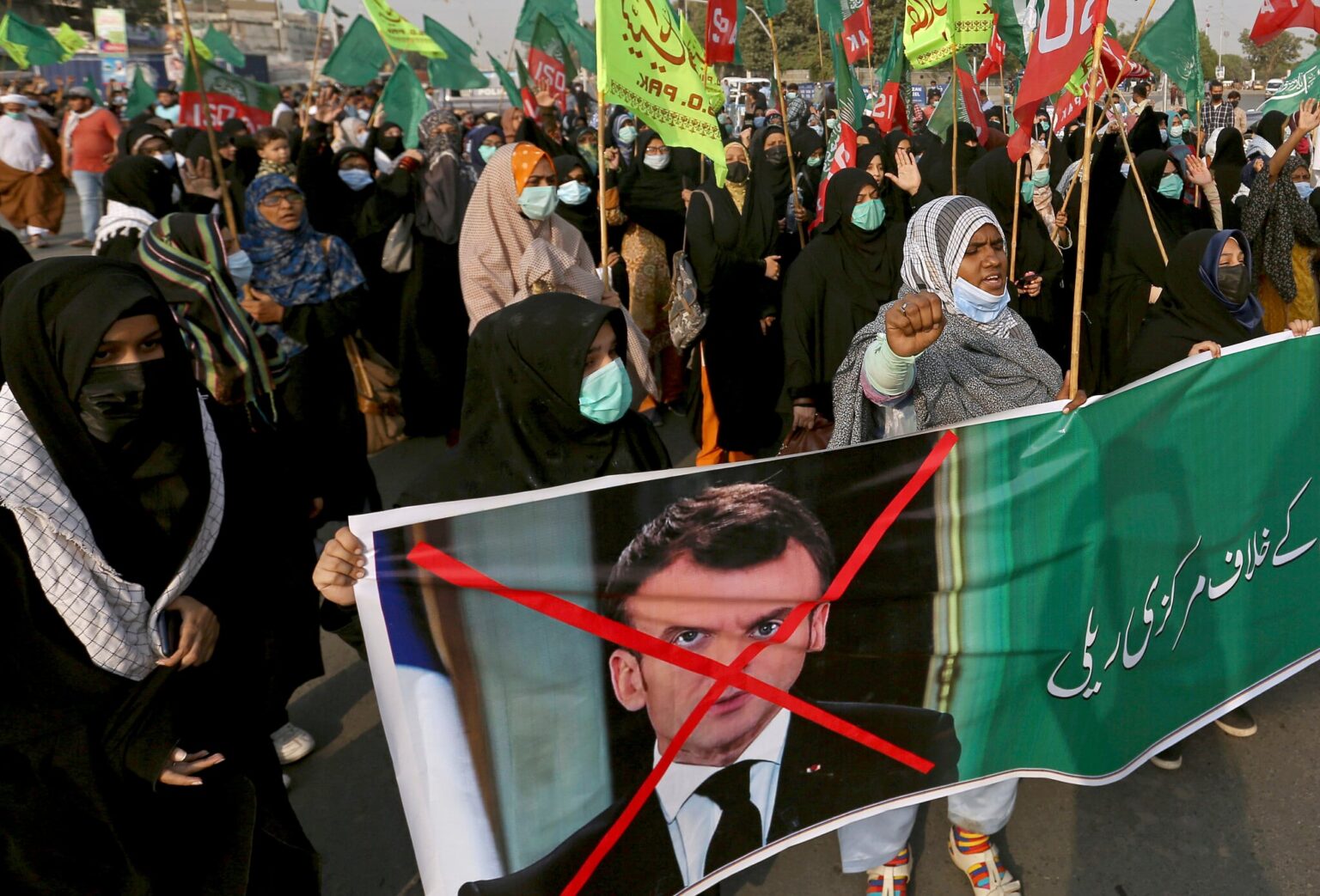
France stands at an existential demographic, cultural, and geostrategic crossroads that could permanently transform Europe and reorder global power. Reliable estimates place the Muslim population at 6 to 7 million—nearly 10 percent of the total. That share has exploded from under 1 percent in living memory, driven by sustained immigration from Muslim-majority countries, markedly higher fertility, and stalled assimilation in urban strongholds.
The numbers are clear. Muslim women in France average 2.9 children; native French women average 1.8. Overall native fertility sits at 1.59, well below the 2.1 the opposite level. In several major cities, more than 25 percent of newborns already carry Muslim-origin names. High-migration projections show the Muslim share reaching 18 percent by 2050. If current fertility gaps and net migration persist, demographic compounding points to a Muslim population of 40 to 50 percent by mid-century.
At that threshold, Muslims cease to be a minority and become the decisive social and electoral bloc. Recent polling confirms the rupture. A 2025 survey of more than 1,000 self-identified Muslims found 46 percent believe Islamic law should apply in France to some degree. Among those aged 15 to 24, the figure rises to 59 percent; 57 percent of this cohort say Islamic rules take precedence over French law in any conflict. These attitudes have roughly doubled since the late 1990s, reflecting a generational re-Islamization that places religious governance above secular republican values.
Political power follows demographic weight. France’s electoral system rewards concentrated urban communities. Once Muslims form a near-majority or pivotal swing force, a Muslim president or commanding parliamentary majorities cease to be speculation and become arithmetic certainty. France would then stop functioning as a traditionally secular European republic and emerge as Europe’s first Muslim-majority power—potentially aligning with the Organisation of Islamic Cooperation while retaining its arsenal of roughly 290 nuclear warheads and its permanent United Nations Security Council seat.
Native French resistance is inevitable. History shows that people fight to preserve their identity. Anglo-Saxon kingdoms repelled Viking incursions through determination and force, adapting yet retaining their core character. Today’s challenge arrives through birth rates and migration rather than longships, but the instinct for self-preservation endures. Mass protests, political realignment, or outright civil unrest—on a scale recalling Europe’s most violent historical upheavals—become likely the moment large segments of the native population feel their country slipping away.
The most radicalized Muslim states will not remain spectators. Bound by faith, culture, and strategic interest, they can be expected to apply diplomatic pressure, economic leverage, financial support, and possibly more direct assistance to embolden their European co-religionists and neutralize local resistance. What sounds like geopolitical fiction is actually the current logical trajectory.
The recent confrontation with Iran has already exposed Western hesitation and division. Protracted ceasefire talks while adversaries probe the limits of resolve signal weakness to Russia and China. Beijing may press harder on Taiwan; Moscow may accelerate pressure on Ukraine, the Baltics, and Eastern Europe. The West increasingly lacks the unity, resolve, and military readiness to respond effectively.
Internally, Europe drifts toward extreme-left coalitions that accommodate Islamist positions on blasphemy, gender segregation, and foreign policy. This convergence accelerates self-inflicted decline precisely when authoritarian powers sense vulnerability.
Critics in America correctly note that the United States is a nation of immigrants. Those immigrants, however, came overwhelmingly from Europe and, despite linguistic and national differences, largely shared Judeo-Christian foundations and a willingness not to assimilate but to integrate and help build the strongest and most successful nation in history. Importing large numbers from regions whose populations reject integration and seek to transplant exogenous agendas produces the opposite: parallel societies, eroded social trust, and eventual fracture—already fueling radicalism on both ends of the political spectrum.
Muammar Gaddafi understood the mechanics with brutal clarity. In 2006, he declared that 50 million Muslims already in Europe would conquer the continent “without swords, without guns, without conquest,” through the power of the womb. Demographic reality increasingly validates his warning.
A France under predominant Muslim political control would fundamentally reshape global strategy. Its nuclear deterrent, originally forged to protect the West, could realign with Middle Eastern priorities hostile to the State of Israel—potentially before Iran achieves full nuclear breakout. The first European nuclear power reoriented toward Islamist governance would fracture the North Atlantic Treaty Organization, destabilize the European Union, and tilt the Middle Eastern balance of power in ways that could threaten Israel’s survival.
France and Europe still possess the sovereign tools to reverse course—strict border enforcement, rigorous secular integration standards while respecting people’s private liberties and religious rights, and pro-natalist policies aimed at restoring demographic vitality. Demographics are not destiny when nations retain the political will to act.
This assessment springs from unflinching realism, not prejudice. While hatred of any minority must be rejected, the demographic arithmetic, polling on Sharia preference, fertility differentials, urban concentration, and the existential geostrategic risk of a nuclear-armed permanent Security Council member potentially pivoting toward Islamist priorities demand immediate, unsentimental confrontation.
France and Europe must act if they are to preserve their historic identity and the Western order they anchor. Inaction guarantees the civilizational erosion already unfolding. France’s reckoning is the West’s warning.
Jose Lev Alvarez is an American-Israeli scholar specializing in Middle Eastern security policy.
A multilingual veteran of both the IDF Special Forces and the U.S. Army, he holds a B.S. in Neuroscience with a Minor in Israel Studies from American University, three master’s degrees (international geostrategy, applied economics, and intelligence studies), and a medical degree. He is currently completing a Ph.D. in Intelligence and Global Security in the Washington, D.C. area.
In addition to blogging for the Times of Israel, he contributes to the Washington Examiner, is a writing fellow at the Middle East Forum, and regularly provides geopolitical analysis on Latin American television networks.