
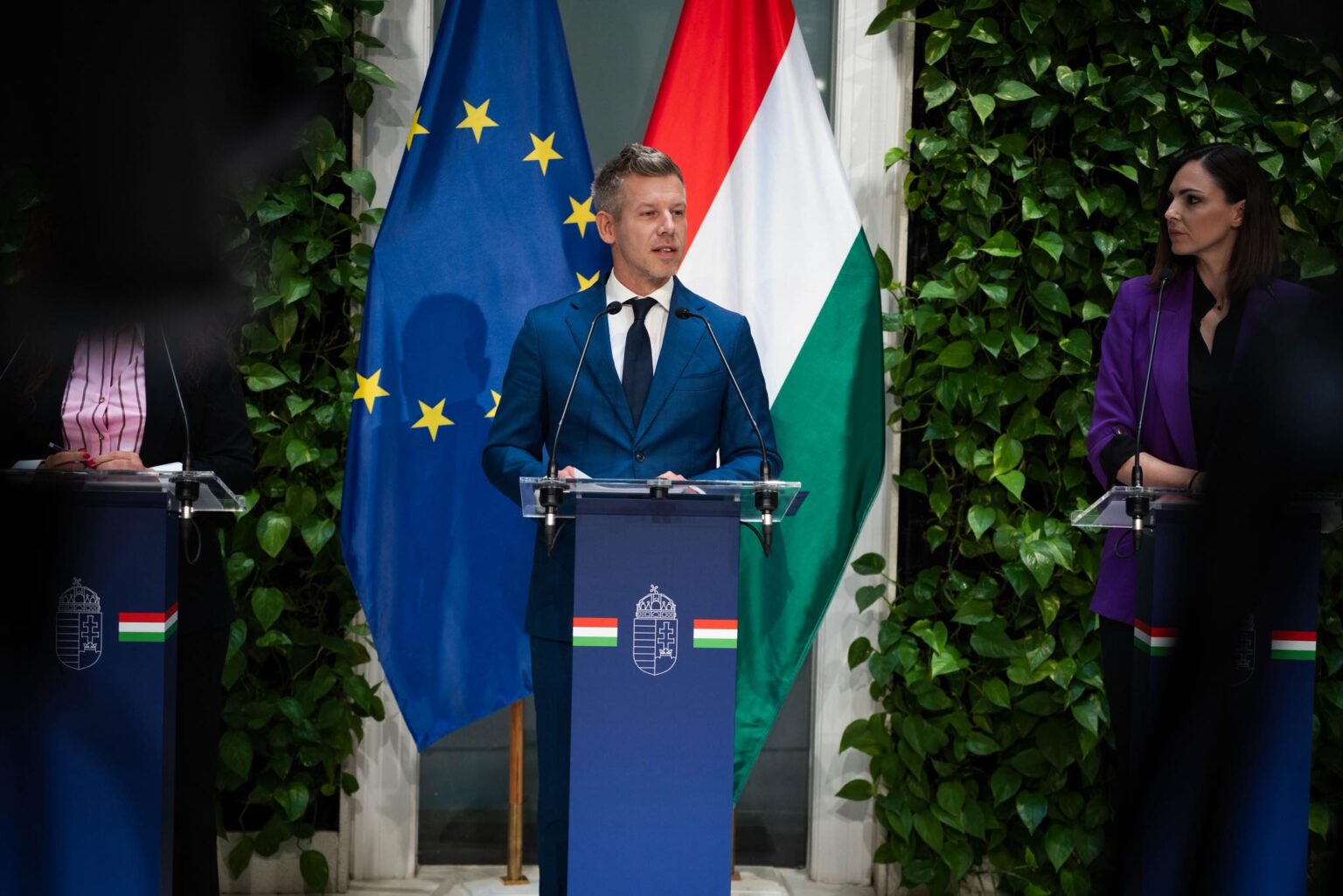
A bill on the National Asset Recovery and Protection Office could be submitted to parliament within one or two weeks, with the Tisza government aiming to grant the new institution the broadest possible powers, Prime Minister Péter Magyar said in an interview with Telex on Monday evening.
The prime minister said he would very much like the office to be operational already this summer, but believes it is more important to equip the institution with genuine powers and avoid overlaps with the Integrity Authority and the prosecution service — or, if overlaps occur, ensure they are “supportive overlaps”.
He noted that rule by decree has ended, meaning that unless parliament treats a matter as urgent, it generally takes one to one-and-a-half months to pass legislation, or even longer if proposals undergo social and professional consultation.
In the case of the National Asset Recovery and Protection Office, the government would also like to open a public consultation, even if only briefly, he said, adding that the bill establishing the office must be submitted to parliament within one or two weeks.
Asked whether business figures linked to the former National Cooperation System (NER) had attempted to reach an understanding with the government behind the scenes, Péter Magyar said he receives countless messages but never responds to them.
He said oligarchs should not “waste 30 forints on an SMS”, because “the idea of anyone striking a deal with anyone else does not even arise”.
“No matter how many messages they send or what methods they try. We know what enormous mandate we received and what responsibility this carries toward the Hungarian people,” he stressed.
Péter Magyar also highlighted the short deadline for reaching an agreement with the European Union, stressing that only changes beneficial to Hungary would be accepted.
He recalled that EU-requested measures must be implemented by 31 August after the previous government had, in his view, failed to act for three years. “For years, they did not even want to compromise with the European Commission,” he added.
“The interest of Hungarian people, companies, transport infrastructure, healthcare and housing policy is to secure financing for as many useful future projects as possible, including grants that do not need to be repaid,” he said.
He added that Hungary had been allocated EUR 10.4 billion — nearly HUF 4 trillion — through the recovery fund.
Péter Magyar warned that while projects funded through the programme have already been completed in other member states, Hungary has implemented only a few, many of them irregularly. This makes it difficult to assemble projects that can still be completed within one or two years.
Examples include the procurement of new suburban rail and train carriages, launching a comprehensive rental housing programme, financing the SME sector, supporting energy-efficiency investments and developing energy infrastructure.
He said he sees goodwill on the part of European institutions but noted there are constraints. “There are super milestones and decisions we can no longer fulfil because the previous government ran out of time. We have to find alternatives and get them accepted,” he said.
As examples, he mentioned public-interest foundations and expanding the powers of the Integrity Authority, while stressing that all changes must remain compatible with Hungary’s Fundamental Law.
“We still have a president of the republic who may raise constitutional objections, which could delay the process and make the whole thing collapse,” he said.
“The devil is in the details, and everything really has to fit together by 31 August,” he added, arguing that Hungarians had already lost substantial funding from the recovery fund because of the Orbán government.
He also referred to cohesion funds worth EUR 7 billion and a EUR 16 billion defence policy loan facility.
Péter Magyar repeated his call for President Tamás Sulyok to leave office by 31 May, partly because numerous legal amendments linked to EU funding may be required.
“It is in Hungary’s interest that these legal amendments pass,” he said regarding a future agreement with the EU.
He stressed that only changes beneficial to Hungary would be accepted, such as beginning the process of joining the European Public Prosecutor’s Office, establishing an anti-corruption authority, reforming public procurement rules and reducing invitation-only tenders.
The prime minister also pointed to ongoing domestic crises, including Monday’s railway shutdown, asbestos contamination, hospital air-conditioning problems, a recent train derailment and an accident at the MOL plant in Tiszaújváros, all of which require day-to-day management.
At the same time, he argued that Hungarians can see the government is functioning, with ministers travelling to affected sites if necessary, while noting an agreement with the Austrian chancellor to establish a bilateral working group on asbestos contamination.
Péter Magyar said parliament will meet this week, there will be a cabinet meeting, Budapest will host the Champions League final, and he himself will travel to Brussels on Thursday for talks with the president of the European Commission, the NATO secretary general and the Belgian prime minister. On Sunday, children raised in child protection care will be hosted at the Carmelite Monastery, he added.
Turning to President Tamás Sulyok, Péter Magyar said the head of state had damaged the institution of the presidency.
He stressed that one of the president’s duties, alongside safeguarding constitutionality, is fostering national unity. Since 1990, presidents had generally enjoyed the highest popularity ratings among active politicians, but “this is not the case with Tamás Sulyok — in fact, he ranks among the least popular”, he said.
According to public opinion polls, around two-thirds of Hungarians expect the president to resign, while Tisza Party surveys put the figure above 70%, he claimed.
“It becomes impossible for a president to embody national unity if 72% of people think they should leave office,” he argued.
Péter Magyar said the institution of the presidency should be separated from Tamás Sulyok’s personal performance.
“A head of state is not merely a technician who invites the leader of the strongest party to form a government, but someone who speaks out on important issues — and silence is also a message,” he said.
He argued that the institution had already weakened under previous “party soldiers” occupying the office, but that Tamás Sulyok had ultimately discredited it.
If the government seeks to significantly rewrite or amend the constitution, he said, it would not proceed in the same manner as Fidesz, but would involve social consultation and professional debate.
Péter Magyar stressed that the government’s current task is to implement the will of voters, who knowingly gave Tisza a two-thirds mandate for systemic change, including the removal of “Orbán puppets”.
If there is sufficient public demand for constitutional reform, a new Fundamental Law or stronger presidential powers, this should be decided together with citizens, he added.
He stressed that alongside uncovering the past, the government must also begin building the future, including securing EU funds, implementing school-start support, introducing pensioners’ SZÉP cards and launching economic stimulus measures.
If Tamás Sulyok resigns, parliament would elect a successor, he said, adding that no preferred candidate has yet been identified, but the country needs someone capable of restoring the prestige of the office.
Asked about direct presidential elections, the prime minister said his own opinion was secondary and that society should decide.
He suggested it may be worth strengthening checks and balances between branches of power, including potentially stronger presidential powers or direct elections.
Regarding the future of Fidesz, Péter Magyar said he does not believe the party, “in this structure and form”, can survive politically.
Speaking about the proposed eight-year limit on prime ministerial terms, he said it would apply equally to Péter Medgyessy, Gordon Bajnai, Ferenc Gyurcsány, Viktor Orbán and himself, and that the proposal would withstand constitutional scrutiny.
Péter Magyar argued that many on the political right view Fidesz’s decline sadly and accused Viktor Orbán of leading the movement into “a state resembling the final days of the Hungarian Socialist Workers’ Party”.
He said Fidesz voters have been abandoned by politicians more focused on organising “defensive lines” than taking responsibility for the country’s alleged looting.
The prime minister also said parliament would discuss reducing MPs’ salaries and ending what he called “enormous wastefulness” under the Fidesz government.
“They burned through more than HUF 200 billion for nothing,” he said, adding that cuts would affect not only his own salary and those of ministers and state secretaries, but mayors as well.
He claimed Hungary is in a poor budgetary situation, alleging that deficits had been misrepresented and major expenditures hidden.
However, he stressed that salary cuts would not affect ministry department heads or professional civil servants.
Péter Magyar said Antal Rogán “has many reasons to worry”, adding that it will be up to law enforcement authorities, including NAV, the future asset recovery office, the Integrity Authority and the courts to prosecute wrongdoing.
On the pardon scandal, he argued that former President Katalin Novák had not independently altered the justice minister’s recommendation, because political responsibility ultimately lies with the government.
He said an investigating committee would be established on the pardon case, while parliamentary rules governing such committees would also be tightened, including fines of up to HUF 1 million and compulsory attendance.
“This is a story that smells rotten in every element,” he said, claiming that officials at both the Justice Ministry and the presidential office had recommended against granting the pardon.
Péter Magyar argued that previous claims by Gergely Gulyás and Katalin Novák that the president was unaware of the severity of the crimes involved had later been contradicted.
Asked how ministers had been selected, he said the cabinet consists of professionals from diverse backgrounds chosen through broad consultation.
“There is no perfect decision, but I proudly stand by our choices,” he said, describing the government as “the most professional and patriotic since the democratic transition”.
He added that ministers and state secretaries were chosen for expertise, independence, accountability, willingness to debate and teamwork.
Regarding the withdrawal of justice minister-designate Márton Melléthei-Barna, Péter Magyar said the politician had stepped back after weighing public reactions and not wanting to harm the movement.
He said Melléthei-Barna may still take on an important role elsewhere.
Péter Magyar described campaign chief Péter Tóth, appointed as national security adviser, as “150% suitable” for the role, saying he serves in a coordinating and analytical capacity.
He also said the government will investigate possible Russian interference in the campaign and the condition of intelligence services, which he claimed had suffered under political management.
Péter Magyar criticised Index over an allegedly false report on a Tisza Party programme, arguing that a brief correction was insufficient after what he described as a taxpayer-funded smear campaign.
He also compared an alleged thwarted terrorist attack on a Serbian gas pipeline before the election to what he called a “fake terror attack”.
The prime minister announced that asset declaration rules will be extended to party leaders and made subject to verification, claiming Viktor Orbán avoided parliamentary office partly to avoid future disclosure requirements.
“There will be a time and place for Viktor Orbán to account for his wealth,” he said.
Turning to Monday’s locomotive fire at Budapest’s Kelenföld station, Péter Magyar said power has now been restored throughout the area and train services are expected to resume shortly.
He said a 27-year-old leased French locomotive caught fire around 3:30 p.m. on a siding and blamed former transport minister János Lázár for leasing trains instead of purchasing new ones with EU funds.
The incident paralysed much of western Hungary’s rail network, he said, while also criticising passenger communication and cooperation between railway operators and disaster management authorities.
Artificial intelligence was used for the translation of parts of the original Hungarian text.