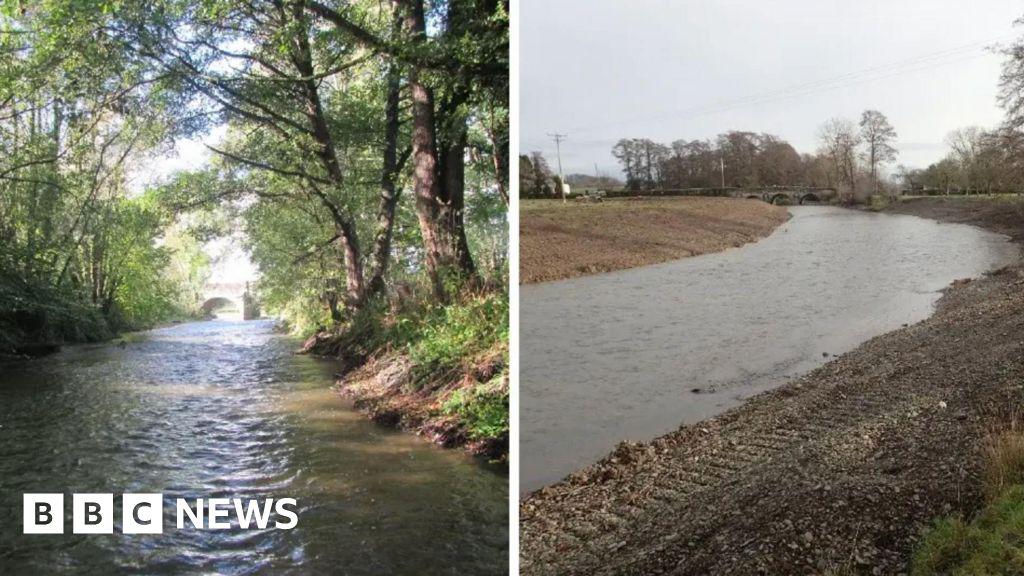
Herefordshire river will take decades to recover from ‘vandalism’
https://www.bbc.com/news/articles/c1m2xnr1pmxo
Posted by nimicdoareu

Herefordshire river will take decades to recover from ‘vandalism’
https://www.bbc.com/news/articles/c1m2xnr1pmxo
Posted by nimicdoareu
10 Comments
>It’s amazing the damage that a human being can do in a very short amount of time.
An ecologist says it will take 20 to 30 years for a stretch of River Lugg in Herefordshire to recover after being damaged by a local farmer.
John Price was jailed in 2023 for illegally removing tonnes of gravel from the riverbed to build a road and horse yard at his home and tearing out 71 trees.
He was ordered to pay £600,000 and to restore the damage he had done.
I’ve always felt that in cases like this, the government should confiscate the land. It’s the only way landowners will learn if they lose half their property after illegally tearing down a bunch of trees or removing gravel from the river.
There is zero chance he’s going to restore the damage. He’s just going to kick the can down the road and ignore it until the council forgets
He has a history off this sort of behaviour:
* In 1998 the farmer piled rubble against the riverbank claiming it was some sort of flood barrier
* In August 1999 he removed about 10 tonnes of gravel from the river without consent
* In July 2007 he was prosecuted for creating a dam across a tributary in order to irrigate his potato crop, drying up the river for 1.5km downstream
* In November 2018, Mr Price reprofiled the river at Oxpasture and created flood embankments using material he had scraped from the river
* In July 2020 Mr Price was warned about planting crops right up to the riverbank and failing to observe a buffer zone
[Here’s the other side of the story](https://www.fwi.co.uk/news/environment/farmer-hits-back-over-flood-work-on-protected-river) (make of it what you will)
[Interview with the guy](https://www.youtube.com/watch?v=85E007pByVI)
“Farmer” is such BS propaganda when you Google this guy
An ecologist says it will take 20 to 30 years for a stretch of River Lugg in Herefordshire to recover after being damaged by a local farmer.
John Price was jailed in 2023 for illegally removing tonnes of gravel from the riverbed to build a road and horse yard at his home and tearing out 71 trees.
He was ordered to pay £600,000 and to restore the damage he had done.
“It’s amazing the damage that a human being can do in a very short amount of time,” said ecologist Richard Fishbourne.
The River Lugg is home to six protected and endangered species, including common otter, Atlantic salmon, white clawed crayfish, brook lamprey, shad and bullhead.
It flows into the River Wye, and in 1995 it was made a Site of Special Scientific Interest (SSSI).
[District Judge Ian Strongman described John Price’s actions as “ecological vandalism on an industrial scale” when he sent him to prison in May 2023.](https://www.bbc.co.uk/news/uk-england-hereford-worcester-65339969)
The farmer admitted using bulldozers and diggers to remove gravel from a mile-long stretch of the river by his farm in 2020 and 2021.
At the trial, Natural England described the damage as the “worst case of riverside destruction” seen by the organisation.
As part of his sentence, Price was ordered to re-plant trees and restore the riverbed and banks, with the Environment Agency and Natural England overseeing his work.
We visited the site with Herefordshire ecologist Richard Fishbourne, to see how the restoration project was going.
Fishbourne is an environmental designer who helps communities to restore natural spaces and work with wildlife.
“There’s no sign of life, there’s nothing in the water here now,” he said.
“It takes tens of years, decades, to build up this wonderful community of species and habitat and it can all be destroyed in a moment.
“It’s going to take 20 or 30 years to come back to anywhere near the extent that it was.”
# “Impoverished landscape”
River gravel beds are where insects and fish lay their eggs and the young grow.
We spent two days at the site but we didn’t see any sign of the protected species: the Atlantic salmon, the wild brown trout, and grayling.
Fishbourne said he was worried about the lack of insects in and around the water.
“There’s nothing here, it’s an impoverished landscape really.
“I’d expect to see fish moving, fish rising, in the old days you’d see fish topping all over the place, you’d see a lot more flies as well, none of that is here anymore.”
Emma Johnson, West Midlands Deputy Director for Natural England, said the damage done by Price was a “serious environmental concern and the site and wildlife will take a long time to fully recover to a healthy state.”
The Environment Agency and Natural England said their monitoring shows the river’s condition is improving, with trout, bullhead and minnows present, alongside kingfishers and sand martins.
Price didn’t want to be interviewed about the restoration project.
The Environment Agency and Natural England have put logs in the river to help create gravel bars and banks where fish can spawn.
The agencies told us they’ve inspected this site four times in three years, they’re happy to work with citizen scientists, and they’ll continue to monitor the ecology.
“Four visits isn’t enough really,” said Fishbourne.
“If we’re going to commit to prosecuting someone who’s degraded the landscape, then we should make sure that they atone by monitoring that landscape sufficiently afterwards.”
“To make sure that things get back to a reasonable state, you need more effort in those after interventions, that monitoring is so important.”
Buffer strips planted by the river provide habitat for insects and mammals
In court in 2023, Price admitted that he’d used the gravel from the river to build a road and horse exercise yard at his home.
In defence, he said he also wanted to stop nearby homes from being flooded.
The river levels through Kingsland haven’t reached the same heights since the damage was done, so it’s not possible to prove or disprove his view.
Price has replanted some trees and installed buffer strips of grass and flowers between the ploughed farmland and the river.
The Environment Agency and Natural England said some of the trees died due to a lack of rain, so more planting will be needed.
“Some of this new growth that’s occurring is a really good sign, it means that there’s natural regeneration there,” said Fishbourne.
“It should help to bind the bank together so it’s stopping erosion from some of these excessive floods that we’re experiencing more and more.”
“It’s really important to have a mix of biodiversity in this space.”
[](https://www.bbc.co.uk/news/uk-england-hereford-worcester-65339969)
Sadly a lot of locals think he is a hero for preventing flooding.
They should keep the responsible person in prison until the river recovers. And I’m being serious.
The £600,000 penalty sounds meaningful until you realize what “restore the damage” actually means in a case like this. He can tear out the road he built, replant trees, recontour the bank but that’s infrastructure removal, not ecological restoration. The ecologist is saying 20-30 years because gravel removal destroys spawning habitat, sediment patterns, invertebrate communities. You can’t write a check or operate machinery to restore that. It regrows on geological time or it doesn’t.
The repeat pattern here matters too. 1998, 1999, 2007, 2018, then this. UK environmental agencies have been chronically underfunded for years, which means enforcement mostly happens after the damage, and follow-through on restoration orders is often weak. The comment above about him ignoring the order until the council forgets? That’s not cynicism, that’s pattern recognition. Unless someone is physically on-site watching him dismantle what he built and monitoring for a decade after, the odds he actually complies are low.
What would be useful to know: has he started any of the ordered restoration work, and is anyone actually checking?
There’s a growing opinion in the UK that all rivers need dredging. It’s going to be an ecological nightmare when the party they all support gets in.