
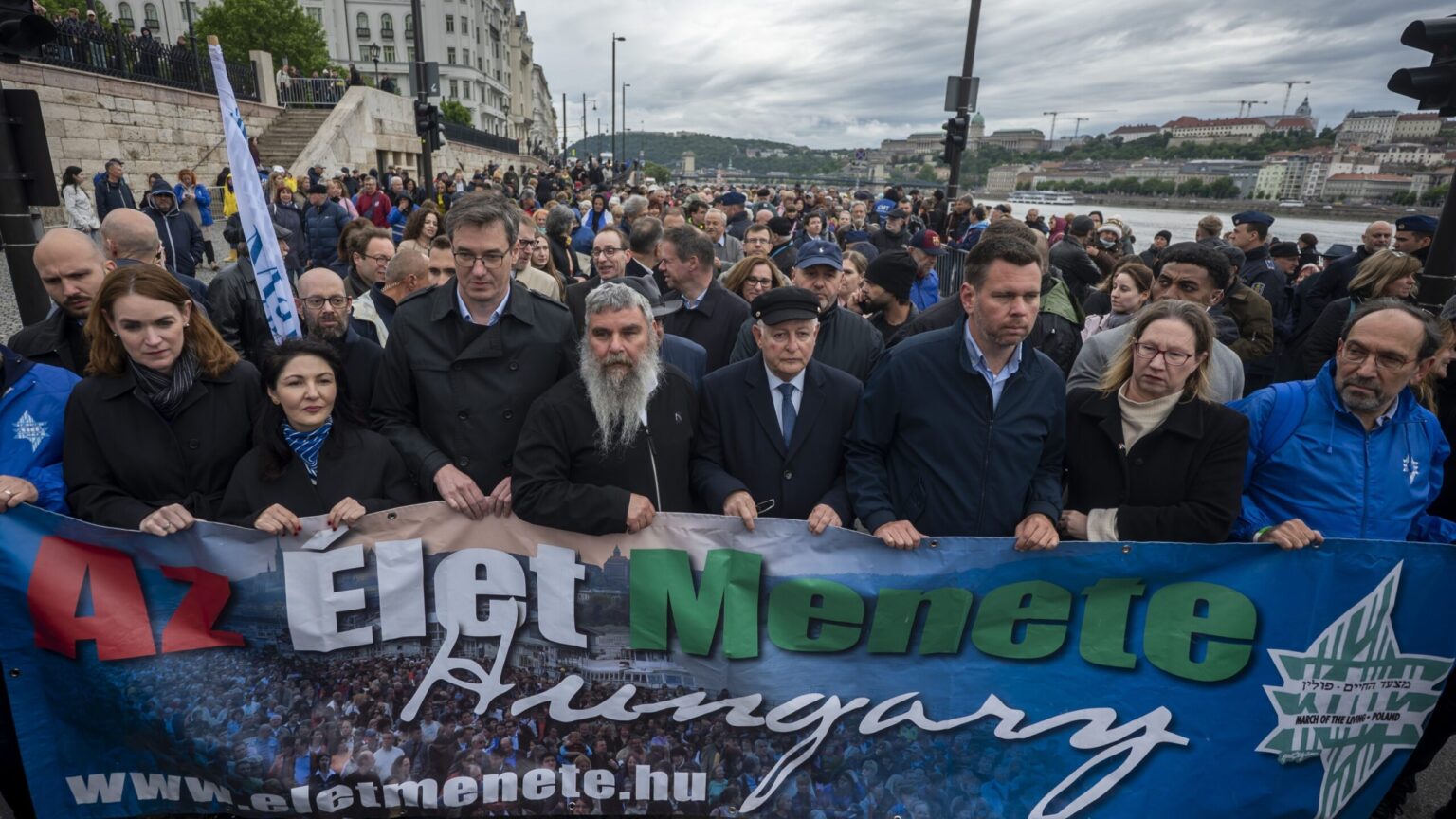
Speakers at the annual March of the Living commemoration on 17 May held in Budapest emphasized the importance of remembrance and the urgent need to resist hatred, division, and public indifference. Addressing participants at the annual event honouring the victims of the Holocaust, Budapest Mayor Gergely Karácsony and leaders of Hungary’s Jewish community warned that silence and social fragmentation continue to threaten democratic societies.
The memorial march concluded at the Carl Lutz rakpart (the Rescuers’ memorial), where speakers reflected on the lessons of the Holocaust and the responsibility of present generations to preserve historical memory.
‘The Holocaust is not merely a tragedy of the past, but an eternal warning about where hatred, inhumanity, and indifference can lead,’ organizers said during the commemoration. ‘Every generation bears the responsibility to remember and to remind others.’
Historical Relativization and Genuine Remembrance Cannot Coexist
Karácsony described Hungary as a ‘torn apart country’ that now faces a choice: either deepen social divisions or rebuild solidarity and mutual respect. According to the mayor, the strongest response to hatred in all its forms—including antisemitism—is the creation of an open and inclusive society founded on justice, human dignity, and social responsibility.
He argued that forgetting cannot be an option ‘when the normalization of inhumanity remains a constant threat.’ The mayor also warned against what he described as dangerous attempts to relativize or distort the historical reality of the Holocaust.
‘The Hungarian Holocaust was carried out by the Hungarian state against Hungarian citizens,’ Karácsony stated, insisting that historical relativization and genuine remembrance cannot coexist.
Karácsony stressed that the Holocaust ‘did not begin with gas chambers, but with words and hatred.’ What begins with contempt and exclusion, he warned, can ultimately lead to destruction. He called for a renewal of public discourse, cautioning that inflammatory and divisive rhetoric remains deeply present in political and social life.
‘The Holocaust “did not begin with gas chambers, but with words and hatred”’
In one of his most pointed remarks, the mayor criticized the continued use of the term ‘national side’ in Hungarian politics, arguing that the nation should unite citizens rather than divide them into opposing camps.
‘It is time for all of us in this homeland to find our way back to where we now have the most important task: back to one another,’ Karácsony declared.
‘Never Again’ Must Not Become an Empty Slogan
Andor Grósz, President of the Federation of Hungarian Jewish Communities (Mazsihisz) and Chairman of the Board of Trustees of the March of the Living Foundation, said the message of the event was ‘simple and crystal clear’: society must never again allow hatred to gain ground, the memory of the victims to fade, or indifference to replace moral responsibility.
Grósz emphasized that participants in the March of the Living do more than remember the dead—they also affirm that Jewish life, culture, and solidarity remain active and visible in Hungary today.
‘We will not allow the silence that was once louder than the cries to descend again upon this city and this homeland,’ he said. ‘We will not allow oblivion to prevail, hatred to take root again, or “Never Again” to become an empty slogan.’
Speaking at the Memorial to the Rescuers, Grósz highlighted the courage of Hungarians who risked their lives to save Jews during the Holocaust. Their example, he said, demonstrates the moral responsibility individuals carry even in the darkest periods of history.
Addressing younger participants directly, he warned that hatred rarely begins with dramatic violence. More often, it starts with humiliation, harassment, exclusion, and silence in the face of injustice.
‘Your courage will determine whether these acts remain without consequences,’ he told the younger generation.
Combating Antisemitism Requires Standing with Israel
Israel’s ambassador to Budapest Maya Kadosh, argued that combating modern antisemitism cannot be separated from support for the State of Israel. For centuries, she noted, Jewish communities depended on the protection and goodwill of others, while the Holocaust exposed the catastrophic consequences of Jewish powerlessness.
‘After two thousand years, the Jewish people are no longer defenceless,’ Kadosh declared. ‘Israel does not need to apologize for defending itself.’
At the same time, the ambassador distinguished between legitimate criticism of Israeli government policies and denying Israel’s right to ensure the security of its citizens. The latter, she argued, represents ‘the modern face of antisemitism.’
The march proceeded along the Id. Antall József embankment and the Carl Lutz embankment, led by 73 Holocaust survivors travelling in electric vehicles. Participants began the procession to the sound of the shofar, the traditional Jewish ceremonial horn.
Among those leading the procession were Mayor Gergely Karácsony, Andor Grósz, Ambassador Maya Kadosh, politician Dávid Vitézy, and former minister for European affairs János Bóka.
This year’s Budapest commemoration also echoed concerns raised earlier at the international March of the Living held on 14 April at Auschwitz-Birkenau, where around 7,000 participants marched between the Auschwitz and Birkenau camps on Holocaust Remembrance Day.
Survivors Warn of Antisemitism ‘on an Unprecedented Scale’ at the International March of the Living
The 38th annual march on 14 April began beneath Auschwitz’s infamous ‘Arbeit Macht Frei’ gate and concluded with a ceremony ending in the singing of Hatikvah, Israel’s national anthem.
One of the ceremony’s most emotional moments came when Agam Berger, a survivor of the Hamas terrorist attacks of 7 October 2023, performed on a violin donated to Yad Vashem by relatives of a Holocaust survivor. The performance underscored, for many attendees, the historical echoes between past and present forms of antisemitic violence—linking the suffering of Holocaust victims with the trauma of Israelis kidnapped, murdered, and brutalized during the Hamas attacks.
‘I choose a path of faith,’ Berger told the audience after her performance. ‘The everlasting God of Israel will not be false, Am Yisrael Hai!’
Revital Yakhin Krakowski warned that antisemitism has spread globally ‘on a scale we have never known’ since October 2023. March President Phyllis Heideman similarly argued that ‘history is warning us’, while stressing the importance of hope and international cooperation.
A recurring theme throughout the Auschwitz commemoration was the warning that the Holocaust began not with extermination camps but with dehumanization, public indifference, and the erosion of democratic norms.
‘The form of antisemitism may change, its language may evolve, but the consequences are always the same—tragic’
Paul Goldenberg, who led a delegation of international police officers attending the march, stated that ‘when democracy is shaken, and minorities begin to feel unsafe, that is a clear warning sign.’
Holocaust survivor Nate Leipciger, 98, warned that antisemitism has merely ‘changed its language’ rather than disappeared. ‘The form of antisemitism may change, its language may evolve, but the consequences are always the same—tragic,’ he said.
Participants also included survivors of recent antisemitic attacks in Manchester, Sydney, Washington, and Israel. Many spoke openly about living with a growing sense of insecurity. Yoni Finlay remarked that antisemitism ‘has become a way of life’, adding: ‘We are just waiting for the next attack.’
Israeli Soldiers Saluted Holocaust Survivors Participating in the March
The event also highlighted growing international cooperation in combating antisemitism. Law enforcement delegations from around the world joined the march to strengthen collaboration in protecting Jewish communities, while Muslim supporters of the Abraham Accords participated alongside Jewish organizations and Holocaust survivors.
One of the most symbolic moments came when a delegation of Israeli soldiers stopped to salute Holocaust survivors participating in the march. Irene Shashar, an 88-year-old survivor of the Warsaw Ghetto, told the soldiers: ‘We have to be united and not divided. We have to remember not just to cry over the dead but to yearn for a better life and future.’
The message emerging from both commemorations—in Auschwitz and in Budapest—was unmistakable: remembrance alone is not enough without moral vigilance and political responsibility. Speakers repeatedly stressed that ‘Never Again’ must remain more than a historical slogan; it must serve as an active commitment to defending democratic values, resisting hatred, and protecting vulnerable communities.
The March of the Living has become one of Hungary’s most significant annual Holocaust remembrance events, bringing together survivors, religious leaders, public officials, and ordinary citizens to honour the memory of the hundreds of thousands of Hungarian Jews murdered during the Second World War.
Related articles: