
 3 min read
Here’s what you’ll learn when you read this story:
- Fog is dirtier than you may have realized: it’s filled with various microbial life.
- One percent of droplets from fog banks tested in central Pennsylvania contained microbes, roughly the same concentration as found in the ocean.
- Methylobacteria—known to break down pollutants like formaldehyde—proliferate after a fog event and help to clean up the atmosphere.
In Stephen King’s The Mist (1976), an ominous fog descends on the small town of Bridgeton, Maine. In the area where the story’s set, something called advection fog is a familiar sight. It generally forms when warm air from the south comes into contact with cooler ground. But in King’s nightmarish world, the mist rising from the ground isn’t any ordinary Maine fog—it’s alive with something.
As it turns out, King’s vision is a lot less sci-fi than you might imagine. In a new study published in the journal Environmental Microbiology, a team of researchers from Arizona State University (ASU) and Susquehanna University in Pennsylvania analyzed fog droplets sampled from 32 weather events across central Pennsylvania over the course of two years.
Related Story
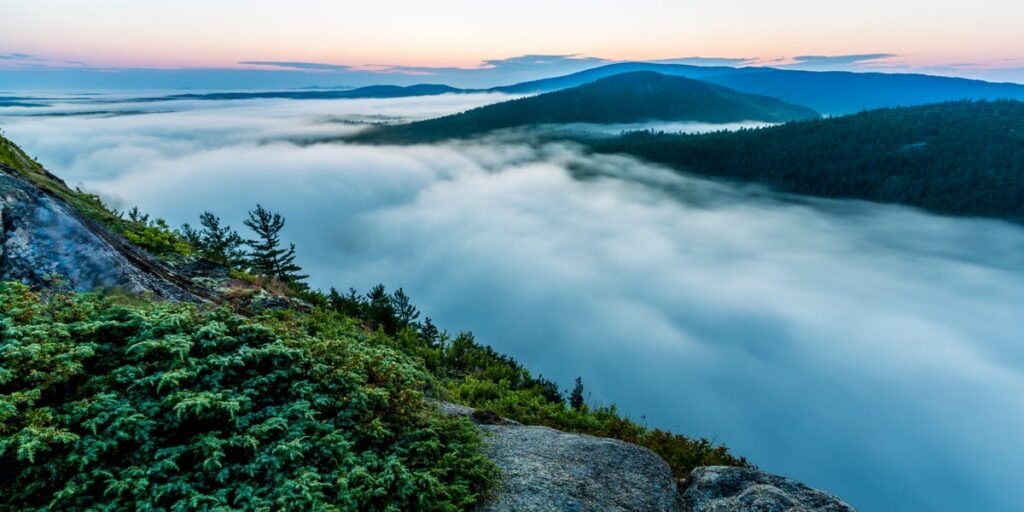
The study focused on radiation fog, which forms overnight as heat radiating from the ground rapidly cools. Since the time of Louis Pasteur, scientists have understood that there are bacteria in the air, but it was only in 1970 that they realized clouds are extremely good ecosystems for bacterial life. And it took until 2019 for researchers to examine the bacteria in ground-level fog. The study, which was conducted in coastal Maine and Namibia, showed that it’s full of microbes, and in coastal areas, it even contains ocean microbes. These bacteria live short but productive lives by taking advantage of the fog in some way. The research suggested that fog might provide bacteria a safer means of travel than dust, or maybe some form of protection from UV rays.
Now, in a new study, researchers dug a bit deeper into what exactly is going on in those fog banks as a whole. First, they took samples of fog droplets and found that about 1 percent of them contained bacteria. While that’s a small figure on paper, it collectively amounts to massive numbers of bacteria floating in those sprawling fog banks.
“When you take all of the droplets together, the concentration of bacteria is the same as in the ocean.” ASU’s Ferran Garcia-Pichel, a co-author of the study, said in a press statement. “If they are growing, then the droplets are a habitat. That’s a mindset change.”
One of the more interesting specimens captured from the fog was methylobacteria, which eat simple carbon compounds such as the pollutant formaldehyde. Typically formed when methane undergoes a photochemical reaction with sunlight, this pollutant can damage the ozone and harm human health, causing respiratory irritation and even cancer. By sampling air before and after a fog event, the researchers found an increase in methylobacteria, suggesting they’re not only thriving, but also feeding on harmful pollution.
Related Story
“We observed them under the microscope to see that, yes, the bacteria are getting bigger and they’re dividing, so there is growth,” Former ASU Ph.D. student and current postdoctoral researcher at Virginia Tech Thi Thuong Thuong Cao, the lead author of the study, said in a press statement. “We also found that they’re using the formaldehyde as food to support their growth.”
There’s still a lot we don’t know about these low-lying, soggy microbial communities. For example, different concentrations of microbes, such as those along the coast, might behave differently, and scientists aren’t sure how active these microbes act at night, since most atmospheric chemistry uses sunlight for power.
But one thing is for certain, the fog really is alive—just not like in a horror movie.







Darren lives in Portland, has a cat, and writes/edits about sci-fi and how our world works. You can find his previous stuff at Gizmodo and Paste if you look hard enough.