
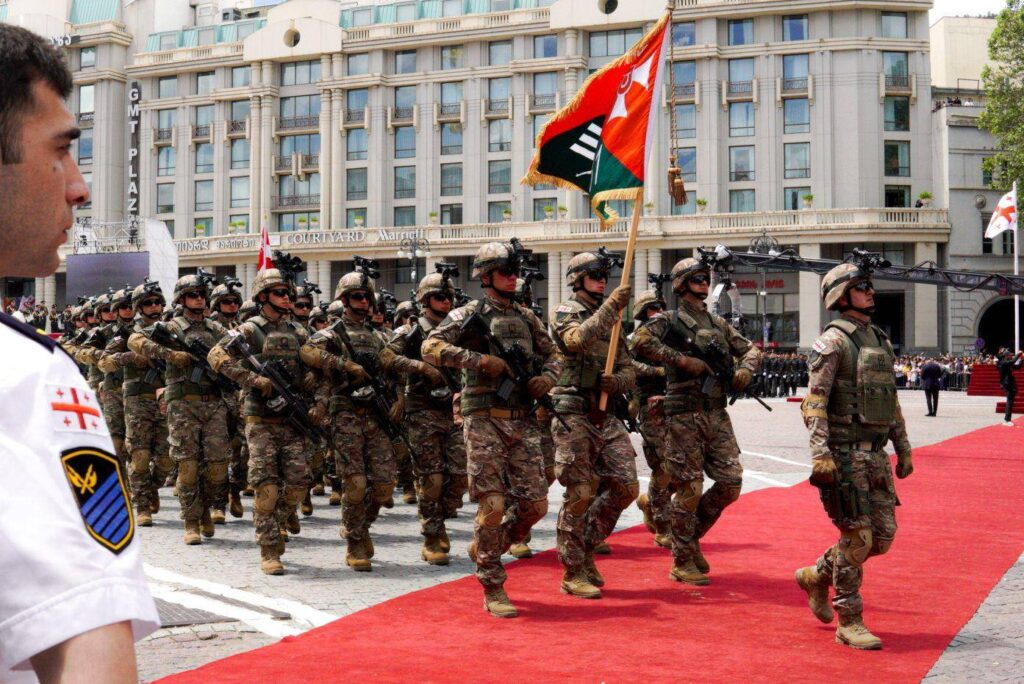
Georgia marks Independence Day on May 26, with planned events ranging from official ceremonies in Tbilisi and across the country to an opposition-led protest march later in the capital.
On May 26, 1918, Georgia’s National Council adopted the Act of Independence in Tbilisi, establishing the Georgian Democratic Republic (First Republic), widely regarded as Europe’s first Social Democratic rule. Emerging on the ashes of the Tsarist Empire, which had annexed Georgian kingdoms in the 19th century, the republic was also the product of decades of debate, political activism, and intellectual work, reflecting compromises forged among Georgia’s political and intellectual circles. The short-lived, but vibrant democratic experiment collapsed in the wake of the Red Army’s invasion of 1921, but left a lasting legacy. 70 years later, on April 9, 1991, Georgia declared the restoration of its independence based on the May 26, 1918, act.
The day finds the country amid a prolonged political crisis, divisions, and widespread international isolation, as the Georgian Dream government continues to struggle to secure full domestic and international legitimacy following a democratic crackdown and a series of anti-Western moves.
The date was marked by traditional public events. Georgian Dream government officials addressed the public, while military service recruits took the traditional oath in Tbilisi and twelve “historic locations” across Georgia, followed by a ceremonial flyover by military aircraft.
Public celebrations, which began around 11 am, are expected to remain largely confined to the Liberty Square and Orbeliani Street surrounding the presidential palace, as Rustaveli Avenue, the former main venue for the festivities, has hosted continuous protests since late 2024.
This year’s public celebrations are also tied to the theme of the 1,700th anniversary of Georgia’s adoption of Christianity as the “state religion.” Government buildings have been decorated with respective “1,700” banners and portraits of late Patriarch Ilia II alongside the national flags.
Opposition Alliance, uniting nine political parties, announced a large Independence Day march in Tbilisi on March 31 to culminate their “national mobilization” campaign. The march will start after 7 pm at Tbilisi State University and end at the parliament. Various civic and activist groups announced joining the march, but the Alliance representatives said that they received rejections both from Tbilisi City Hall and the Interior Ministry over planned events, including setting up the stage or other constructions near the parliament.
Mikheil Kavelashvili’s Address
Georgian Dream-elected President Mikheil Kavelashvili, who also serves as Commander-in-Chief of Georgian Defense Forces, said in his address that “in the history of every nation, there are dates that define its identity and future. For the Georgian people, such a day is May 26th. 108 years ago, following centuries of annexation, the country restored its statehood, and the world saw independent, free Georgia.”
According to Kavelashvili, “our ancestors carried the sacred idea of Georgian statehood to this day through the sword, the pen, prayer, and devoted deeds, and despite the many trials endured over the centuries, we survived! We survived because we prevailed in the most important war: we defended the highest values: faith, identity, traditions, and we did not surrender our native language.”
He said Georgian statehood had survived through “faith, identity, traditions” and the preservation of the Georgian language despite centuries of hardship. Kavelashvili also stressed the role of the Georgian Orthodox Church in preserving “national identity, historical memory, and spirituality.” Referring to the 1,700th anniversary of Christianity becoming the state religion, Kavelashvili said the date demonstrated how “inseparable our history and faith are from one another.”
“We must always remember every hero who fought for independence, honor, and preserve their legacy, protect and strengthen it; do everything in our power so that, together with our Abkhazian and Ossetian sisters and brothers, we may build a united, prosperous Georgia and leave our children a far stronger, resilient, and free country!” he concluded.
Patriarch Shio III’s Address
Newly enthroned Patriarch Shio III addressed the ceremony after Kavelashvili, saying, the Georgian Orthodox Church “has always been the spiritual pillar of the Georgian people and the foundation of national unity.”
He paid tribute to those who fought for Georgia’s freedom and highlighted the legacy of late Catholicos-Patriarch Ilia II, saying his “half-century of work became a vital cornerstone in strengthening the spiritual and civic unity of the nation, national consciousness, and the international authority of both the Church and the country.”
He addressed the Georgian defense forces and soldiers, saying, “Remember, each one of you must be not only a guarantor of state security, but also an example of peace, responsibility, and love for the homeland to your fellow citizens. The strength of an army should be expressed not in the desire for war, but in the preservation of peace. Peace is the highest goal one that establishes eternal values and true freedom among people.”
Shio III also addressed the younger generations, saying they must “properly understand the essence of freedom. In the modern world, we often encounter mistaken notions of freedom. People are inspired to believe that freedom is merely the rejection of all restraint, but in reality, genuine freedom is, first and foremost, responsibility, faith in God, inner strength, and an honest and moral life. It is the overcoming of vices and passions, and an obligation to do what is right and pleasing to God. Only a generation raised with a true understanding of these values will be able to preserve the unity of the country and its national independence.”
Irakli Kobakhidze’s Speech
Georgian Dream Prime Minister Irakli Kobakhidze said Independence Day is an occasion to reflect on Georgia’s “centuries-long struggle for statehood and independence, the courage and wisdom of our freedom-loving people and great figures of history, and the eternal values that have preserved our national dignity and identity through the ages.”
“Over these seventeen centuries, empires around us rose and fell, yet Georgia has preserved its national identity and independence to this day. Were it not for God’s protection and the Georgian people’s faith that we are children of the land chosen by the Mother of God, this miracle of history could never have come to pass,” he said.
Kobakhidze noted that “as we speak with pride of our country’s Christian traditions, we must express our deepest gratitude to our spiritual father, His Holiness and Beatitude Catholicos-Patriarch Ilia II, who revived the Georgian Orthodox Church and restored autocephaly to our Mother Church.” He then welcomed the new Patriarch Shio III wishing “his work may lay the foundation for yet another remarkable era in the history of our Mother Church.”
Noting that 35 years have passed since Georgia restored independence, Kobakhidze said, since then, “we have continued to walk Moses’s forty-year path.” He said that “Every patriotic Georgian can be proud of the fact that Georgia is independent and sovereign as never before. It is precisely this growth in independence and sovereignty that has given our country the ability, despite the most difficult challenges, to firmly defend its faith, preserve peace, and remain steadily on the path of progress and development, which will inevitably lead us to the Promised Land: the achievement of all our national goals, and a united, resplendent Georgia.”
Shalva Papuashvili’s Remarks
Disputed Parliament Speaker Shalva Papuashvili then took the floor, saying the struggle for Georgian independence had continued throughout the country’s history. “This tireless drive passed from generation to generation, always awaiting history’s next window of opportunity. Today’s celebration carries special significance because this year we mark the 1,700th anniversary of the declaration of Christianity as the state religion in Georgia. This date reminds us that the Georgian state and the Georgian Church together, over seventeen centuries, built the spiritual and national foundation that saved us in the most difficult of eras.”
He described “love of country, fidelity to traditions, and steadfastness of faith” as Georgia’s “three supreme treasures,” adding that the Georgian state and the Georgian Church were “the two pillars of the one body called Georgia.” He continued, “Two centuries ago, both of these pillars were taken from us, a golden chain was placed around us, and it was intended to strip us of our faith. Since then, we have been fighting for our independence, and that fight has yet to be won.”
Papuashvili further claimed that “some still wish today to bring down our two pillars, that we not stand on our own feet, that we follow their rules and renounce what is ours. Bound by a new golden chain to do everything except for being an independent state; lean on others rather than on ourselves. This will not work. The will of the Georgian people is firm. Our centuries-long struggle belongs to the autocephalous Church and the independent state. That is the formula of Georgia’s freedom.”
More to follow…
Also Read:
Copy URL
URL Copied