
Rebuilding democratic institutions and norms after illiberal rule is difficult, as Poles have learned throughout their post-communist transition to democracy after 1989. In 2023, Polish voters successfully voted out the right-wing Law and Justice (PiS) party after eight years of illiberal rule and democratic backsliding. The advice from Poles — government officials, civil society activists, and analysts — to American democrats (with a lower case “d”) is to start planning now for how to build a framework for democratic renewal.
As participants in a recent bipartisan delegation of American political and civic leaders to Poland sponsored by The States Forum (and co-organized by one of us, Mieczysław), we heard how liberal democratic forces managed to prevail in the 2023 parliamentary elections. They successfully challenged a regime that had replaced independent public media with nonstop propaganda, subjugated the judiciary, and regularly attacked civil society and other watchdogs with SLAP lawsuits and other measures.
After all, authoritarian governments are adept at creating systems and institutions that are structured so they are hard to change, creating obstacles for reform by subsequent rulers without resorting to arguably undemocratic tactics themselves. Hungary is facing this challenge now after the defeat of Viktor Orban’s Fidesz party in recent elections, but Poles have grappled with dilemmas related to reversing democratic backsliding for more than two years. As one Polish rule of law expert told us, “What if the rule-of-law repair requires bending the rule of law?”
Our Polish interlocutors said they realized that conversations about how to approach a return to full, sustainable democratic institutions did not happen early enough, and thus the new government of Prime Minister Donald Tusk struggled to deliver reforms or resorted to legally questionable measures, such as its takeover of public TV. Tusk and his advisers knew they must radically reorganize and restaff the public broadcaster, which had become infamous for hate speech and disinformation, but they faced a formidable legal challenge: the governing body had been appointed strategically by PiS for a term that exceeded that of parliament. As such, according to one journalist we met, the new government had to use “inelegant legal tricks” to change its leadership, which involved liquidating the broadcaster using mechanisms of financial law. Many opponents of PiS were naturally happy with Tusk’s move, but it also garnered widespread criticism not only from PiS supporters but also from independent civil society organizations. As one watchdog leader told our delegation, “You can’t use shortcuts: otherwise, you just lower the bar, violate standards, which will only make things worse in the future.”
Balancing Speed of Delivery With Effectiveness
Yet, the Polish case shows that moving slowly on reform can be just as problematic as acting too swiftly. Tusk’s reformist government did not act quickly or “creatively” when it came to judicial reform, thereby disappointing many of its core supporters. The judiciary remains problematic and rule-of-law reform still not delivered. This, according to several public opinion specialists, contributed to the government’s loss in the presidential elections in 2025, and the president has significant veto powers.
Polling at the start of 2025 suggested that more Poles thought the rule of law had worsened under Tusk than improved: 34.8 percent said the situation was worse, compared with 24.4 percent who said it had improved. An election observation report from the intergovernmental human rights and rule of law body, the Council of Europe, later noted that the unresolved rule-of-law crisis sustained mistrust in institutions, weakened support for the governing coalition, and contributed to perceptions of broken promises.
Americans looking to a transition in 2028 should be mindful of the Polish experience when considering how to unravel the Trump administration’s harm to U.S. democracy. It has turned the Justice Department into a wing of the president’s retribution machine; created a Department of Government Efficiency (DOGE) that stripped government institutions and the American public of tens of thousands of world-class experts who’ve been fired; eliminated entire institutions such as the U.S. Agency for International Development; issued executive orders to undermine elections; and threatened media companies, universities, and law firms that refused to bend their knees to (or pay) the president; weaponized federal law enforcement agencies to terrorize citizens and non-citizens alike. The list goes on.
A new administration could come in, for example, and create its own DOGE to counter Trump’s by firing personnel hired under the current administration. But is that the most sustainable way forward? As our Polish friends warned, that would risk creating a vicious cycle in which chaos ensues every four years, fostering further popular distrust in institutions. Institutional repair need not become a partisan purge.
Repairing the Democratic Architecture
An electoral transition in January 2029 should be treated not merely as an opportunity to reverse Trump-era abuses, but as a rare chance to repair the democratic architecture that made those abuses possible. Long before Trump, U.S. institutions suffered from structural problems that left millions underrepresented, made government feel unresponsive, and helped fuel distrust in democracy itself: winner-take-all elections, partisan gerrymandering, money-dominated campaigns, weak ethics rules, and democratic norms that were never converted into enforceable law.
There is no shortage of serious reform ideas. Organizations such as FairVote and Protect Democracy have developed proposals on ranked-choice voting, proportional representation, and fusion voting; the Brennan Center for Justice, the Campaign Legal Center, and RepresentUs have advanced reforms on voting rights, redistricting, campaign finance, anti-corruption, and election protection while institutions such as the American Academy of Arts and Sciences, New America, and Stanford’s Deliberative Democracy Lab have explored citizens’ assemblies and other forms of civic participation.
In the shorter term, Americans from both sides of the aisle concerned about the direction of the country’s democracy need to consider how to pursue reform that is at once meaningful and reasonably swift but also does not further undermine the very rule of law they are trying to restore. Poland’s post-2023 experience suggests that the hard part is not only about crafting reforms, but making them lawful, legitimate, durable, and fast enough to matter.
Key Lessons for Restoration
Our Polish interlocutors offered several important lessons:
First, the reform coalition needs to be constructed long before an election, and not after. One Polish journalist cautioned the delegation that American commitment to liberal democracy cannot be coming from one party alone. Without bipartisan alignment, reform will ebb and flow after each partisan transition. A broad, bipartisan pro-democracy coalition can help bring legitimacy to reconstruction at home and also restore trust in the transatlantic relationship. But this coalition also cannot be left to just political parties. It should involve civil society, state and local officials, lawyers, judges, unions, faith communities, youth organizations, racial justice groups, business leaders, and ordinary citizens. In Poland, civil society helped define reform priorities and make clear that institutional repair is not partisan revenge but democratic renewal.
Second, reform leaders need to map the legal pathways now. As one Polish rule-of-law expert put it, reformers need to ask: What will the public accept? Where are the legal boundaries? What methods are available? In the U.S. context, that means identifying which reforms require congressional action, which can be done through executive actions, or which require state laws.
Third, go local. As Polish local government leaders emphasized, building public trust in democracy must take place from the ground up. Mayors’ offices and city councils are usually the first point of contact between citizens and government, as people seek local solutions
to important concerns such as fixing street lights, improving schools, and fighting crime. Civic activism, public participation, and community-building in Poland’s peripheral and rural areas have been key to building citizens’ trust in government and proving democracy delivers. Poland’s experience demonstrates that it is also at the local level where true democratic innovations are taking place, whether engaging in participatory budget processes or experimenting with citizens assemblies.
Fourth, turn vulnerable norms exploited by Trump into law. The Trump administration’s practices have exposed how much American democracy depends on voluntary adherence to norms such as noninterference with prosecutions (e.g. guardrails separating the White House from the Justice Department), respect for election results, and ethics compliance. A serious reform agenda should ask, norm by norm, which of these practices need statutory protection, independent enforcement, or even constitutional amendments.
One way to make pro-democracy messaging relevant to ordinary voters is by reminding them of the corruption often inherent in illiberal rule and translating how corruption adversely affects the average citizen. Speaking about the “rule of law” in the abstract is not enough. During the 2023 election, the Polish opposition successfully highlighted several controversies involving PiS: a cash-for-visas scandal (a particularly poignant instance of that government’s hypocrisy, given that it was blatantly anti-immigrant and often xenophobic), campaign use of public resources, and alleged surveillance abuses, all of which illustrated clearly the corruption of the sitting government in ways that would resonate with the general public. In the aftermath, combating corruption became central to the coalition’s accountability agenda.
Fifth, act early — but not recklessly. The Polish warning cuts both ways. Moving too aggressively can undermine legitimacy and make reform look like retribution. But moving too slowly can frustrate supporters, allow captured institutions to obstruct change, and undermine the liberal coalition. The goal should be lawful speed: immediate action where authority is clear, transparent processes, and visible benchmarks so the public can see progress.
Sixth, Americans must become better students of democracy. The United States has long been comfortable teaching democratic lessons abroad and far less comfortable learning them. But reform experiments are taking place across the world — in Poland, Brazil, and now Hungary — and the United States can benefit from a broader global community of best practice. As autocrats share tactics and lessons learned, support one another, and build networks, the liberal democratic community must do the same: a kind of “Democracy, Inc.”
Finally, lasting democratic reform cannot be limited to supply side interventions. Fixing institutions and building new laws and practices is vital, but lasting reform must address the demand side of authoritarianism – in other words, understanding what drives citizens to seek illiberal strongmen. In Poland, as in the United States, societal divisions have been growing between urban and rural areas, religious and secular communities, and younger and older generations against a backdrop of rapidly changing perceptions of culture. So even as inclusion has increased for marginalized populations, others have felt excluded and, as a result, instilling fear of potential economic or cultural consequences. Citizens who feel alienated and angry need new partnerships and new approaches. It is essential to repair and build trust between groups, preempt myths and fears about “the other,” forge common projects that cross dividing lines to rejuvenate the idea that individuals can have great agency because of democracy.
Among the numerous Poles our group was privileged to meet in Poland, young leaders were perhaps the most compelling. We heard repeatedly that the mobilization of young voters — who turned out in overwhelming numbers of more than 70 percent in the 2023 elections — was critical to the Civic Coalition’s success that year. Correspondingly, their subsequent disillusionment was a key contributor to populist President Karol Nawrocki’s 2025 victory.
Poland’s experience offers a sobering reminder: defeating authoritarian politics at the ballot box is only the beginning. The United States can learn from Poland’s electoral success as well as its formidable challenges in democratic reconstruction, and should heed the overarching words of advice from its Polish friends: start planning now.
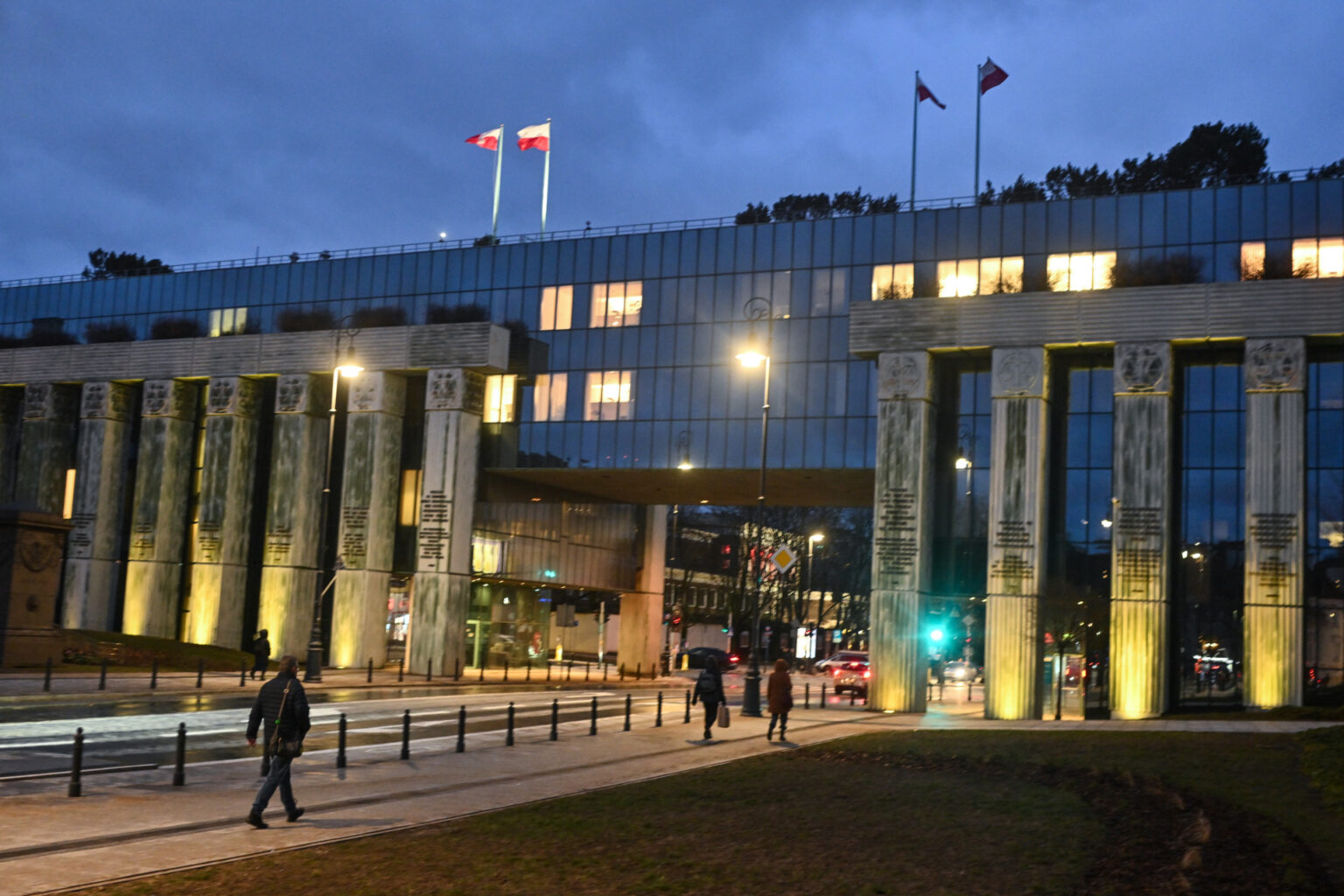
FEATURED IMAGE: People walk past the building of Poland’s Supreme Court, the country’s highest judicial body, on January 25, 2024, in Warsaw. (Photo by Omar Marques/Getty Images)