
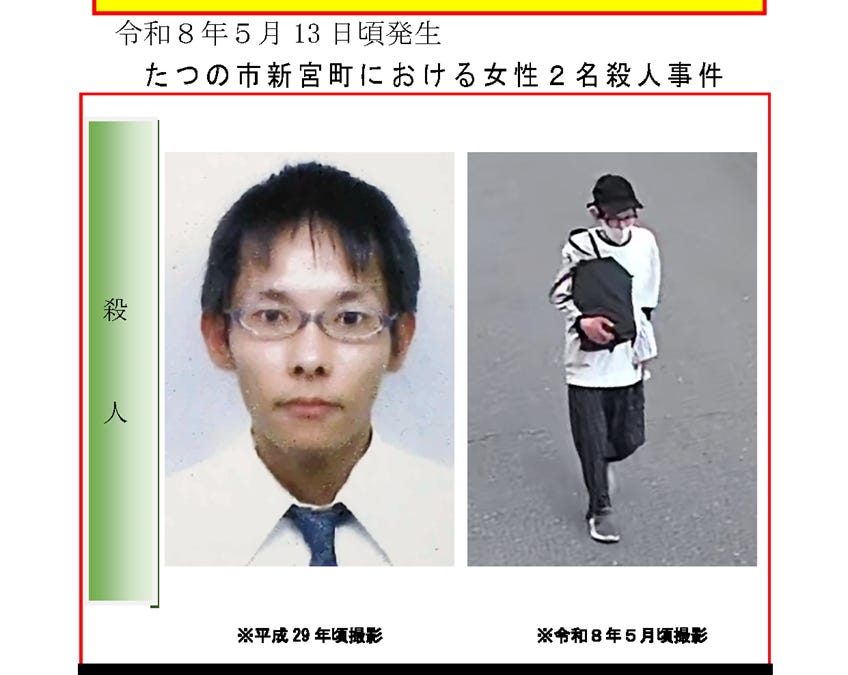
42-year-old Oyama Kenji (大山賢二) was sleeping on the sidewalk when the Hyogo Prefectural police woke him up.
It was around 10:20 P.M. on a Saturday night, May 16. Officers asked him what he was doing and he answered frankly. He had just committed a murder in Tatsuno City, which was 30 kilometers away from where he was sleeping. The police brought him to the station for questioning, but Oyama allegedly did not say anything specific or substantial enough to support his bizarre claim. So the police just let him go. They gave him a ride back to Tatsuno City, his last known listed address, and dropped him off.
It was three days after that confession that the bodies were found. 74-year-old Tanaka Sumie and her daughter Chihiro, age 52, were discovered in Sumie’s home in Tatsuno City on the 19th of May around 10:30 in the morning. There had been no vandalism. The only thing out of place was the grisly scene itself: Sumie and Chihiro had both been stabbed multiple times with a knife and bled to death in the hall and near the front door.
It was estimated that the two were killed on May 13th. Oyama confessed and was released on the 16th. And on the 17th, he was caught on security cameras near the site of the murder, wearing a mask, baseball cap, and clutching a large black backpack. That footage is the last known sighting of Oyama, who, as it turns out, used to live not just in that same neighborhood ten years ago, but also just to the south of the deceased as well. His current address is unknown.

On the 24th, police added him to the most wanted list. They put up posters looking for the man who had all but walked into the police station to confess his crime and had been escorted back to the crime scene vicinity. Typically that might be considered quick detective work, but in this case, it’s a wonder it took them this long to connect the dots.
When the police refuse to police
In Japan, not only do the police sometimes let a murderer walk away — sometimes they let him kill, even after he has made it perfectly clear that is exactly what he intends to do.
Famously, in stalking cases (such as the one that led to the fatal stabbing of a 23-year-old Pokemon Center employee in Ikebukuro) the police seem to do more to avoid legwork than they do to proactively protect victims. The law enables their inaction, allowing the police ample lines to draw in their investigative abilities with subtle technicalities in the stalking code. In the Ikebukuro murder-suicide, and countless other cases like it, the stalker-killer often makes explicit threats of violence against their victims, which the victims report to the police in hopes of getting help.
Instead, the police drag their feet to issue even the bare minimum of guardrails like restraining orders or warnings, much less surveillance and protection.
To be clear, the double murder in Hyogo Prefecture is not considered a stalking case as far as anyone knows. But it’s rooted in the same avoidance and misplaced scrutiny that leads to police giving a comfortable ride home to the men who kill and victim-blaming the women fearing for their own lives.
There is no better, or more damning, example of that than the Okegawa stalker murder case of 1999. It was the case that resulted in Japan’s ineffectual stalking laws, but at least a step forward in protecting women from femicide before it happens.
The Okegawa-Case: Betrayal At Every Turn
On October 26, 1999, a 21-year-old university student named Ino Shiori was stabbed to death in broad daylight outside JR Okegawa Station in Saitama Prefecture. She was killed by a hired hitman — a man paid to murder her by the brother of her ex-boyfriend, Komatsu Kazuhito. Komatsu, the ex-boyfriend, had ordered the murder. His brother was the middleman.
Komatsu had spent months making Ino’s life a waking nightmare after she ended their relationship. The murder itself was horrific. What came before it was worse. And what came after — the lies, the smear campaign, the cover-up — was, in some ways, the most revealing part of all. The stalking had begun months earlier. Komatsu considered her leaving him to be an unforgivable act and wanted to make suffer for it.
He and his associates launched a campaign of harassment so systematic and so brazen that it is almost incomprehensible that it was allowed to continue. They made threatening phone calls. They sent menacing letters. They printed and distributed flyers around Shiori’s neighborhood, plastering her photograph alongside fabricated, defamatory claims about her character. Slut-shaming. Character assassination. All of it designed in a deliberate attempt to humiliate her publicly and make her feel like there was no safe ground anywhere.
Shiori and her family went to the police. They went many times. No one knows how many times because some of the records were destroyed later. They brought evidence. They explained the escalating threats. They asked for help. The police told them it was essentially a private matter: a relationship dispute. Not something they could do much about.
It was the standard line, but not the whole truth. Under laws that existed at the time, the harassment — particularly the distribution of defamatory flyers — was potentially already criminal. Officers had tools available to them, but they just chose not to use them.
And then the situation escalated further: one of the perpetrators actually approached police before the murder and indicated his involvement in a plot against Shiori. The police did not act on this either.
On October 26th, Shiori was killed on her way home.
When police and press join the abusers
In the immediate aftermath of the murder, the Saitama Prefectural Police did something that would later become the most damning evidence against them. They could have acknowledged their inaction, that they had been warned, had done nothing, and that a young woman had paid for that failure with her life. Nope.
Instead, they went on offense.
They launched a victim-blaming campaign in shades of blue. Police sources began feeding stories to the press portraying Shiori not as a victim, but as a problematic young woman who had brought trouble upon herself. She was characterized as a promiscuous flirt, a girl who chased Louis Vuitton bags and other luxury goods, someone who had been working as an escort. The tabloids, hungry for a sensational angle, ran with it. The mainstream press followed.
Within days of her murder, the public narrative in Japan had been twisted: this wasn’t a story about police failure, but a story about a complicated dead girl who had lived a complicated life and probably got the complicated ending she deserved.
The whole story was, from start to finish, a fabrication. And it worked — for a while.
If it wasn’t for one nosy journalist, a weekly tabloid writer named, Shimizu Kiyoshi, the whole thing would have swept under the rug. But Mr. Shimizu, an investigative journalist who took nothing for granted, didn’t just talk to the the police; he talked to the family. And that’s where the whole scenario spun by the cops and the hacks began to unravel…..
We’ll pick this back up on Friday. Stay tuned.