
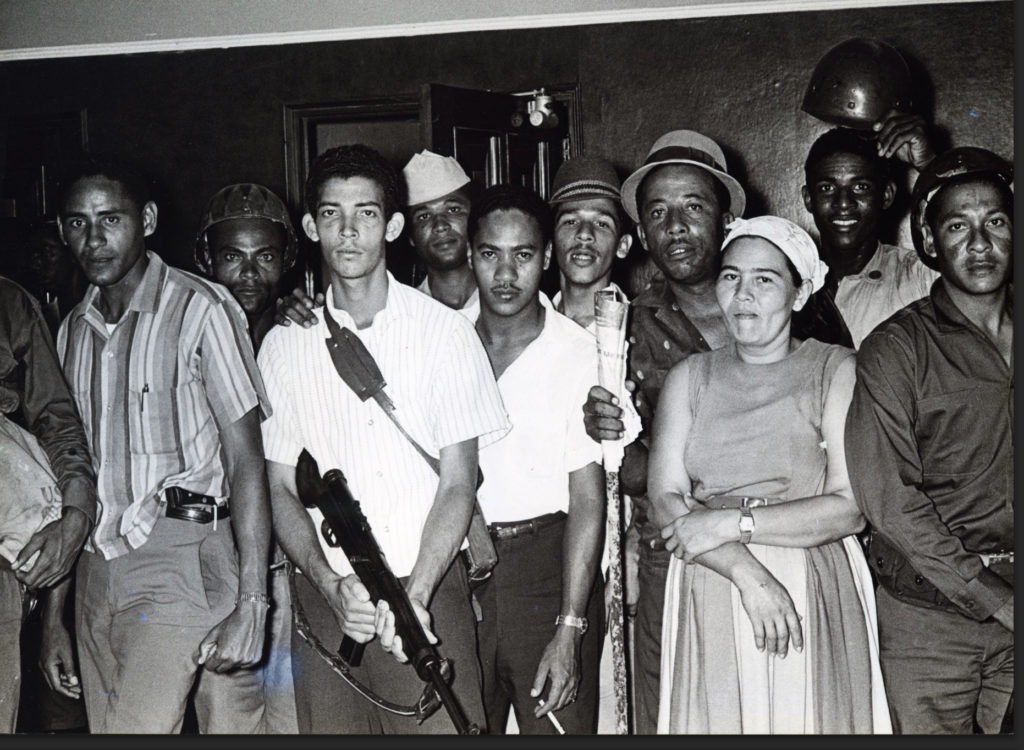
 Members of a comando popular or people’s militia. Source: AGN
The April 1965 revolution in the Dominican Republic was part of a broader trend of worldwide revolutions and anti-colonialist revolts that emerged in the 1950s and 1960s, placing it alongside the epochal turning points embodied by the anti-colonialist struggle in Vietnam, the Cuban Revolution and the Algerian War of Independence.
The Dominican revolution, with its mix of spontaneity and politico-military planning, left an enduring legacy despite its tragic defeat by the US hegemon. One of the consequences of the defeat was the return of right-wing and anti-communist forces under Washington’s tutelage, paving the way for a twelve-year dictatorship under Joaquín Balaguer. Balaguer’s counter-revolutionary regime imprisoned, tortured and murdered thousands of revolutionaries, unionists and peasants; opened up the country to extractivist mining; and strengthened the Dominican state’s anti-democratic and pro-imperialist character to this day.
As far-right dominance continues to prevail in Dominican society there is an urgent need for international solidarity to confront President Luis Abinader (a Washington lackey) and his ultra-reactionary agenda. By looking back at the 1965 revolution, we can find valuable insights that offer guidance to navigate the current political moment. The points presented here aim to expand the discussion on the Dominican revolution and provide a re-evaluation of its radical legacy six decades later.
At first, the April revolution led by young, radicalized military officers, had a democratic character whose only political demand was the return of the constitutional order interrupted by the US-backed military coup that overthrew the democratically elected reformist government of President Juan Bosch in September of 1963. But the character of the democratic revolution soon changed into an anti-imperialist, popular revolution after the United States invaded the country on April 28, four days after the revolution broke out. The fast pace of events transformed the initial democratic slogan of “Return President Bosch and Restore the 1963 Constitution!” into a loud and resolute popular cry: “Yankee Go Home!”.
Washington’s aggression shifted the situation on the ground by turning the democratic revolution into a war of anti-imperialist resistance in defense of Dominican sovereignty, and in the process, it unified the popular sectors and some segments of the middle-class, reawakened political consciousness and ultimately, intensified anti-imperialist sentiment beyond Latin America and the Caribbean region.
The 1965 revolution was the culmination of a brief but tumultuous period marked by mass struggle that began in 1961 after the fall of the Trujillo dictatorship. From 1961 to 1964, waves of labor and student mobilizations emerged. In addition, the failed November 1963 guerilla uprising, spearheaded by the 14 of June Movement with the aim of overthrowing the coup regime, proved the validity of mass mobilization over guerrilla warfare and tactics detached from concrete reality (foquismo).
For the first time in three decades, the Dominican people entered the stage of history in full force. The revolution created democratic spaces for marginalized and oppressed sectors of society who quickly became full-fledged political actors in the making of history. Among some of the most combative layers of society who participated in the revolution were different sectors of the working-class: women, people of Afro-Dominican descent, LGBTQ people, students and chiriperos (informal workers).
The April Revolution cracked open the old Trujillo army created by US occupying troops during the first military occupation (1916-1924). The sudden irruption of popular power and subsequent military defeats led to an unprecedented political scenario which created deep internal divisions within the military and the police. One wing of the military, for example, sided with the revolutionary cause while the other openly sided with US imperialism. This new development dealt a heavy blow to the remnants of the Trujillo regime whose army was on the brink of collapse, raising alarms in Washington where President Lyndon B. Johnson, of the Democratic Party, ordered the US military invasion to prevent the emergence of “another Cuba”.
One of the most significant weaknesses of the revolution was its inability to spread beyond the capital city of Santo Domingo. Although there were some attempts to extend the revolution to the Northern regions, for instance to San Francisco de Macorís where pro-coup forces quickly repelled the insurrectionary efforts, the revolutionaries failed to spread the revolution to the rest of the country, and in particular, to the countryside. One of the reasons why the revolution did not spread was the political backwardness of rural areas which lacked the political experience of urban dwellers. Further, in some rural areas like San Juan de la Maguana, the population feared reprisals as the memories of the 1962 Palma Sola massacre, carried out by the provisional Council of State government, were still fresh in people’s minds.
Unlike the Cuban Revolution, workers in key sectors of the economy such as the sugar industry played no role at all. The reason was twofold: a lack of unionization among workers, and the political weakness of the labor movement due to state repression during the proto-fascist regime (1930-1961) of Dictator Rafael Trujillo. Additionally, the system of racial and labor segregation installed by the sugar barons in the early twenty-century, in complicity with US occupying troops and the Trujillo regime, contributed to the isolation of sugar cane workers of Haitian origin which represented a large segment of the Dominican working class.
However, the formation of people’s militias (comandos populares) was key to sustaining the revolution. In fact, the comandos populares played a crucial role in providing military training to civilians, distributing weapons, feeding people, taking care of the wounded, disseminating revolutionary propaganda, maintaining local control, and encouraging democratic participation. People’s militias brought together civilians, soldiers, artists, students, intellectuals and workers. In fact, one of the most prominent people’s militias was that of POASI, or Sindicato de Trabajadores Portuarios de Arrimo (the Dock Workers Union). The comandos populares were organs of popular self-government, an expression of the dual revolutionary power created by the revolution.
The revolution and this anti-imperialist resistance revealed the potential of solidarity between Haitians and Dominicans who to this day share an island that was divided two-hundred and fifty years ago by the European imperialist powers of Spain and France. For a moment, the revolution put a brake on the virulent nationalism and anti-Haitian racism espoused by the brutal Trujillo regime.
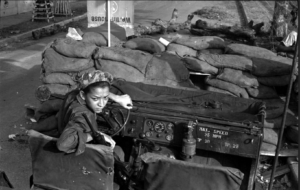 Revolutionary fighter in Santo Domingo. Photo by Milvio Pérez
After the fall of the Trujillo dictatorship, a considerable number of Haitian exiles opposed to Dictator François Duvalier entered Dominican territory. At the onset of the 1965 revolution, these Haitian political exiles joined the revolutionary cause and formed a people’s militia. Hoping to spread the revolution to Haiti and topple the Duvalier regime, Haitian internationalist fighters became legendary for their military skills and bravery.
Although the revolutionary Left and working class played a significant role during the revolution, the main leaders of the revolution hailed from the middle class sectors of society. Such as Col. Francisco Alberto Caamaño Deñó, the military leader of the revolt, and democratic sectors of the populist Dominican Revolutionary Party (PRD) as well as radicalized elements from the social-Christian milieu.
Widespread international solidarity with the Dominican people was vital to lifting morale among revolutionary fighters and halting Washington’s imperialist campaign. In 1965, anti-imperialist protests reached every corner of the world: in Mexico City, New York, Buenos Aires, Caracas and Paris, millions of people mobilized to express their anger and opposition to the criminal imperialist violence unleashed on both Vietnam and the Dominican Republic.
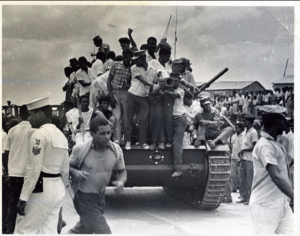 Captured by a military tank by the people. Photo by Juan Pérez Terrero.
The author is grateful to Simón Rodríguez for his comments and revisions.