
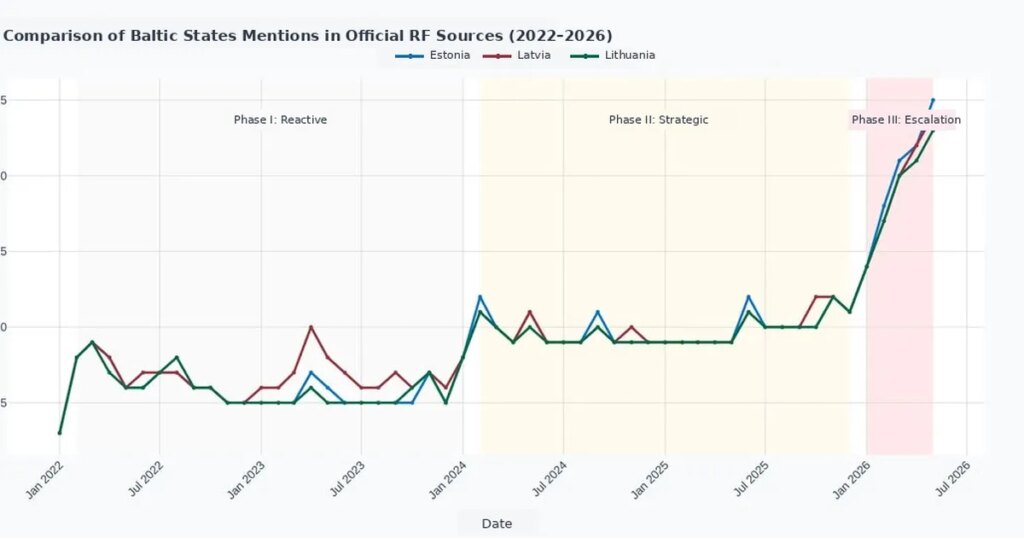
Phase II lasted from 2024 to 2025 and can be called “the strategic response.” This phase is primarily linked to Sweden and Finland joining NATO. Russia responded strategically, which is why new narratives appeared alongside concrete military steps, such as the reestablishment of the Leningrad Military District.
At the same time, the narrative that the Baltic States are not independent actors but merely puppets of the United States and the European Union became stronger.
Phase III began in 2026 and can be called “active escalation.” In this phase, we see a coordinated disinformation campaign, drone-related accusations, military deterrence measures, legislative changes, and appeals to the International Court of Justice, or ICJ.
The data confirms unambiguously that the Russian Federation’s official communication toward the Baltic States has intensified significantly.
The increase is not linear, but accelerating. The sharpest rise occurred from late 2025 to the spring of 2026. Compared with 2022, the increase is at least twofold — 206%.
Russia treats the Baltic States as a single target. The patterns of mentions across the three Baltic States are very similar, which points to a coordinated communication strategy.

Kremlin spokesman Dmitry Peskov. Photo: AFP / Scanpix
Country-specific differences are tied to particular events: Latvia to the Russian-speaking population, Lithuania to Kaliningrad, and Estonia to the drone incident.
It is also interesting that the appearance of Kaja Kallas or other Estonian politicians does not show up in Russian communication statistics as a significant separate factor. This means that “Estonian Russophobia” does not stand out much from the general background noise of criticism coming from Russia.