

 Rocky Mount native Dr. Jared Bowden became director of the North Carolina State Climate Office effective May 1.
Dr. Jared Bowden wanted to be the man you tuned your television to each day for a weather update.
His sole aspiration when he stepped onto the campus of North Carolina State University as a freshman in the mid-1990s was to become a broadcast meteorologist.
Today, that dream is but a fading memory for the Rocky Mount native who was recently named director of the North Carolina State Climate Office. Bowden’s new post became effective May 1.
That title, and the responsibilities that come with it, bring full-circle his passion for climate research, his love for his home state, and his desire to educate and serve his fellow North Carolinians.
“I take it very seriously that I want to do things to benefit our state,” Bowden, 47, said in a recent telephone interview. “What I love about this job is that it’s a public service center, so I’m serving the public and I’m trying to help the public with their problems related to climate.”
The State Climate Office is North Carolina’s leading scientific partner for understanding weather, climate, and atmospheric data. Its mission is to deliver climate-related services to local governments, state and federal agencies and businesses and residents.
The office was established in 1976 and originally housed at the University of North Carolina Chapel Hill. In 1980, the office was relocated roughly 25 miles east from the Tarheels’ campus to the home of the Wolfpack, Bowden’s three-time alma mater.
Bowden was about 2 years old at the time, toddling around in his parents’ house where his father, Don Bowden, was presumably already kindling his youngest son’s desire to pursue a career in weather meteorology.
Up until his dad’s death in November, “everyone considered him the weatherman of the family despite me having the degree,” Bowden later wrote of his father in an email.
Bowden earned bachelor’s degrees in meteorology and marine sciences at the end of an academic year that, about a month into its beginning, exposed him and thousands of fellow eastern North Carolinians to one of the most destructive hurricanes in the state’s history.
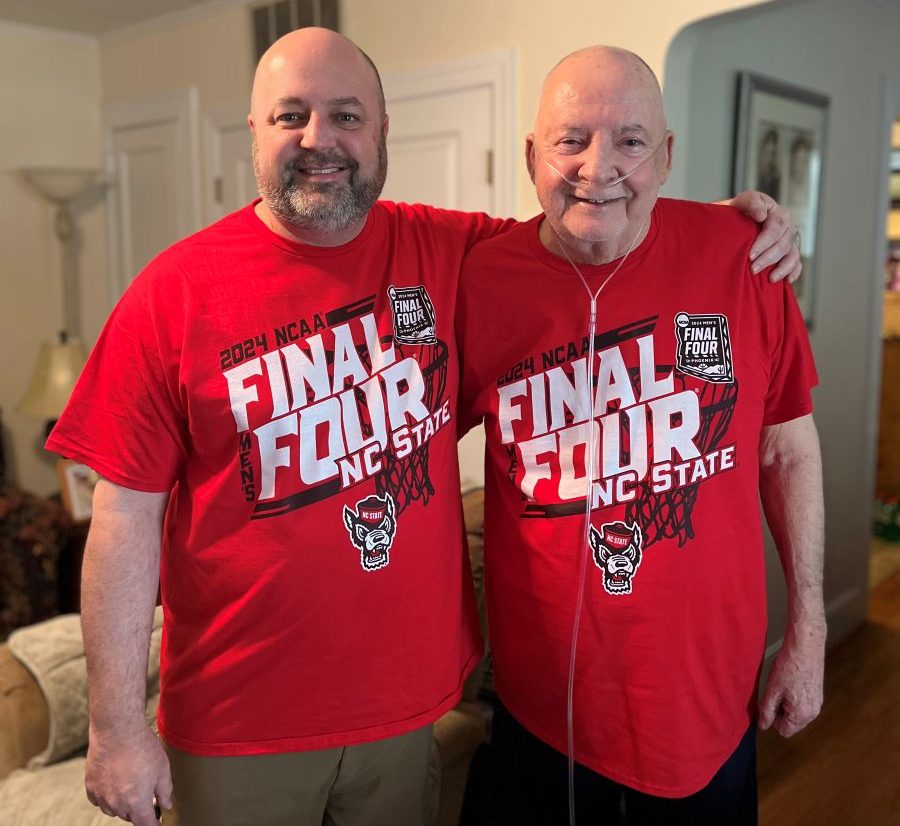 Dr. Jared Bowden, North Carolina State Climate Office director, and his father, Donald Bowden, who died in November at 78, don matching Wolfpack red Final Four T-shirts.
After making landfall near Wilmington in September 1999, Hurricane Floyd dumped rain for more than 60 consecutive hours in some areas of eastern North Carolina, where just 10 days earlier rain from Tropical Storm Dennis had inundated waterways and saturated soil.
Bowden vividly recalls seeing rescue crews — swift water rescue teams and helicopters — temporarily stage in an area that was a short two-minute walk from his parent’s home near Stony Creek, a picturesque stream that converges with the Tar River.
His childhood home was ultimately spared from flooding, but his hometown would be changed forever.
The Tar River crested at more than 31 feet in Rocky Mount, where flooding claimed lives, wiped out local businesses and homes, and damaged Tarrytown Mall, eastern North Carolina’s first enclosed shopping mall, beyond repair.
“It was really an eye-opening experience to be honest with you,” Bowden said. “People that have experienced this type of flooding know firsthand of how devastating it is and it’s not just you, but also the broader community that’s impacted.”
That experience instilled in Bowden a drive to better understand extreme weather.
His senior year at State would be one where, as he put it, he got “sucked into the research world.” There, he discovered he was particularly good at atmospheric modeling.
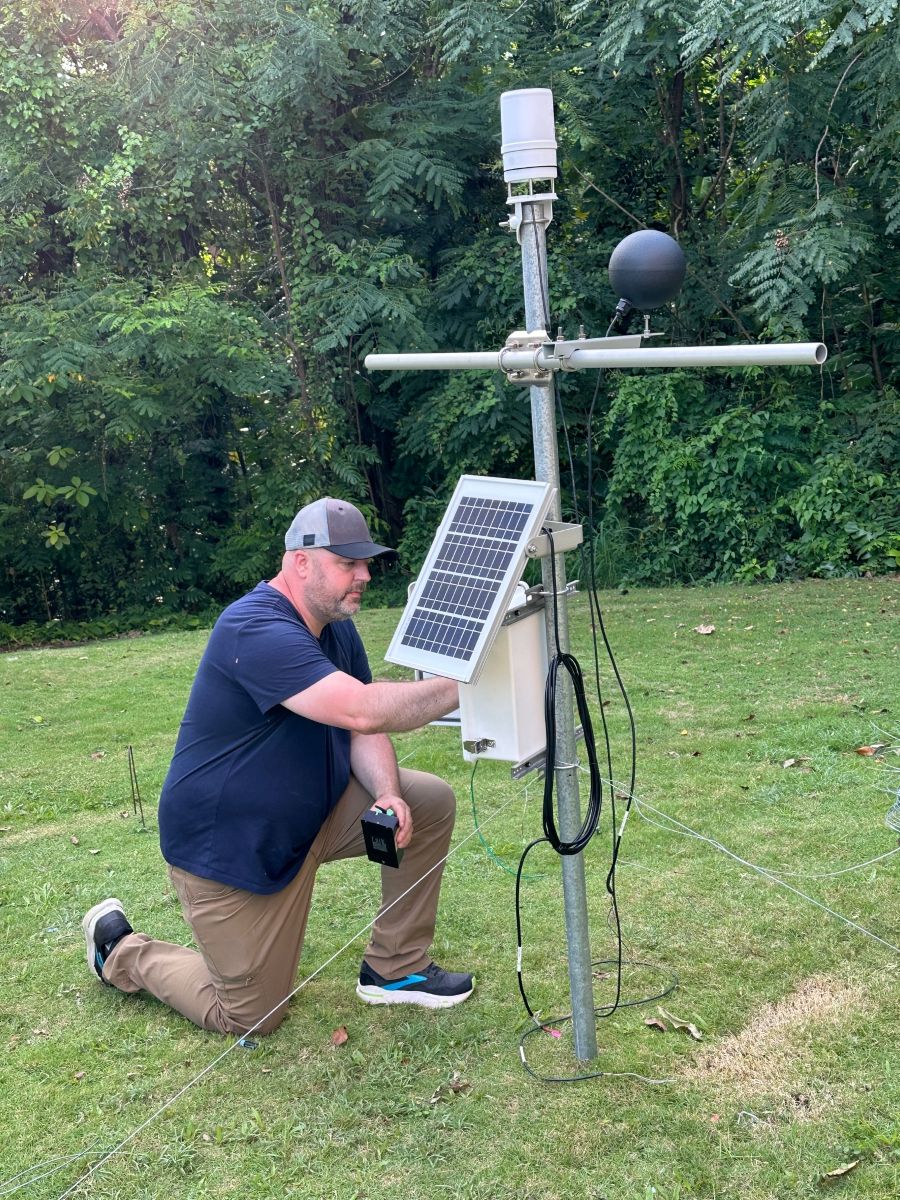 Jared Bowden works with a weather instrument station.
Bowden went on to earn a master’s and doctorate in atmospheric science, landing a job as a postdoctoral researcher at the U.S. Environmental Protection Agency’s Research Triangle Park office, where he worked with “some of the best atmospheric modelers in the world.”
From there, he settled into a world of research related to atmospheric modeling, eventually accepting a job as a research assistant professor at UNC Chapel Hill.
“But that kind of took me away a little bit from my passion of climate,” Bowden said.
When the position of associate director opened up at the State Climate Office in 2024, he applied for the job, one that would get him back to not only his love of climate research, but climate research specific to his home state.
Bowden was named interim director of the State Climate Office in August 2025 following former director Kathie Dello’s departure to become the N.C. Department of Environmental Quality’s assistant secretary for resilience.
The North Carolina Office of Recovery and Resilinecy was established in the fall of 2018 in the aftermath of Hurricane Florence, a storm that dumped more than 35 inches of rain in parts of eastern North Carolina and racked up an estimated $22 billion in damages in the state.
“We’ve seen quite a number of events over the years, and even in Rocky Mount there’s been events that haven’t been related to tropical systems that have created some really big flood problems,” Bowden said. “I didn’t see those types of things growing up. It is what I would say is a new normal that eastern North Carolinians are facing. But, as you know now, no place is safe within our state. From the mountains to the coast, everybody’s experienced something.”
Portions of western North Carolina continue to recover from the devastation of Hurricane Helene, a Category 4 storm that made landfall at Florida’s Big Bend and swept north. Wind and rain generated from the storm claimed the lives of more than 100 North Carolinians and caused an estimated $78.7 billion worth of damage.
Within just the last decade, the state experienced its hottest year on record in 2019. Last year, more than 5,000 heat-related emergency room visits were reported in North Carolina.
As of May 19, more than half of the state’s 100 counties are experiencing extreme drought. Most of the 20 coastal counties are under severe drought.
“The pendulum is swinging much more aggressively both ways and that’s what our state has to be prepared for,” Bowden said. “We have to work closely with our partners, we have to reach out to various groups to understand what those challenges are so that we’re able to serve them better.”
The office, which is comprised of 10 staff, is in the process of creating HANC, or Heat Atlas for North Carolina.
“It looks at, if you were to think about a hundred-year, three-day heatwave, what would that temperature be for your locations,” Bowden said. “That’s something I’m really excited about and we’re thinking about how to extend it to a broader footprint into South Carolina and possibly Georgia.”