
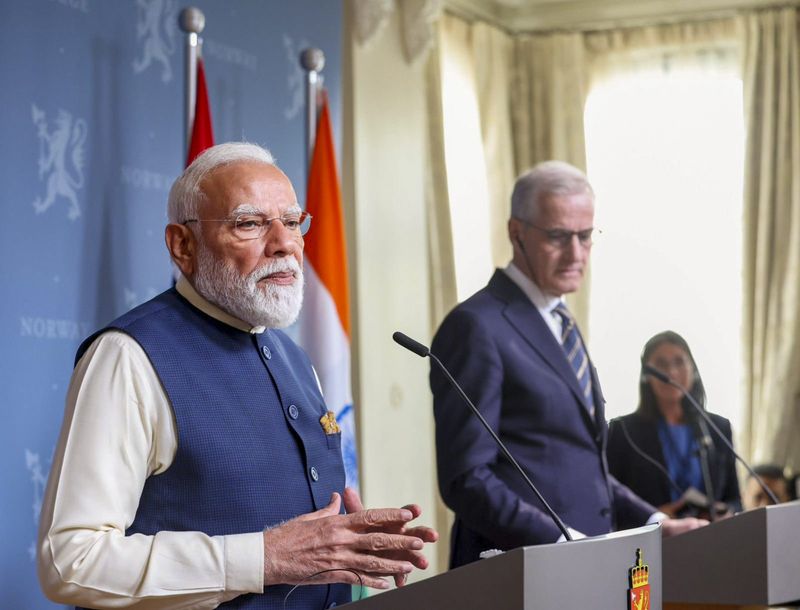
Nehru facing the Norwegian press in 1957, and 69 years later Modi avoiding a sharp query in 2026, indicates how the high stature of India during Nehru era has been demolished during Modi’s tenure as prime minister.
India’s first prime minister Jawaharlal Nehru passed away on May 27, 1964. Nine days before the solemn occasion of his 62nd death anniversary, on May 18, 2026, when prime minister Modi was in Oslo, a young journalist of that country, Helle Lyng, asked, “Prime Minister Modi, why don’t you take some questions from the freest press in the world?” As Modi moved away without any response, those words reverberated not just in India but across the world. People wondered how Modi reconciled his bizarre stand to avoid press with his claim that India is a pulsating democracy.
Nehru facing the Norwegian press, Modi walking away
Modi moving away without responding to Lyng’s ringing words very strikingly reminded the contrasting image of Nehru who during his visit to Norway on June 22, 1957 was introduced by the then president of that country Rolf Jerving to the Norwegian press as a leading statesman of the world. Jerving urged them to avail of the rare opportunity of asking questions to such an internationally acclaimed personality. Nehru in turn displayed remarkable graciousness and gravitas and told the Norwegian journalists, “I shall leave myself in your hands to be dealt with, I hope, gently and kindly.”
So, Nehru facing the Norwegian press in 1957 and 69 years later, Modi avoiding a sharp query of Lyng, “Prime Minister Modi why don’t you take some questions from the freest press in the world?” indicates how the high stature of India during Nehru era has been demolished during Modi’s tenure as prime minister.
Lyng is absolutely right in asking, “When French President Macron came to Norway, he took questions. Every single head of the nation takes questions. But, Indian PM didn’t. I wanted to highlight that you can’t have your definition of democracy.”
Had she been aware of the 1957 press conference of Nehru at Oslo where he took 21 questions and answered all of them very persuasively, she could have drawn the attention of Modi to the exemplary legacy left behind by Nehru and the critical necessity to uphold it.
“It is our job to question the powers we cooperate with,” she wrote on X, and brought out the contrasting status of India in press freedom index – Norway occupying first position in the Reporters Without Borders’ global Press Freedom Index and India securing 157th rank out of 180 countries.
Lyng was keen to field a question to Modi when he was entering an elevator but the doors got closed before she could finish. “What I was wondering,” Lyng wrote next to a video of her trying to approach the Indian PM, “was whether he thinks he deserves the trust of the Nordic countries given his human rights violations and his restrictions on press freedom.”
Editors guild of India questions Modi
Apart from Lyng’s indicting observations and unenviable status of press freedom in India, the observations of Editors Guild of India regretting the confrontation between the Government of India and the press in Norway and Denmark during the prime minister’s visit also brings out the devaluation of India’s image attributed to Modi’s failure to take a single question. The Editors Guild of India described such a confrontation as deeply “embarrassing” and expressed regret that Modi did not take a single question during his visit to these two countries and flagged with anguish Modi’s failure to address a single press conference either in India or abroad during the last twelve years.
Snake charmer cartoon
Such painful observations on Modi’s stubbornness on not facing questions from the media in Norway and elsewhere stood in sharp contrast to several press reports after Nehru answered questions from the media in Oslo that he charmed Norwegians. Whereas in 2026, Modi’s unwillingness to take a single question from the Norwegian media possibly angered the press fraternity of that country and a cartoon in the leading daily of Norway Aftenposten depicted him as a snake charmer holding pipe in the shape of a snake to fill fuel in vehicles alongside an opinion piece titled “A clever and slightly annoying man.”
Lyng’s another question deserves to be quoted – “As we strengthen our partnership, why should we trust you? Can you promise that you will try to stop the human rights violations that go on in your country? And also will the prime minister start taking critical questions from the Indian press at some point in the future? And also if possible I would like you to answer straight away.”
Critical questions Nehru faced
Among several critical questions Nehru answered in Oslo in 1957, the one on Kashmir and the other on Middle East merit attention.
When a Norwegian media personality asked why India did not accept arbitration in the Kashmir dispute, Nehru emphatically replied that a country does not accept arbitration about its own territory. He said that J&K being India’s integral part, elections were organised to seek people’s mandate for its governance and in contrast, in Pakistan Occupied Kashmir no elections were held.
Remarking that Pakistan’s aggression on Kashmir has been acknowledged by UN, Nehru firmly stated that the portion of J&K occupied by it had to be vacated unconditionally. Nehru persuasively put forth that Kashmir for India is more than a territory. “It is a question,” he remarked, “of basic approaches, a kind of theocratic approach on the Pakistan side and a secular approach that we follow.”
Those words of Nehru assume greater relevance now to provide healing touch to Kashmir, particularly after the Modi regime, among others, reduced J&K’s status to a Union Territory and conducted elections only after the Supreme Court directed it to do so.
Answering a question on the Middle East situation, Nehru stated that outside interference endangered the equilibrium of the region because external powers were driven by its oil, ignoring the poor people there. “Middle Eastern people,” he candidly stated, “have got wealth through oil, but they have much more trouble through oil than anything else.” “They,” he said, “probably had a calm and more peaceful life without oil than with oil.”
Those words of Nehru are playing out now in a more pronounced manner. That is why Nehru’s legacy endures regardless of attempts by Modi regime to vilify him.
S.N. Sahu served as Officer on Special Duty to President of India K.R. Narayanan.
This article went live on May twenty-seventh, two thousand twenty six, at twelve minutes past ten in the morning.
The Wire is now on WhatsApp. Follow our channel for sharp analysis and opinions on the latest developments.