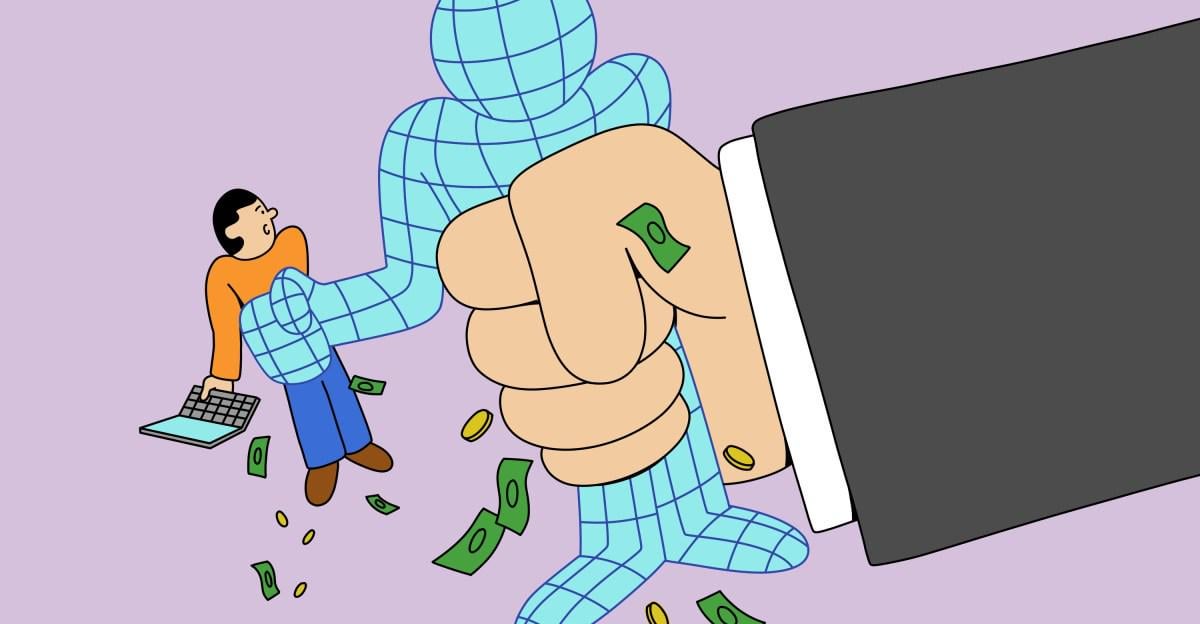
You’re about to feel the AI money squeeze | Ads, rate limits, feature restrictions, price hikes. The AI free ride is over
https://www.theverge.com/ai-artificial-intelligence/917380/ai-monetization-anthropic-openai-token-economics-revenue

You’re about to feel the AI money squeeze | Ads, rate limits, feature restrictions, price hikes. The AI free ride is over
https://www.theverge.com/ai-artificial-intelligence/917380/ai-monetization-anthropic-openai-token-economics-revenue
47 Comments
Oh no, less AI slop?
Please stop I can can only get so erect
Jokes on them I don’t use AI
As is the entire business model lol who tf has money for this
Companies be like: Aight time to lay off more people, cant be helped
Cable TV, streaming models, subscription models. It’s always the same play. Get a good products and enough market share, then enshitificate and squezze..
It could come crashing down… if no one can use it because its too expensive then the datacenters, everything, were all for nothing. And if they keep using it even if its more expensive than human labor… its just a net negative
I can’t wait, bring it on
(non-AI people are already feeling the squeeze as (for example) computer component costs skyrocket thanks to the tulip chasers, the sooner the robo bros feel the pain the better)
Used copilot add on for Excel, asked it 3 or 4 things and that includes having it do the same thing because it messed up the first time so badly, then it said I hit my limit for the day.
1) didn’t even know there was a limit
2) some of those were just to fix your mistakes Mr AI
3) I can do the task it just takes me an extra couple steps, so I’ll just do that.
the end is near finally!?
I heard it called a rug pull
By you I think you mean corporations paying the AI bills that will now have to decide if the cost savings over a hiring an underpaid intern or entry level position to do the same quality of work were all they were cracked up to be.
And this is a bad thing?
>The AI free ride is over
That is written like they think I am somehow happy to the be on the “AI ride” to begin with.
The only AI thing I have a paid plan for is the Gemini Pro plan that Google gave me for “free” when I bought my Pixel 10. But that runs out in August and costs $200/yr and they just introduced those usage limits. I can’t see myself being willing to actually pay for it once the free year is up given I just ask it random questions and to generate funny images sometimes.
If I was gonna pay anyone I would pay Kagi for their AI addon plan. That gives me access to most of the big models and puts an abstraction between me and the likes of Googles data hording.
Still waiting for when AI makes things better, let alone be asked to pay for it.
Issues of note:
>Investors have poured hundreds of billions of dollars into companies like OpenAI and Anthropic to help them scale and build out their compute. Now, they’re expecting returns. After years of offering cheap or totally free access to advanced AI systems, the bill is starting to come due — and downstream, users are beginning to feel the pinch.
>
>Over the past few years, most top AI labs have introduced new subscription tiers to court power users. OpenAI and Anthropic shifted their pricing plans for enterprise. OpenAI introduced in-platform advertisements. Anthropic, of course, restricted third-party tools.
>
>In some ways, this is a tale as old as time, and particularly, a clear echo of the tech boom of the ’10s. Venture capitalists helped startups subsidize fast growth in all kinds of areas: ride-hailing apps, e-commerce, takeout and grocery delivery. Once companies cemented their power, they raised prices, added new revenue streams, and delivered a return to investors. Or they didn’t — and they crashed and burned.
>
>…
>
>“Is the era of basically free or close-to-free AI kind of coming to an end here?” said Mark Riedl, a professor in the Georgia Tech School of Interactive Computing. “It’s too soon to say for certain, but there are some signs.”
>
>Gartner’s Sommer studies long-term economic market trends related to generative AI, including calculating just how much money is at stake. Between 2024 and 2029, he said, Gartner estimates that capital investment in AI data centers will reach about $6.3 trillion — a “massive amount of money.”
>
>…
>
>To reach that bare minimum of 7 percent, Gartner forecasts that large AI companies would need to earn cumulatively close to $7 trillion in AI-driven revenue through 2029, which is close to $2 trillion per year by the end of the period. In order to achieve “historic returns,” the providers would need to earn nearly $8.2 trillion in the same period.
>
>OpenAI has already made $600 billion in spending commitments through 2030, the company said in February, which Sommer says is already a “massive step down” from the $1.4 trillion it had planned before. Based on OpenAI’s revenue forecasts and potential compound annual growth, Sommer said that even in the best-case scenario, he predicts that the lab would only hit a fraction of the overall spend required to hit that 7 percent ROIC.
>
>…
>
>Sommer estimates that if you only account for the direct cost of infrastructure and electricity, “every company is making very reasonable margins on every token.” But that margin is probably tighter or nonexistent with newer, more token-hungry models. And it’s eaten up completely by indirect operation costs, like building out more compute and the “ungodly” expense of constantly training the next big model.
>
>“As soon as you then add all of the infrastructure that needs to be built for the next generation of model, and you look at how these models are going to scale, it becomes increasingly untenable,” Sommer said.
>
>Sommer predicts that many companies “won’t be able to sustain their burn rate,” and says market consolidation is virtually inevitable — in his eyes, no more than two large language model providers in any regional market will survive. And the era where nearly every service has a fairly generous unpaid tier probably isn’t going to last.
>
>…
>
>In the early days of AI, the bulk of compute costs went to training initial models, while inference (or performing tasks) was cheaper. As models have advanced and systems have added features, however, inference has gotten far more resource-intensive. AI agents, or tools that ideally can complete complex, multistep tasks on your behalf without constant hand-holding, now use vastly more tokens than the basic chatbot models did a few years back.
>
>Reasoning models, which increasingly power AI agents, are notoriously expensive on the inference side as well, said Georgia Tech’s Riedl. These agents — such as popular open-source platform OpenClaw — are typically more efficient and effective than ones without reasoning, but they also expend far more tokens doing behind-the-scenes work the end user may not see. That may look like “thinking through” a lot of different potential paths, launching sub-agents to do portions of a task, or verifying the accuracy of different steps of the process.
>
>“You put in your one-sentence prompt… and it’ll talk out loud to itself for thousands and thousands of tokens, thousands and thousands of words, maybe even tens of thousands when you get into coding,” Riedl said, adding, “If you have thousands or millions of people using these things every single day, the inference costs of just the users generating tons and tons of tokens all the time really outweighs the training side of things.” If model providers were making a straightforward profit on all these tokens and had the compute to handle them easily, that wouldn’t be a problem for them — but as things stand, it’s a strain.
>
>…
>
>In consumer chatbots, some model makers are trying to mitigate this with advertising. OpenAI recently introduced ads within ChatGPT, which show up as a separate sidebar, and it’s reportedly working on a tool to track how well those ads work. (Anthropic famously decried the move in its 2026 Super Bowl ads.)
>
>But for companies that build tools on top of models like GPT-5 or Claude Opus, the price of tokens is going up, and the extra cost is largely trickling down to their customers. Multiple tech companies The Verge spoke with said they, or their customers, are changing strategies to offset the new pricing. Some are considering moving fully or partially to open-source models, and some are using considerable time and resources to evaluate how expensive high-end models perform on certain tasks compared to cheaper alternatives.
>
>…
>
>Gartner’s Sommer likens the whole scenario to what he called the “stegosaurus paradox.” When scientists first discovered the stegosaurus fossil, he said, they didn’t understand how a large body could be supported by such a small head with a tiny mouth — and the theory they developed was that the stegosaurus would need to constantly be eating, and eating a highly nutritious diet.
>
>“We see AI as kind of being the same deal,” Sommer said — for the stegosaurus (AI labs) to survive, then providers need to find more food for it (the entire global economy, not just the tech market) and it has to be highly nutritious, too (i.e., providers need to be able to earn a margin from it and stop subsidizing). If the stegosaurus paradox isn’t resolved, and the mouth is “too small for the body,” he said, it will lead to write-downs, falling valuations, dried-up financing, and a broad resetting of expectations for AI worldwide. Therefore, Sommer said, a sustainable business model “would require that genAI be infused in everything from billboards to checkout kiosks,” with providers taking a cut of all of those transactions.
>
>“The free era was really a land grab — it’s a common strategy used by startups,” said Eve’s Madheswaran. “That’s just not a business model. You can’t do that for too long.”
With every new technology in recent years, it looks like there’s been a rush by companies to grow as quickly as possible to dominate the market before regulations come in or before VC money runs out. This approach to development and growth is certainly one way to do it, but as we’ve seen time and again, it’s a colossally wasteful way of doing things and usually leaves the public holding the bag when things go awry. Perhaps a less chaotic and greedy approach might be more sustainable in the long run.
Good news for me. I never used it and never want to.
Imagine a bunch of shady lads with prior convictions wrapping an arm around your shoulder and saying with a big smile “Here, my friend, there’s a million pounds in that dark alley. Come, we’ll walk you there” and then, obviously, you get beaten to a pulp and robbed. The shady bunch of lads: Google, Microsoft, Amazon and individuals like Altman, Bezos or Gates. “Industrial revolution” me hole. It’s as real as that million pounds in the dark alley. If the Al bubble doesn’t burst first, the regret of handing over our entire lives and company resources will be enormous. But itll be too late.
Hell yeah, finally, charge all those dummies.
Oh nooooo how will I ever cope with using my own brain to form original thoughts?
Cant feel it if I never needed it
Trained on our data, replacing our jobs, and now will be too expensive for us to use. Our leaders have failed us and it should’ve been regulated years ago.
Good because I wasn’t buying into it anyway.
I am so excited for the bubble to pop.
Please be true I just want this shit over with
I only use AI in any capacity, because it costs me no money. My company pays for a co-pilot license and it is useful to many in the IT dept, but we have a limited budget and AI is not that high a priority (despite big tech trying so hard to make it out to be the past year or two). Big Tech is about to price themselves into obsolescence .
It was never meant for us. We were just training data.
Oh no, anyways
Or we could just not use it ever
The free ride was trash so have fun pushing the paid slop
I mean, *I’m* not.
I hope so. This way, people will stop with the slop
It’s barely useful with the current cost structure lol. Good luck guys
It was already too expensive for what it was, and you’re telling me it will get more expensive? Well seems like a lost cause now. A few addicted will continue to use the services but it won’t be adopted by the masses.
In the end, companies like Apple who did the bare minimum like add features that just help make a phrase sounds more professional or just create silly custom emoji are just winning by not playing.
Many may not recall but ATMs were originally free. This mode of “free to getcha hooked” is repeated, uh, repeatedly!
ATM, cloud storage, etc etc.
Totally predictable.
It’s one thing to raise prices and blame inflation, but to raise them bc THEY invested in a dumb idea? Yeah I don’t think people are gonna be chill with that
Good. Maybe this can finally get the bubble to burst.
I think this is a record for fastest ‘enschittification’ of a product to date. Less than 3 years and it’s gone from ‘free’ to ‘more expensive than human labor’
wait, are you saying a company offered a service for a good price long enough to make you dependant and then hiked up the price?
man! that will trick any powerful minds, like CEOs and such
I’ve never used AI and actively avoid it at all costs.
You may call me naive, but I’m genuinely surprised how quickly the squeeze is happening. This has all evolved RAPIDLY over the last couple years. It was only last fall that OpenAI made Sora 2 which had insane video technology and were begging people to use it for free, grok had effectively limitless image and video gens, etc… and now just in the spring they completely shut down Sora 2, grok severely reduced its limits even for paid subscriptions, etc… literally within a span of months.
If I have to go back to fully coding by hand, I’m all for it.
Cool, get it the fuck off of my phone, computer, tv, websites, etc. I’m happy to keep not using it and not paying for it.
This is what will kill the entire “industry”. We were forced and cajoled into using a product that nobody asked for, as investors were promised massive returns on labour costs— most of which have not materialized.
Add to that the increased— and unsustainable — demand on infrastructure from data centres, and this whole house of cards is coming down.
Biggest Ponzi scheme of all-time.
Good thing I refuse to use AI for anything.
People aren’t going to pay for AI. If it becomes paywalled, then it will die on a massive scale and only used in enterprise.
Let them decide how they want to go about it.
Tech companies can take their AI & shove it up their ass. I’ve been avoiding it like a plague since day one. It’s doing way more harm than good.
the arc is always the same. make it free, make it essential, make it expensive. we’ve watched this happen with every platform and still fell for it again