
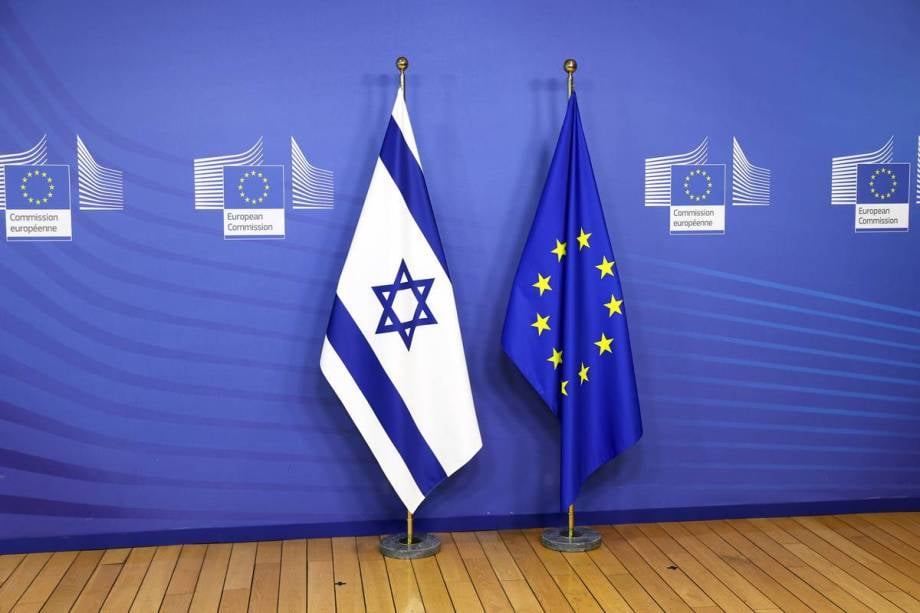
Europe is careening toward strategic irrelevance as Iranian proxies tighten their noose around its southern flank and radical Islam spreads through its streets and no-go zones. Israel is the hard-power partner the European Union can no longer afford to keep at arm’s length. Full membership would end the dangerous halfway status that leaves both sides exposed and vulnerable.
The economic foundation is already robust and growing more vital by the day. The European Union accounts for 31.7 percent of Israel’s goods trade, totaling 43.3 billion euros in 2025, with services adding another 26.6 billion euros the year before. Israeli technology, pharmaceuticals, and advanced machinery flow north while European industrial exports move south. This is not charity; it is symbiosis at the cutting edge of global competitiveness. Israel also spends more than 5 percent of its GDP on research and development — the highest rate in the world — generating breakthroughs that European firms license and integrate every day.
The 2000 Association Agreement created a free-trade zone, yet it remains hostage to political reviews and tariff threats, exactly as the European Commission demonstrated in 2025. Full membership would lock in permanent single-market access and strip anti-Israel factions inside the European Union of the leverage they now exploit at will.
Cultural integration runs far deeper than Eurovision and UEFA football tournaments. Israel already embodies the European spirit in moral, political, and cultural terms. Similar architecture, comparable lifestyles, and a shared commitment to innovation and debate define daily life in Tel Aviv and Europe’s major capitals alike.
Israel’s linguistic character reflects Europe’s diversity through successive waves of immigration, and Israelis pronounce the “reish” exactly as Germans, French, Dutch, and Yiddish-speaking households across the continent still do. Israeli cuisine fuses European, Middle Eastern, and North African influences into a cohesive national identity that Europe itself once possessed but has largely abandoned. These are not superficial similarities. They are living proof of civilizational bonds that membership would finally formalize.
Unlike Turkey — which has bankrolled Hamas terrorists for years, repeatedly sabotaged North Atlantic Treaty Organization cohesion from within, and moved again to crush domestic opposition in yet another authoritarian power grab previewing exactly how it would weaken the European Union from the inside — Israel represents the return of Europe’s two great Jewish civilizations, the Ashkenazim and Sephardim. Their European origins, intellect, and fighting spirit were cultivated by the continent before Europe expelled them. Full membership, therefore, would not be an act of generosity, but the overdue restoration of a civilizational partnership capable of hardening the Union against the Islamist forces Ankara continues to enable.
The moral case is one the European Union prefers to avoid. The Holocaust murdered six million Jews, the overwhelming majority of them European, through machinery built and operated on European soil. Full membership would deliver concrete atonement by placing the Jewish state at the table that its people helped build before the genocide. Anything less reduces “never again” to empty rhetoric while antisemitism surges across European cities, synagogues are firebombed, and Jewish students are harassed on campuses from Paris to Berlin. The postwar European conscience cannot claim moral authority while isolating the world’s only Jewish state.
Geostrategically, membership would transform the European Union’s position in the Middle East overnight. It would neutralize the automatic anti-Israel majority dominating United Nations General Assembly votes — 154 resolutions against Israel from 2015 through 2023 versus just 71 against every other country combined. That bloc, driven by the Organization of Islamic Cooperation’s coordinated voting machine, has turned the United Nations into a farce on Middle Eastern affairs.
If Saint Pierre and Miquelon’s being off Canada is considered a sufficient pretext for Ottawa’s theoretical eligibility for EU membership, then Israel’s exclusion becomes indefensible hypocrisy. The Jewish state offers Europe far greater geostrategic value as an indispensable frontline bulwark against Iranian expansion, jihadist terror networks, and Russian-Chinese encroachment in the Eastern Mediterranean.
An Israeli delegation inside the European Council and Parliament would block one-sided declarations, cut funding to hostile organizations, and force realism back into European foreign policy. Eastern European states that already view Israel as a model against hybrid threats — from Russian disinformation to Iranian terror networks — would gain a permanent ally forged in the same fire.
Today, virtually no one inside the Union still defends Israel now that Viktor Orban is gone. The last serious brake on anti-Israel measures has disappeared. Hungary now backs new sanctions packages and stands prepared to enforce International Criminal Court arrest orders against Prime Minister Benjamin Netanyahu and ministers such as Bezalel Smotrich. Membership would end this isolation before the European Union completes its slow surrender to the anti-Israel consensus.
For the European Union, the gains would be immediate and immense. Israel could establish joint intelligence fusion centers, drawing on Unit 8200-honed expertise, to track Iranian, Hezbollah, and jihadist networks before they reach European soil. These networks already finance mosques, recruit in European prisons, and plot attacks from Brussels to Nicosia. Israeli trainers could impart the urban and tunnel warfare tactics refined during Israel’s recent wars, preparing European forces for the hybrid conflicts of the future.
Israel’s artificial-intelligence border systems — proven against virtually every infiltration method — could help secure the Mediterranean while distinguishing genuine refugees from radical infiltrators. During the Red Sea crisis, Israeli naval intelligence and technology helped protect shipping lanes vital to European economies. These are not abstract theories. They are battle-tested capabilities that could save European lives and restore the deterrence the continent has steadily squandered.
Membership would also force Europeans to confront and dismantle their anti-Israel mentality. Once Israelis sit in the same council chambers and vote on the same policies directly affecting them, the old post-Second World War bubble — the distorted lens treating Israel as an eternal aggressor while ignoring the realities of radical Islam and authoritarian expansionism — would finally burst. Europeans would recognize that defending Israel ultimately means defending themselves.
The new European right should champion this idea without hesitation. Israel represents precisely the strong borders, national identity, unapologetic self-defense, and technological supremacy that right-wing parties across the continent increasingly demand. It offers a living model against the globalist weakness that has hollowed out Europe’s institutions, confidence, and willpower.
The economic payoff would be equally substantial. Israel’s startup ecosystem and defense industry would inject thousands of high-value jobs into European supply chains. Joint research in cybersecurity, green technology, and precision agriculture would accelerate European competitiveness against China. Israel’s world-leading drip irrigation and desalination technologies — which transformed the desert into an agricultural export powerhouse — offer Europe a practical lifeline against the droughts ravaging Spain, Italy, and Greece, succeeding where the European Union’s Green Deal and subsidy-driven policies have fallen short.
Today, nearly 500,000 Israelis already hold European Union citizenship. Most Israelis travel to Europe when they go abroad. These human bonds are assets, not liabilities. Full membership would convert them into permanent strategic depth. The post-Second World War European mindset created a bubble preventing clear recognition of today’s threats. That bubble has left the continent weaker, its institutions compromised, and its national security increasingly fragile. Israel’s integration would shatter the illusion, strengthen the European economy, and give Europe’s new right the concrete ally it needs.
Europe faces a stark choice: continued drift into weakness, demographic decline, and cultural surrender — or decisive alignment with the one Middle Eastern state that consistently wins wars and builds prosperity from scarcity. Israel faces a parallel choice between continued vulnerability and permanent institutional protection. Full membership would resolve both problems at once. The era of half-measures has passed.
Full Israeli membership would hand Europe’s ascendant right the one proven template it still lacks: a nation that built a 245-kilometer electronic barrier along its Egyptian frontier, slashing illegal infiltrations from thousands annually to just eleven in 2016, proving that strong borders combined with unyielding national identity can defeat the demographic and cultural fragmentation wrought by woke multiculturalism. It would simultaneously place a forward American intelligence and defense foothold inside European Union institutions, coordinating the containment of Iranian nuclear ambitions and proxy networks before they reach European soil.
Most urgently, it would establish a permanent institutional firewall against the ultimate nightmare: an Islamist-influenced Europe exerting leverage over France’s 290 nuclear warheads. With Israeli missile-defense and air-dominance systems already comprising 54 percent of Europe’s defense imports during a record $15 billion export year, accession would cement this strategic interdependence and forge the civilizational alliance Europe needs before radical Islam and Tehran complete the unraveling of the postwar order already well underway.
Jose Lev Alvarez is an American-Israeli scholar specializing in Middle Eastern security policy.
A multilingual veteran of both the IDF Special Forces and the U.S. Army, he holds a B.S. in Neuroscience with a Minor in Israel Studies from American University, three master’s degrees (international geostrategy, applied economics, and intelligence studies), and a medical degree. He is currently completing a Ph.D. in Intelligence and Global Security in the Washington, D.C. area.
In addition to blogging for the Times of Israel, he contributes to the Washington Examiner, is a writing fellow at the Middle East Forum, and regularly provides geopolitical analysis on Latin American television networks.