
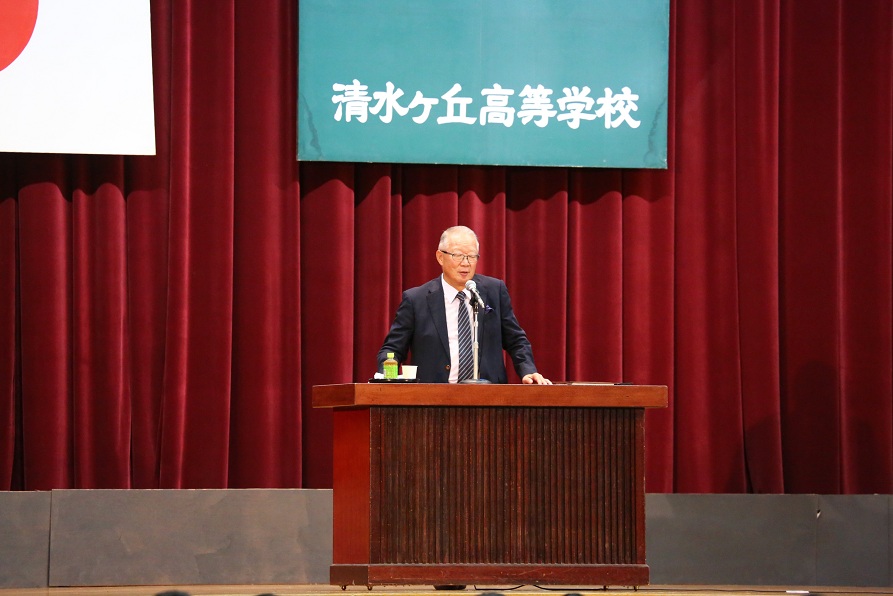
Hideaki Ota, Representative Director of Japan Forward and adviser to The Sankei Shimbun, delivered a speech titled “On Japan and the Japanese People” at Shimizugaoka High School in Kure, Hiroshima Prefecture, on October 14, 2025. The audience included about 600 students, including visitors from its sister school, Aoyama Junior and Senior High School.
The speech followed a capping ceremony for first-year nursing students at Shimizugaoka High School, marking the start of their clinical training. An edited version is published here with the school’s permission.
Third in a Three-Part Series
Read Parts One and Two
Many foreigners came to Japan from the late Edo period through the Meiji era. They included merchants, soldiers, diplomats, interpreters, and many others, and they left behind numerous diaries and reports. One impression recurred in their writings: Japan was safe, and its people lived surprisingly cheerful lives.
Let me share a story about a British man who came to Japan at the end of the Edo period. Before leaving on a business trip one day, he entrusted some valuables to the owner of the inn where he was staying and asked him to keep them safe. The innkeeper simply placed the items in a cupboard in the room without even locking it.
The British man was deeply concerned. “Will my belongings really be safe without a lock?” he wondered. Still uneasy, he returned two weeks later after finishing his business.
The innkeeper took the valuables out of the cupboard and handed them back to him. Nothing was missing. The British man was reportedly astonished, saying that such a thing would have been unimaginable in his own country.
Early Impressions of Japan
Even today, visitors to Japan are often amazed when lost items are returned to them. For Japanese people, however, this is simply normal.
I would like to quote from a book I greatly admire, Nihonjin no Hokori (The Pride of the Japanese People). It introduces the impressions of the country and its people recorded by a Dutchman named Henry Heusken (1832–1861), who worked as an interpreter at the time.
The book quotes Heusken’s writing: “I admire the simplicity of the people of this country and their unadorned customs. Seeing the richness of this land, hearing everywhere the joyful laughter of children, and being unable to find misery anywhere, I cannot help but think: Oh God! This happy scene now seems destined to come to an end, as Westerners appear ready to bring with them their grave vices.”
The author, Masahiko Fujiwara, writes: “Many Westerners made various observations, but nearly all of them shared one common impression: the people were poor, yet they seemed happy.”
Of course, some foreigners found the strong smell of pickled daikon overpowering, while others considered noisy eating to be crude and impolite. Even so, such records suggest that it would be one-sided to describe that era simply as a time of poverty and unhappiness.
A World Carved by Empires
Now let us move from the Edo period into the Meiji era (1868–1912). Near the end of the Edo period, US Navy officer Matthew C. Perry’s “Black Ships” arrived in Japan.
But even before Perry’s arrival, Russia and Britain had already been sending warships to waters near Japan, seeking contact in various ways in hopes of gaining influence and advancing their interests. At the time, Japanese men still wore topknots. What was the rest of the world experiencing then?
It was the age of imperialism and colonialism. Led by the British Empire, which had gained immense economic wealth and military power through the Industrial Revolution and the invention of the steam engine, the great powers competed to carve up territories around the world. It was an era ruled by force.
Britain controlled India, Burma—present-day Myanmar—and the Malay Peninsula, while also exerting colonial control over parts of China. It ruled Canada, Australia, and even Egypt. This was the height of British power.
France dominated much of Africa, the United States controlled the Philippines, Hawaii, and large parts of Latin America, and the Netherlands colonized Indonesia.

Meiji Restoration
Despite the restrictions of Japan’s policy of national isolation, both the Tokugawa shogunate and the powerful feudal domains had some understanding of world affairs. They lived with the fear that Japan, too, might one day be invaded and turned into a colony by foreign powers.
At the same time, they possessed the determination to prevent that from happening at any cost. Amid the turmoil of the late Edo period, the Meiji Restoration took place, and Japan set out to build a strong, modern nation.
In the process, countless people devoted their lives to strengthening Japan as an independent country. You have probably heard the names of figures such as Saigo Takamori, Sakamoto Ryoma, and Takasugi Shinsaku. What they shared was an unwavering resolve never to allow Japan to fall under foreign rule.
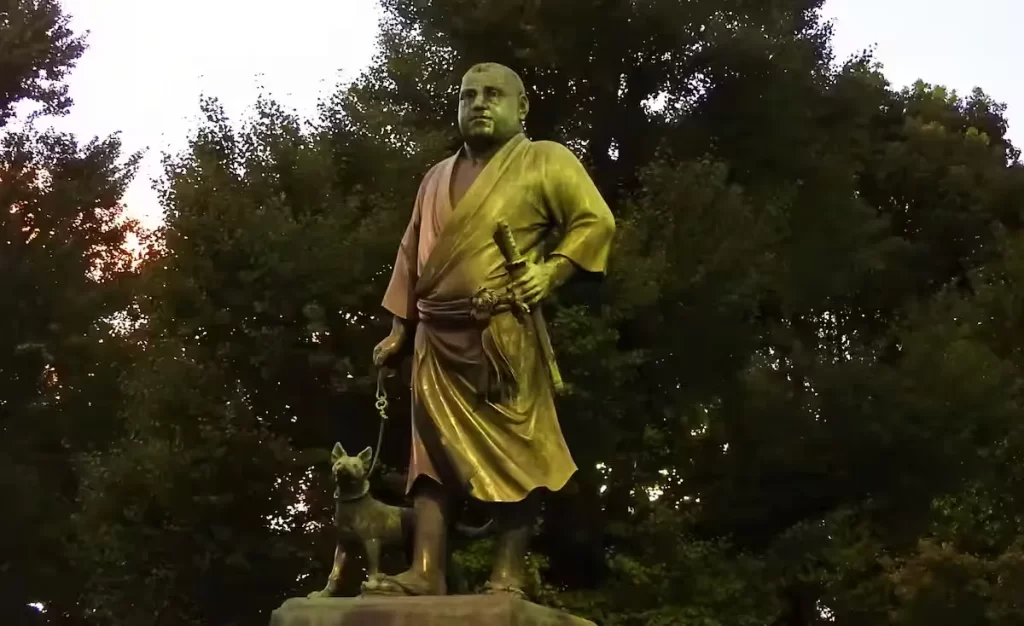 Statue of Saigo Takamori, a prominent figure of the Meiji Restoration. Ueno Park, Tokyo. (©Sankei/Atsuo Seki)
Learning from the West
Much of Asia became colonies of Europe or the United States. Yet Japan did not.
One reason was the legacy of the 260 years of the Tokugawa era. Within the framework of national isolation, Japan maintained a self-sufficient society while continuing to enjoy stable prosperity. It also cultivated a unique culture of its own. Although it was still largely an agricultural nation, many ordinary people lived content and fulfilling lives.
Japan had not undergone an industrial revolution, but it possessed advantages that differed from those of many other Asian countries, including a relatively high literacy rate. Then, after the Meiji Restoration, knowledge and information from the West flowed rapidly into Japan, and many Japanese became determined to catch up with, and eventually surpass, the Western powers, no matter the cost.
The national goal Japan adopted was fukoku kyohei—”enrich the country and strengthen the armed forces.” To achieve this, the government pursued several strategies. One of them was the hiring of oyatoi gaikokujin—foreign advisors or specialists.
In fields such as medicine, law, civil engineering, technology, and education, where Japan lagged behind the West, the country worked with extraordinary determination to modernize and learn as quickly as possible.
To attract these foreign specialists, what today we might call highly skilled professionals, Japan offered astonishingly high salaries. Although the country was still poor at the time, some foreign experts reportedly earned two or even three times more than the prime minister.
Studying Abroad in Europe
At the same time, Japan actively sent its talented young people overseas to study. Though the country was still poor, it dispatched many students, mainly to Europe. Japan’s first prime minister, Ito Hirobumi, was one such example. So was Shibusawa Eiichi, whose portrait now appears on the 10,000-yen note. Natsume Soseki and Mori Ogai also studied in Europe.
Let me share a story about one young man who was sent to study abroad.
Furuichi Koi was living in a boarding house in Paris while studying civil engineering. One day, he caught a cold, and the landlady told him, “Why don’t you at least take today off and rest?”
Furuichi replied, “If I take one day off, Japan will fall one day behind.”
After returning to Japan, Furuichi went on to make enormous contributions to the development of the country’s infrastructure, including its roads, bridges, rivers, and ports.
I wonder what the landlady thought when she heard the words of this young Japanese student. Perhaps she felt that this country called Japan, far away on the eastern edge of the world, might someday become an astonishingly great nation.
New Words and Ideas
There is one more thing I would like to share about this period of Japan. It concerns the introduction of new words and concepts such as “love.”
Words such as democracy, freedom, philosophy, and fine arts did not exist in Japan during the Edo period. They appeared only after the Meiji Restoration. The concepts behind these words were not present in Japan at the time—they were introduced from the West and translated into Japanese.
There are many more, including words like the individual, evolution, physics, politics, rights, society, and science.
From the early Meiji period onward, people such as Fukuzawa Yukichi and Nishi Amane worked with great effort and ingenuity to translate these ideas into Japanese. The two-character compound words they created are still in everyday use today, and many were later adopted in China as well.
Our ancestors devoted themselves to this work with painstaking dedication. It is fair to say that the way we think and live today is built, in part, on their efforts.
Discrimination and Colonialism
Another important point I would like to share is that Japan played an early role in the global discussion of human rights.
Even today, it is clear that societies are not free from racial discrimination. In particular, discrimination by white people against people of color is closely tied to the history of the slave trade.
It is said that as many as 10 million enslaved Africans were transported to the Americas and Latin America, many of them to European colonies in those regions. It is also said that hundreds of thousands were taken to the United States.
In 1918, World War I came to an end. Japan had taken part in the war on the side of the Allied Powers and emerged as one of the victors. The Paris Peace Conference was subsequently held to establish the League of Nations.
The Rejected Racial Equality Clause
As a member of the victorious powers, Japan participated in the conference and proposed that a racial equality clause be included in the Covenant of the League of Nations. This was one of the first political proposals of its kind on the international stage. At the time, much of Asia and Africa was still under colonial rule, and the idea of racial equality was far from widely accepted.
Many countries supported Japan’s proposal, and it would have passed by a majority vote. However, the United States, which still held colonies and where racial discrimination remained a reality, strongly opposed it.
In particular, US President Woodrow Wilson, who chaired the conference, ruled that such an important issue should require unanimous agreement rather than a simple majority. As a result, opposition from the United States and Britain led to the rejection of Japan’s proposal.
Japan’s initiative was driven in part by anger over the racial discrimination and prejudice it faced in Western countries, as well as by a desire to improve its standing in the international community.
The country sought to take a leadership role as a representative of non-white nations, particularly those in Asia and Africa, but the proposal was ultimately rejected.
Even so, we should remember that more than 100 years ago, our ancestors stood proudly at an international conference and presented such a proposal to the world.
The Maria Luz Incident
There is another event I would like you to know about in the context of Japan and human rights: the 1872 Maria Luz Incident, which took place in Yokohama shortly after Japan had opened its ports to the world.
The Maria Luz was a Peruvian ship, and the incident is considered an important early case involving human rights. It is a historical event that many Japanese people are not familiar with. It took place about 50 years before the Paris Peace Conference, in the early years of the Meiji era.
When the ship arrived at Yokohama Port, it was carrying indentured Chinese laborers known as “coolies.” They were subjected to conditions close to forced labor and, in effect, resembling slavery. During the voyage, some of the workers escaped from the ship and sought protection in Japan.
The Peruvian side demanded their return. However, the Japanese authorities viewed the situation as involving human trafficking and treated it as a violation of human dignity, leading to a legal dispute between the two countries.
International Recognition
A Japanese court ruled in Japan’s favor, but Peru challenged the decision and brought the case to international arbitration. In the end, the ruling upheld Japan’s position. At the time, Japan’s foreign minister (in modern terms) was Soejima Taneomi.
He argued the case on humanitarian grounds, as well as on the basis of Japan’s sovereign legal authority as an independent nation. Japan ultimately won at the international arbitration tribunal. This outcome contributed to Japan’s recognition in the international community as a civilized nation, even in the early stages of its modernization after the Meiji Restoration.
Even many Japanese of my generation are not familiar with this event. I feel a strong sense of respect for the predecessors who helped shape a dignified history.
Hopes Comes From the Past
I often think of the idea that “hope comes from the past,” which is why it is so important to learn from our history. So far, we have traced our way back to the Heian period and then up to the Meiji era.
Now, let us turn to more recent events.
In 2025, two Japanese researchers received Nobel Prizes. Notably, Japan has produced far more Nobel laureates than China, despite the latter’s much larger population of 1.4 billion.
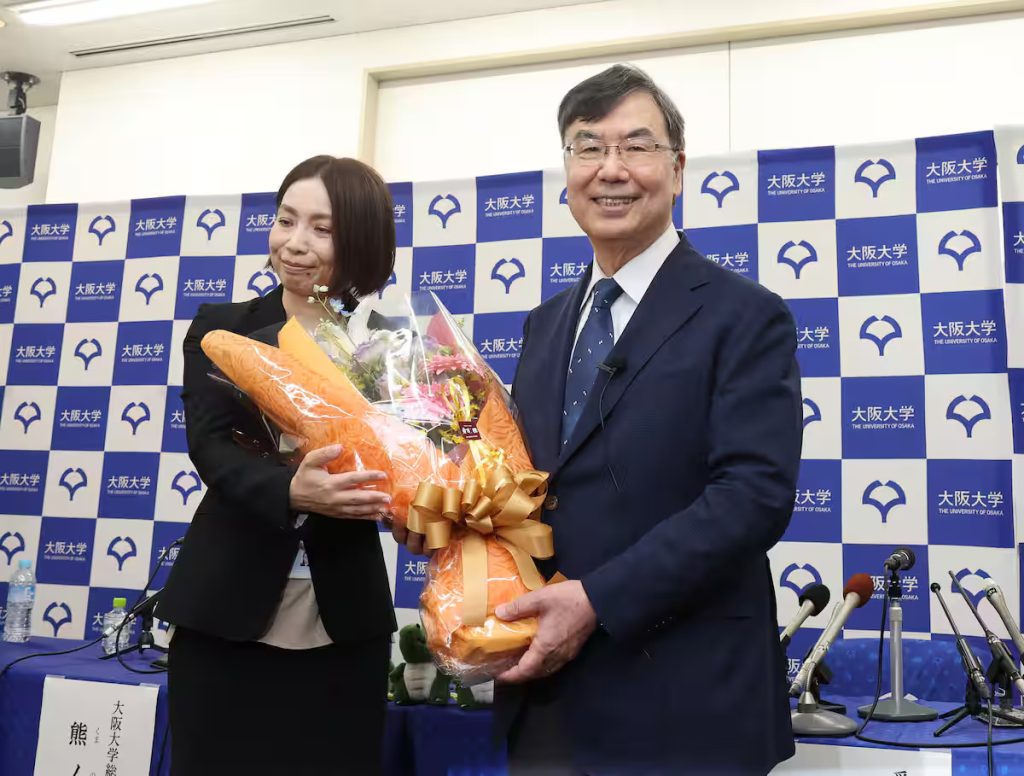 Professor Shimon Sakaguchi (right) receives a bouquet after the announcement of his Nobel Prize in Physiology or Medicine at Osaka University in Suita, Osaka Prefecture, on the afternoon of October 6, 2025. (©Sankei/Kotaro Hikono)
The first Nobel Prize awarded to a Japanese recipient was in 1949, only four years after the country’s defeat in the war. The recipient was Dr. Hideki Yukawa.
At that time, Japan was under Allied occupation led by the United States and other powers, and national confidence was extremely low. In the field of academic research, however, this achievement brought great excitement to the Japanese people.
There was a strong sense of hope that Japan could once again contribute to global science. Many years have passed since then, but I believe the achievements of last year’s two laureates will also contribute to humanity and the future of the world.
Japan’s Current Challenges
So then, what are the challenges Japan faces now?
You may have heard that Japan has a low food self-sufficiency rate, relies heavily on imports for energy—especially oil—and that its national debt is very large, making fiscal conditions difficult. Its national security is also heavily dependent on the United States.
But what concerns me most is the issue of an aging and declining population.
Japan’s population is about 123 million, but the pace of decline is accelerating. In 2024, around 680,000 people were born, while about 1.6 million people died—meaning the population fell by roughly 920,000 people in a single year.
A Shrinking Nation
At this rate, Japan could eventually lose around one million people per year. To put that into perspective, Kure has a population of about 200,000—so it would be as if five Kure-sized cities disappeared every year.
By 2025, when you are in your 30s to early 40s, you will be at the center of society, responsible for carrying Japan forward. By then, Japan’s population is projected to fall from 123 million to around 100 million, a decrease of roughly 20 million people.
Fifty years from now, in 2100, demographic projections suggest Japan’s population could fall to around 64 million.
These projections are often quite accurate. That means Japan in 2100 could have nearly half its current population. In the Edo period, the population was around 30 million, and people lived in a largely self-sufficient society with its own balance and rhythms. So if a smaller population can still support rich and meaningful lives, that may not necessarily be a negative outcome.
That is one way of looking at it. However, on the other hand, the future of the world—and of the Earth itself, including environmental pressures—will be increasingly difficult. Simply assuming that things will somehow work out and passively allowing Japan to gradually decline is not something I personally want to see.
Thinking About the Future
How we think about the future of the country, what goals we set, and what citizens hope for—these are questions that must be discussed across generations. And soon, it will be your turn to take a significant part in that responsibility.
So what direction should Japan aim for? I believe this is something we need to think about very carefully.
Japan already leads the world in advanced technologies such as quantum computing, nuclear fusion, regenerative medicine—including iPS cells developed by Professor Shinya Yamanaka—and robotics.
In my home prefecture of Hokkaido, a company called Rapidus is working on cutting-edge semiconductor development with strong government support. If these kinds of challenges succeed, the landscape could change dramatically. The way the world sees Japan would change as well.
Solutions That Could Benefit the World
I recall the words of Lieutenant Usubuchi aboard the battleship Yamato: “With our deaths, may Japan awaken.” Japan solving its own problems is something that would ultimately benefit not only the country itself, but the wider world.
Even amid population decline, there are many people who genuinely wish to have children but are unable to do so. We need systems that make it possible for those wishes to be fulfilled, as well as structures that allow women to participate and succeed more fully in the workplace.
When highly skilled professionals—people with advanced technical knowledge, expertise, or cultural skills—wish to work and live in Japan, if the conditions are properly in place, many such people will come. From cutting-edge engineers to wine specialists, they could help make Japan stronger and more prosperous.
Before long, English might even become a second official language. Japan could become a country where people who love Japan and respect its traditions find it easy to live. Japanese young people might naturally become bilingual.
Envisioning 2050
In energy, the development and practical use of methane hydrate resources beneath Japan’s waters could also succeed, potentially reducing dependence on imported oil (see Clyde Prestowitz’s Japan Restored: How Japan Can Reinvent Itself and Why This Is Important for America and the World).
It may sound like a dream, but if even one of these challenges is achieved by the time you are in your 30s or 40s, it would be truly transformative. Japan’s population might even begin to increase again, rather than continue to decline.
Japan’s security would no longer be left entirely to the United States. Instead, Japan itself would take a more central role, working in cooperation with other Asian countries. Members of the Self-Defense Forces would be able to take pride in their service and would be respected by the public.
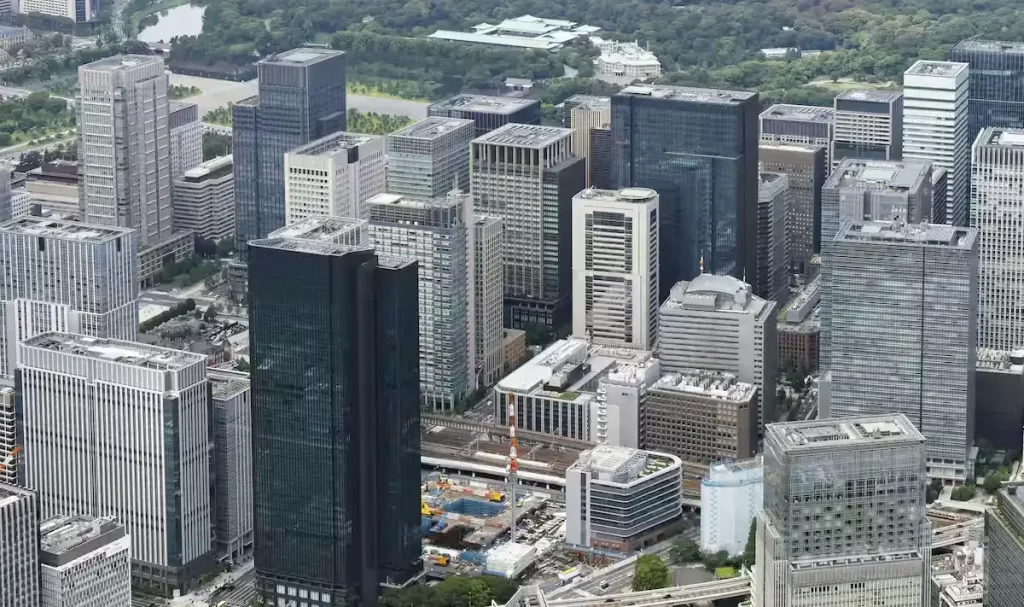 High-rise buildings in central Tokyo, August 2025. (File photo/Sankei)
A More Dynamic Japan
If we seriously commit to these efforts, there are many things that may be possible.
What kind of country should Japan aim to become? My hope is that you will keep this question in mind and discuss it from time to time.
If Japan becomes a more prosperous and dynamic country, its influence in the world will naturally grow, and it will be able to contribute in many different ways.
Today’s world is becoming increasingly chaotic, divided, and uncertain. If Japan can help bring a sense of calm and stability to the world, nothing would make me happier. If that were possible, Japan would be even more respected internationally. As in the animated film In This Corner of the World, in the words of Suzu’s mother: “I just wish everyone could live smiling.”
The years leading up to 2050 will pass in the blink of an eye. I hope you will respect those who came before you—your predecessors and ancestors, from ancient times to the present—and think carefully about the future.
A Society of Respect and Integrity
We should remember that “hope comes from the past” and hold on to words such as courage, justice, and pride. At the same time, those who mock others’ mistakes and take pleasure in exposing them in the media or on social media are, in a sense, lacking in character. Let us avoid such behavior.
Japan is a country where Eastern and Western influences, as well as ancient and modern traditions, continue to coexist.
I hope that many people who can find happiness for themselves while also contributing to society and the nation will emerge—from this city of Kure, from Shimizugaoka High School, and from Aoyama Junior and Senior High School.
Thank you for listening so patiently. Please share even a little of what you heard today with your parents and talk about it together.
Let us build a country where more people can sincerely say, “I’m glad I was born in this country.”
Please live with hope and positivity.
Thank you very much.
RELATED:
Speaker: Hideaki Ota
Continue Reading