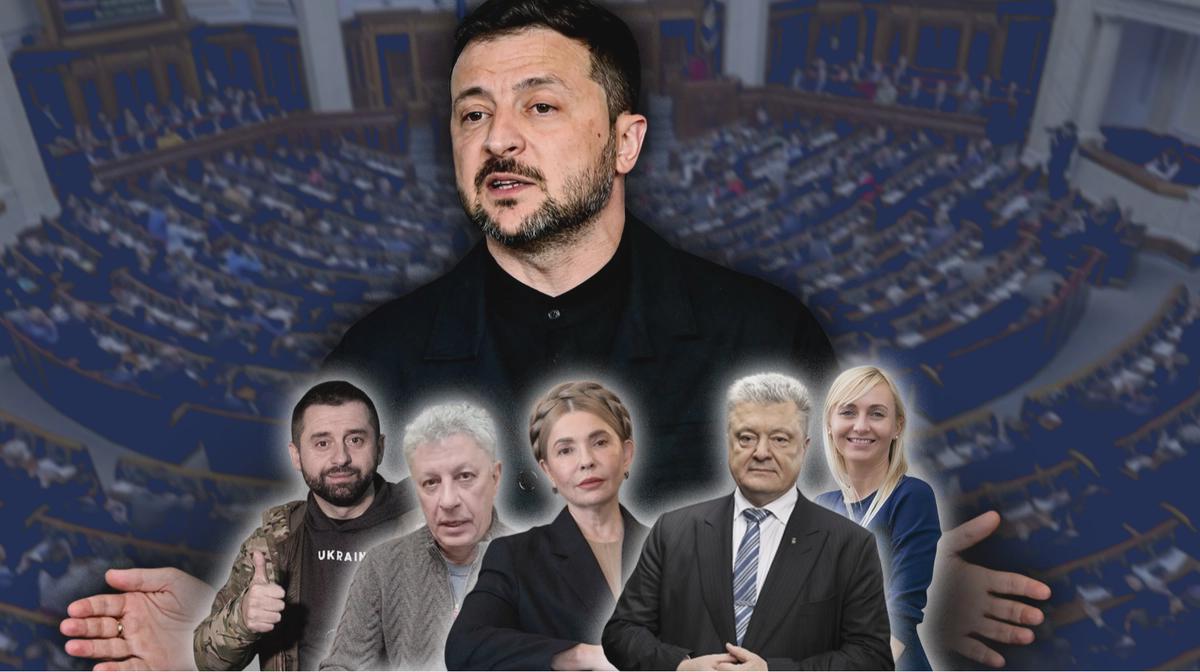
6 Months until peace. How Volodymyr Zelenskyy is trying to reconcile with the “Servants,” Petro Poroshenko, and the rest of Parliament
https://www.pravda.com.ua/articles/2026/05/27/8036537/

6 Months until peace. How Volodymyr Zelenskyy is trying to reconcile with the “Servants,” Petro Poroshenko, and the rest of Parliament
https://www.pravda.com.ua/articles/2026/05/27/8036537/
3 Comments
**Translation:**
**1/2**
In countries with a monarchical system of government, the greatest tragedy is usually the moment when the ruling dynasty unexpectedly comes to an end.
In recent years, Ukraine has been difficult to call a parliamentary-presidential republic. And although it has not become a monarchy, it has already experienced its own “dynastic” crisis: in the form of “Mindichgate” and the suspicion against Andriy Yermak.
The entire previous model of power built by President Volodymyr Zelenskyy was based on the effective disregard of the constitutional principle of separation of powers and their concentration within a single Office and a team of the infamous “five or six managers.”
After most of them received corruption charges, and the head of this “project office,” Andriy Yermak, moved — albeit temporarily — from his office on Bankova Street to a cell in Lukyanivka prison, the previous model officially collapsed.
Overall, this could have remained a small personal political tragedy for Zelenskyy. But under conditions where he is the leader of a state that has been waging a full-scale war against a nuclear superpower for a fifth year already, the president’s problems are not merely his own problems.
One way or another, they affect both the speed of decision-making inside the country and the boldness of geopolitical projects beyond its borders.
Therefore, after a series of corruption scandals involving his closest circle, President Zelenskyy has been forced to rebuild his political agency. First, to stabilize the internal situation, and second, to preserve the ability to fully defend Ukrainian interests on the international stage.
That is why for the second week already, the president has been trying to bring back into Ukrainian politics what is commonly called the “spirit of 2022,” when all state figures — regardless of party affiliation or ideological views — played for one team called “Ukraine.”
How Zelenskyy’s meetings with lawmakers are taking place, why he needs talks with Yulia Tymoshenko, Petro Poroshenko, and other recent “enemies,” and why people around Zelenskyy quietly speak of “six months until peace,” was examined by Ukrainska Pravda.
**What the battlefield maps are saying**
The logic of the latest political actions of President Volodymyr Zelenskyy’s team will be hard to understand unless it is overlaid with the trends that have emerged on the fronts of the full-scale war.
Maksym Fedorov has been in office as Minister of Defense for only four months. But the changes that have taken place in areas such as procurement logic, automation of selecting the best drones, organization of short-range air defense, and so on are so striking that they often raise a rhetorical question: “Wait, so it was possible?”
And immediately another one: if it was possible, why wasn’t it done earlier?
Ultimately, these changes are already visible on the battlefield. According to the Ministry of Defense of Ukraine, for the fourth consecutive month Ukraine has been retaking more territory than Russia is capturing. At the same time, the amount of territory seized by Russia remains roughly stable, while the Ukrainian pace of liberation is increasing from month to month.
In addition, the effects of a new tactic of using UAV units are gradually becoming apparent — both in repelling Russian attacks and in organizing counteroffensive actions by the Defense Forces.
In defense, for several months in a row, Ukraine has been killing more Russian soldiers than Russia mobilizes.
In an interview with Ukrainska Pravda, the commander of the Unmanned Systems Forces, Robert “Madyar” Brovdi, described this in detail. The key point was that Ukraine has reached a stable level of 30,000+ irreversible Russian losses and plans to double or triple this figure. At the same time, Russia’s capacity without a large-scale mobilization is also around 30,000 people per month.
Moreover, according to interlocutors of Ukrainska Pravda in the Ministry of Defense and the Unmanned Systems Forces, the situation at the front is such that increasing the number of Russians in assaults will not change the battlefield outcome, but will only allow Ukrainian defenders to reach the planned threshold of 50,000 killed Russian soldiers per month, which was announced by the defense minister when taking office.
Meanwhile, the tactics and results of UAV use in Ukrainian offensive actions have changed. So-called drone-assault units, tested last year during the battles for Kupiansk, are now actively used in Kharkiv, Zaporizhzhia, and other sectors of the front, producing very significant results.
Recently, the German Defense Minister personally visited one of the southern regions to observe a drone assault in real time.
The footage observed by Boris Pistorius consisted of a feed from hundreds of drones carrying out a mass strike on Russian positions. They completely destroy everything alive within a specific frontline sector. Only after that does infantry advance — finishing off or capturing remaining enemy soldiers and taking positions.
This tactic does not yet enable large-scale offensives, but it completely reshapes the logic of what is happening on the front.
Another extremely important trend in the war is Ukraine’s systematic attempts to fully control Russian logistics in Crimea and along the so-called land corridor from Russia to Crimea.
Its “opening” was one of Vladimir Putin’s greatest achievements in the war. Now, “Azov” and other units regularly publish videos showing systematic destruction of Russian military equipment near Mariupol, Donetsk, and along the highway connecting Russia to Crimea.
Combined with the systematic destruction of Russian air defenses in the south, Crimea, and occupied Donetsk region, the situation for Russia looks increasingly difficult.
Ukraine is now trying to establish full control over the Azov Sea and the Black Sea coastline. If successful, it would essentially mean that there would be no targets left for Madyar’s units on the frontline — no forces would be able to reach the battlefield at all.
This military section is meant to make one thing clear: the overall framework of previous negotiations between Ukraine and Russia, mediated by the United States, is currently not very relevant.
When the American side said that Ukraine was inevitably losing to Russia, and Moscow promised to capture the entire Donbas by the end of summer, the idea of Ukraine withdrawing from the controlled part of Donetsk still had some logic.
However, Russian “promises” to seize the entire Donbas have run into a simple fact: spring is almost over, and the “major Russian spring offensive” has not even begun.
In such a situation, it is not very serious to say that Ukraine “has no cards.” Ukraine is not only not losing, but appears to be seizing the technological initiative.
This leads to the main political question: in order for the military to finish its task, they need weapons and funding for the war.
For half a year now, Ukraine has been fighting almost entirely on its own resources. Therefore, securing Western assistance is absolutely critical.
**The Great Non-Aggression Pact**
In fact, the inability to secure external funding without internal political consensus is one of the key reasons why President Volodymyr Zelenskyy has intensified efforts toward cooperation with the Verkhovna Rada.
On May 18, the president held a meeting with top representatives of the ruling team. The gathering at Bankova included Speaker of Parliament Ruslan Stefanchuk, First Deputy Speaker Oleksandr Korniyenko, Servant of the People faction leader Davyd Arakhamia, Prime Minister Yuliia Svyrydenko, and Head of the Presidential Office Kyrylo Budanov, among others.
There were many issues on the agenda, but the key discussion centered on the need to rally forces and pass IMF-related laws, Ukraine Facility legislation, and all other measures tied to the budgetary — rather than defense — component of a large €90 billion European credit package.
“After the Yermak scandal, the president is somewhat shaken. It cannot be said that he radiates confidence and optimism. But he is at least looking for ways to stabilize the situation. At least until autumn, to show results on the front and achieve Russian readiness for real negotiations,” says an interlocutor from the Rada speaking to Ukrainska Pravda.
Another source within Zelenskyy’s team claims that during the same meeting the president argued that intelligence assessments converge on the idea that if Ukraine manages to seize the initiative, within roughly six months Russia will begin running out of available resources and will be forced into substantive negotiations.
But the country has to survive until autumn first.
A bit too long read for me right now. 😅 Possible to get a TLDR?
Thanks for the very interesting read.