
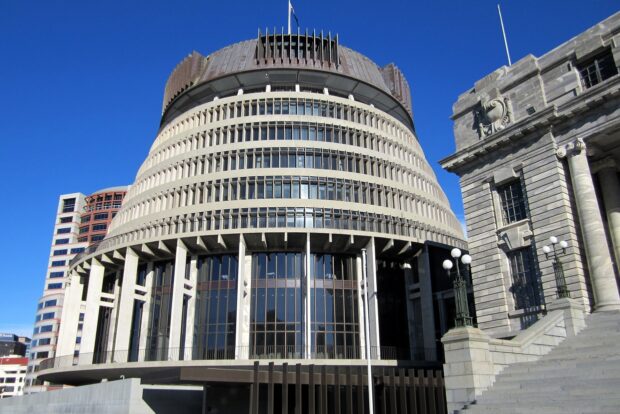
The Beehive Executive Wing of New Zealand Parliament. Nick-D/Wikipedia reproduced under Creative Commons
The New Zealand government has said that it plans to cut around 8,700 public service jobs over the next three years to capture NZ$2.4bn (US$1.4bn) in savings.
The decision is expected to reduce the public service headcount by 14% by mid-2029.
The plan was announced in a pre-Budget speech by Nicola Willis, the country’s finance minister, on 19 May.
Willis said the number of public servants had historically been equivalent “to about 1% of the population” and had increased under the previous government to around 1.2%.
“We will be tracking progress towards a numerical target of no more than 55,000 full-time equivalent public service employees by July 2029,” Willis said.
Paul Goldsmith, public service minister, stressed that the cuts would not affect teachers, doctors, nurses, police or defence personnel, and that the plan would be monitored “regularly”, with agencies made to “demonstrate improvements in productivity, delivery and value for money”.
Read more: New Zealand PM outlines hard realities of a world ‘ordered by power’ in pre-Budget speech
Putting a ‘sinking lid’ on agencies’ operating budgets
Willis said that the country’s current public service operating model was “failing to meet the expectations Kiwis have in 2026, let alone what they’ll expect in 2036 and beyond” and that the government planned to put a “sinking lid on agencies’ operating budgets” to deliver savings that would be invested in public services.
This year’s Budget – which will be officially delivered on 28 May – will reduce most agencies’ operating budgets by 2% in the coming year, with an additional 5% cut in each of the following two years.
Willis said the savings would be spent on government priorities including health, education, building resilient infrastructure and strengthening the defence force and police.
She said that citizens and businesses expected public services to be “responsive, effective and easy to use”, but that too often they have to navigate “fragmented systems, duplication and outdated processes”.
Read more: Public service commissioner sets out ‘significant risks’ to New Zealand government
Plan to merge agencies on a ‘case-by-case’ basis – and opposition’s response to reforms
Government reforms will also include the reorganisation and merging of certain departments.
The ministries for the environment, housing and urban development, transport, and the local government functions of internal affairs are to be amalgamated to form a new department called the Ministry of Cities, Environment, Regions and Transport, or MCERT for short.
The merger will be overseen by the country’s infrastructure minister, Chris Bishop, who said that the reorganisation would not deliver “immediate savings in the next six months or even the next year” but would set the public service up to be “a better partner for local government”.
He admitted that central government had been a “useless partner” to local governments by failing to help them meet challenges related to housing, climate adaptation, infrastructure funding and financing.
“We’ve been hopeless at it, and part of the reason we haven’t been very good at it is that we haven’t organised ourselves properly,” Bishop said, describing this as the main driver behind the creation of MCERT.
The new ministry has a ‘stand-up’ date of 1 July this year.
Christopher Luxon, New Zealand’s prime minister, told the press that future reorganisation and merging of agencies would be approached on a case-by-case basis.
Chris Hipkins, leader of the Labour party, has voiced his concerns about the government’s job cuts and department merging plans.
According to RNZ, he said more than half of the jobs slated to be cut would affect frontline workers outside the Wellington region, including “social workers working with vulnerable kids and families, people working in our prisons, people working at our border [and] people working in the conservation estate”.
On the reorganisation of departments, he told the Morning Report that “bigger government departments aren’t always more efficient than smaller departments. Some of the bigger agencies are the most bureaucratic”.
Read more: New Zealand updates code of conduct to ‘strengthen integrity’ in the public service
A focus on AI
In the run-up to the Budget, Luxon said that there is a “real opportunity to leverage technology” to be more efficient with taxpayer dollars, highlighting “endlessly duplicated IT services, accounts payable services [and] lots of back office functions”.
He said Singapore – which he recently visited – is one example of a country that has been better at applying AI and technology in government, and that Malaysia and other countries in Southeast Asia had been similarly successful in this area.
Willis also referred to a desire to increase the government’s use of AI and other digital tools.
“Businesses and households are using AI every day and, while parts of the public sector have seized the opportunity to innovate, others are still locked into outdated ways of doing things that prioritise box-ticking over outcomes,” she told a Business North Harbour audience.
“Our government is as frustrated as you are by the fragmentation and silos, the complexity, the status-quo thinking and the dangerously slow take up of digital and AI technologies.
“In too many parts, the back-office of government still looks like an 80s relic, run on old-fashioned systems, with slow bureaucratic processes that are too often about box-ticking rather than improving outcomes.”
Read more: New Zealand government forges path to responsible AI with new framework
Budget package
Global Government Forum reported on a pre-Budget speech from Luxon in which he said that the New Zealand government needs to prioritise national security and resilience and a commitment to multilateralism in a world that is “changing quickly and becoming less predictable”.
He has already announced that the net operating package in the Budget will be NZ$2.1bn (US$1.2bn) “or around NZ$300m (US$174m) smaller than the NZ$2.4bn (US$1.3bn) allowance set in December”.
This year’s capital package will be larger than originally planned, at a net NZ$5.7bn (US$3.3bn) and is expected to be invested in building modern and resilient infrastructure, developing a defence force that is “fighting-fit, capable of keeping Kiwis safe and safeguarding our region from malign interference”, and on schools, hospitals and “responsive public services”, Luxon said.
Read more: New Zealand eyes billions in savings through centralised digital procurement