
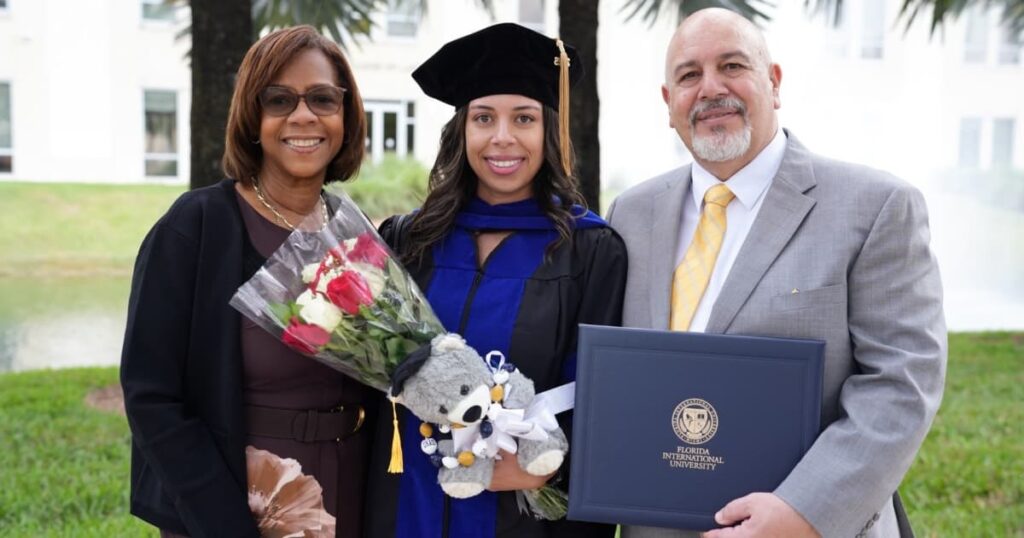
Armed with a doctorate in materials science engineering from FIU, Mellissa Komninakis is focusing her career on confronting a problem that predates her by decades.
Radioactive waste and contamination, like that created during the Manhattan Project’s launch of the world’s first nuclear weapons program in 1942, is scattered across dozens of production and research facilities across the U.S. and requires complex and safe remediation.
“As these facilities age and are dismantled or prepared for future use, there is a risk that radioactive contamination can be accidentally released,” Komninakis says.
“Continued research in this field makes the clean-up efforts safer and more efficient, with lasting impacts. We are working to ensure that workers, surrounding communities and the environment are protected.”
Komninakis is making a mark in nuclear waste remediation, an area of growing recognition for FIU. As a junior engineer at FIU’s Applied Research Center (ARC) at the College of Engineering & Computing, she is studying coatings and foams that can be applied to equipment before clean-up begins. Her work on a project funded by the Department of Energy’s (DOE) Office of Environmental Management helps reduce the release of tiny, but dangerous, radioactive particles.
Her path to nuclear remediation wasn’t a straight line. Before joining FIU’s ARC in 2018, Komninakis built her laboratory foundation as a senior technician operating accelerator mass spectrometers in a radiocarbon dating lab — work that sharpened the experimental rigor she would carry into nuclear cleanup.
Once at ARC, she knew she’d found her field.
“The projects evolved constantly, and the problems demanded creative solutions,” she said. “I realized this was the right fit for me. Being able to contribute to projects that address real environmental and engineering challenges made the work meaningful and purposeful.”
Studying nuclear remediation at the highest level
Stepping into the nuclear remediation lab reignited her passion for formal study, and she went on to earn her doctorate at FIU in 2025.
Today, she is the first author of a study testing how well fixative coatings — protective surface treatments — perform when subjected to fire, mechanical stress or seismic activity.
“Quantifying the effectiveness of fixative coatings in reducing airborne release fractions under impact stress” was published in Nuclear Engineering and Technology, a leading peer-reviewed international journal.
The research is the first to provide empirical data on Airborne Release Fractions (ARFs), quantifying how much radioactive material can become airborne during cleanup operations.
“No one has really tested these materials to any certain degree until this kind of work at FIU,” Komninakis explains.