
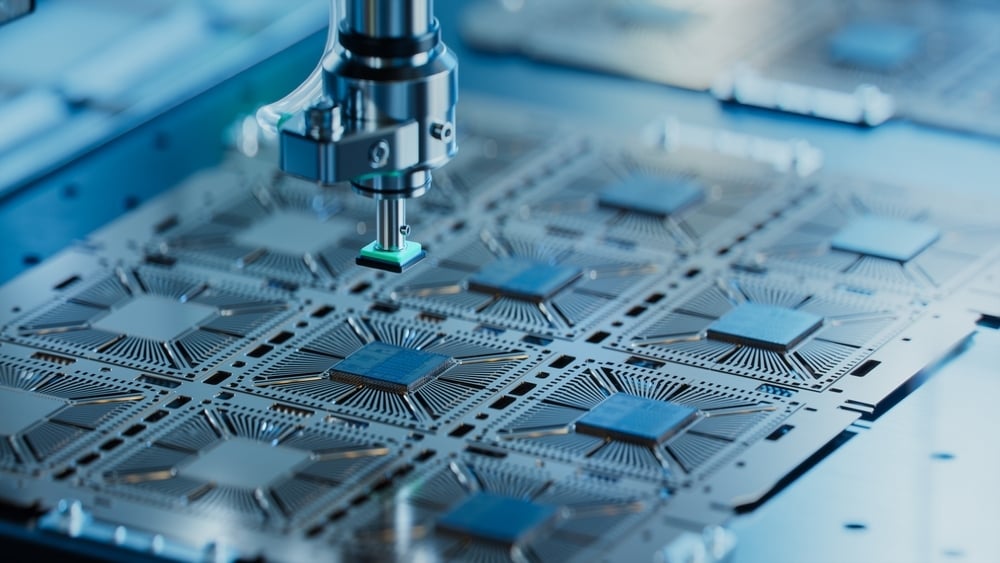
Artificial intelligence has turned the memory-chip market into one of the most explosive trades on Wall Street.
Two memory chipmakers crossed the $1-trillion valuation line this week.
Micron Technology Inc. (NASDAQ:MU) got there first on Tuesday.
Nvidia Corp. (NASDAQ:NVDA)‘s largest memory supplier, the South Korean giant SK Hynix Inc., followed on Wednesday.
Both stocks have delivered extraordinary returns during the AI infrastructure boom.
Yet the rivalry between Micron and SK Hynix is becoming increasingly direct — and increasingly important for investors trying to identify the dominant memory winner of the AI era.
Why Micron vs. SK Hynix?
For years, memory chips were viewed as a highly cyclical commodity business. AI changed that.
The explosion in demand for Nvidia’s AI accelerators created an unprecedented shortage in high-bandwidth memory (HBM) chips — the ultra-fast memory stacked next to GPUs powering large language models and hyperscaler AI infrastructure.
Think of it as the chip’s short-term workbench.
An Nvidia accelerator can only run as fast as it can pull data off that workbench, so HBM, not raw processing power, is increasingly the part that decides how fast an AI server runs.
Every hyperscaler building large-language-model infrastructure now depends on securing enough advanced memory to pair with Nvidia GPUs.
That dynamic transformed memory from a traditionally cyclical commodity business into one of the highest-margin and fastest-growing segments in semiconductors.
Micron, SK Hynix and Samsung Electronics effectively form the “Big Three” of the global memory market.
But unlike Samsung — whose operations span smartphones, consumer electronics and foundries — Micron and SK hynix are much more concentrated pure-play memory bets.
That makes their rivalry far more direct.
The two companies compete head-to-head across DRAM, NAND flash, AI server memory, hyperscaler supply agreements and the next generation of HBM products including HBM3E and HBM4.
Micron vs. SK Hynix: Side-By-Side Stock Metrics Comparison
According to market data, both stocks are up more than 200% year to date and more than eightfold over the past year.
The deeper the lookback, the stronger SK Hynix’s lead appears. Over the past five years, SK Hynix returned 1,624%, versus 1,017% for Micron.
Revenue growth also favors the Korean chipmaker, with SK Hynix posting a 104% two-year revenue compound annual growth rate compared with Micron’s 78%.
But investors are no longer paying for the past. They are paying for the next stage of the AI memory cycle.
And that is where Micron starts to look increasingly dangerous.
Wall Street expects Micron’s earnings per share to surge 906% year-over-year in its next fiscal quarter, versus 549% for SK Hynix.
Revenue growth estimates also favor Micron, with analysts projecting 262% growth against 229% for SK Hynix.
Notably, neither stock looks particularly expensive despite the historic rally.
Micron trades at 9.6 times forward earnings, while SK Hynix trades at just 6.1 times.
Both also carry forward PEG ratios near zero — 0.07 for Micron and 0.08 for SK Hynix — suggesting the market is barely pricing in the growth expected over the coming quarters.
What SK Hynix Owns Today
The company controlled roughly 57% of HBM revenue during the third quarter of 2025, according to Counterpoint Research, while Micron held around 21%.
SK Hynix was also first to mass-produce HBM3E and secured the majority of Nvidia’s memory supply relationships.
That Nvidia relationship has become one of the most valuable strategic advantages in the semiconductor industry.
SK Hynix supplied approximately $5.2 billion worth of HBM to Nvidia during the first quarter of 2026 alone, while its entire 2026 HBM production is already sold out.
UBS estimates the company could supply roughly 70% of HBM4 memory for Nvidia’s next-generation Rubin platform.
What Micron Is Doing About It
Micron, however, is rapidly closing the gap.
The company recently reported quarterly revenue of $23.9 billion, up 196% year-over-year and well above Wall Street expectations. It also guided for next-quarter revenue near $33 billion.
Micron said it has already secured pricing and volume agreements for its entire 2026 HBM supply, including next-generation HBM4 products.
The Idaho-based chipmaker is also leaning heavily into its strategic advantage as the only U.S.-based member of the memory “Big Three.”
Earlier this month, Micron announced a $2 billion expansion of its Virginia fabrication plant alongside the start of advanced DRAM production on American soil.
Independent patent analysis suggests the technology gap between Micron and SK Hynix is narrowing, particularly in HBM4 and future generations of AI memory.
SK Hynix still holds the stronger strategic position today — larger HBM share, deeper Nvidia ties and earlier production ramps.
But Wall Street increasingly sees Micron not as a laggard, but as the fastest-moving challenger in the AI memory race.
And as the industry moves toward HBM4 and even more memory-intensive AI systems, the next phase of the semiconductor boom may ultimately come down to one question:
Can Micron catch SK Hynix before the AI memory gold rush enters its next stage?
Photo: Shutterstock