
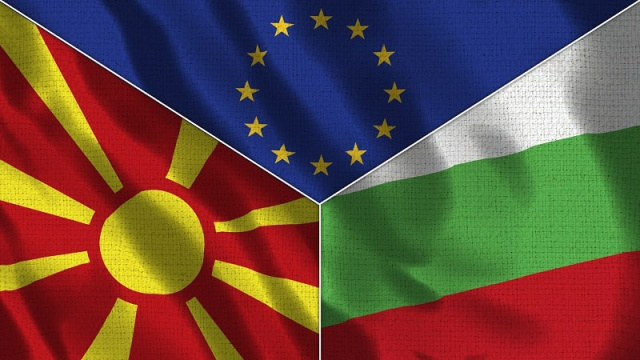
The leader of North Macedonia’s opposition SDSM party, Venko Filipce, has called for a referendum on whether the country should continue its path toward European Union membership, arguing that citizens must directly decide the issue rather than political leaders.
Speaking at a press conference, Filipce said the public should determine “whether they want to pay the price for the criminal policy of Hristijan Mickoski,” referring to the prime minister, whom he accuses of blocking the country’s EU accession process. He added that citizens must be given the chance to decide “whether they want to pay the price for policies that keep the country outside the EU.”
Filipce urged the government to hold a nationwide vote, saying “Call a referendum, ask the citizens. You cannot decide the fate of everyone who lives in the country.” His remarks came in response to statements from Prime Minister Hristijan Mickoski that Skopje would not make further concessions in order to advance EU negotiations and was prepared to bear the consequences of that stance.
He also accused the government of misleading the public and shifting responsibility for the stalled EU process. According to Filipce, “Two questions arise: what are these concessions and who will pay the price?” He claimed the burden would fall on ordinary citizens rather than political elites, adding that “this gang in power simply does not know how to govern the state.”
Filipce further argued that the government was deliberately fostering tensions and creating external and internal enemies to justify its position on EU integration. In his view, this approach shows that the authorities “do not want the country to join the EU, because there is responsibility there.”
At the same time, a separate initiative has been submitted to parliament by former diplomat Viktor Gaber, proposing a referendum that would determine whether constitutional changes needed for EU accession should proceed. Under his proposal, if voters approve, lawmakers would be required to implement the constitutional amendments linked to the EU path. If rejected, parliament would be expected to reconsider the country’s strategic orientation toward EU membership.
Prime Minister Mickoski, meanwhile, has reiterated that his government will not agree to constitutional changes under current conditions, even if that delays EU accession. He said his administration was prepared to “pay the price” for this decision, stressing that there would be no further concessions on issues related to national identity.
He argued that EU integration has been delayed for decades due to bilateral disputes, stating that North Macedonia’s accession process has been repeatedly shaped by political conditions rather than the EU’s formal membership criteria. Mickoski pointed to the country’s long-standing engagement with the EU, including candidate status and reform commitments, as evidence of its readiness to move forward.
Despite the stalemate, he said the government would focus on domestic reforms and implementation of EU-related agendas, including minority rights and economic programs tied to Brussels. He added that Skopje remains committed to eventual membership but will pursue what he described as a more independent approach if bilateral disputes continue to block progress.
The debate takes place against the backdrop of the EU negotiating framework for North Macedonia, which requires constitutional amendments to include Bulgarians among the country’s recognized communities before accession talks can formally begin. The framework also ties progress to the implementation of the 2017 Treaty of Friendship, Good Neighborliness and Cooperation with Bulgaria, along with associated protocols covering minority rights, historical issues, and efforts to combat hate speech.
These obligations were reaffirmed in earlier intergovernmental agreements, which also included commitments related to archival transparency, rehabilitation of victims of past regimes, and non-interference clauses concerning minority claims between the two countries.