
Elena Teslova
28 May 2026•Update: 28 May 2026
Russian border authorities on Thursday accused Estonia of seeking to move away from existing agreements with Moscow on the delimitation of Lake Chudskoye (Peipus) and the Narva River, warning that such actions could lead to border tension.
In an interview with Russian state newspaper Rossiyskaya Gazeta, Vladimir Kulishov, first deputy director and head of the Border Service of Russia’s Federal Security Service (FSB), said Estonia’s initiatives were undermining long-standing arrangements on the shared waterways.
“The Estonian authorities are trying to move away from compliance with agreements on the delimitation of the water spaces of Lake Chudskoye and the Narva River,” Kulishov said.
He stressed that their initiatives “create conditions for conflict situations at the state border and also negatively affect the practice of ensuring navigational safety on border water bodies.”
Specifically, Finland and Estonia have repeatedly changed border crossing procedures since 2022 “unilaterally and under far-fetched pretexts,” he said.
According to him, Finnish border guards additionally erected engineering barriers “in places not stipulated” by the 1960 Soviet-Finnish agreement regulating the border procedures and the handling of border incidents.
Kulishov linked the developments to NATO’s increased military presence on its eastern flank.
“The concentration of North Atlantic Alliance forces on the so-called eastern flank is accompanied by attempts by neighboring states to revise the established practice of implementing agreements on the state border regime, as well as by growing provocative actions on their part,” he said.
He added that Moscow was urging Helsinki and Tallinn to return to proper implementation of international agreements, but said there had so far been no constructive response from either side.
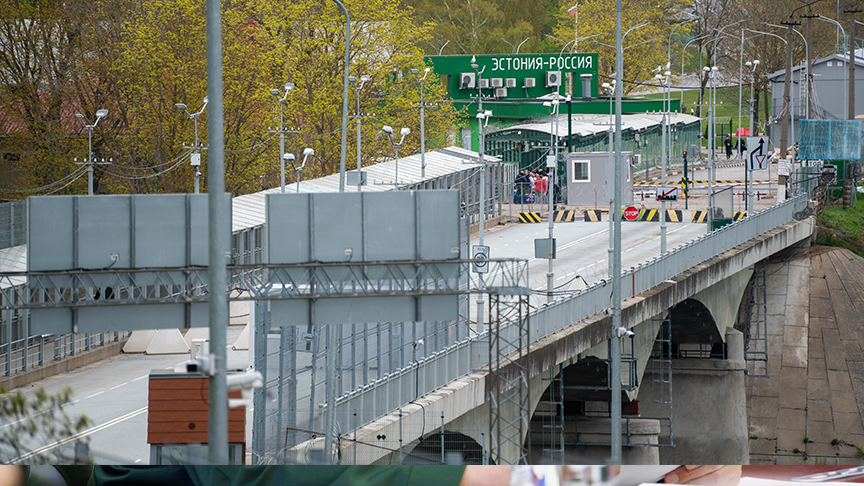
The Russia-Estonia border stretches for more than 300 kilometers and partially runs along the Narva River and Lake Chudskoye. The Narva Riveroriginates from the lake and flows into the Gulf of Finland, separating the Estonian city of Narva from the Russian town of Ivangorod in the Leningrad region.
Separately, Russian Deputy Foreign Minister Alexander Grushko warned that any attempts to blockade or seize the Russian exclave of Kaliningrad, cut off from Russia by the Baltic states, would lead to “the gravest consequences” for NATO, saying the alliance had “zero” chances of carrying out such a scenario.
“I assess their chances as zero,” Grushko told RT TV when asked about the possibility of NATO attempting to block or capture Kaliningrad.
He added, “I proceed from the assumption that NATO, especially military circles, understands that any attempt either to blockade Kaliningrad or, as you put it, seize it, would lead to the gravest consequences for those who entertain such plans.”
The deputy foreign minister also stated that Russia possesses “all the necessary resources” to respond to such scenarios.
Kaliningrad, Russia’s Baltic exclave between Poland and Lithuania, has become an increasingly sensitive issue in relations between Moscow and NATO amid heightened tensions over the conflict in Ukraine and the alliance’s expanded military activity on its eastern flank.