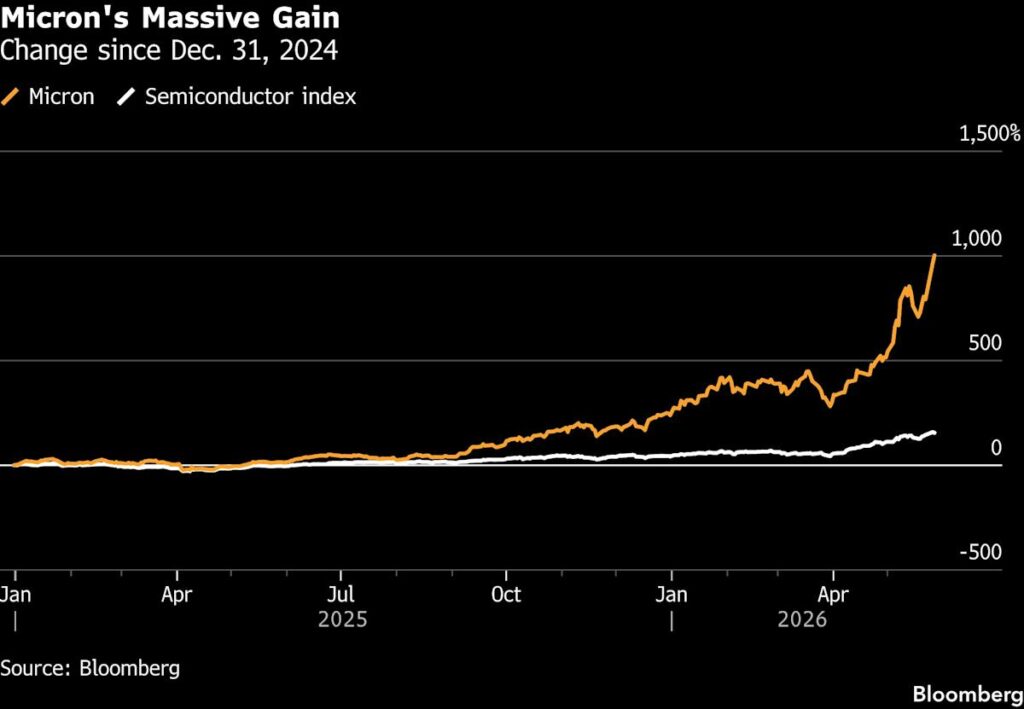
(Bloomberg) — Micron Technology Inc. is the third-best performer in the S&P 500 Index this year and at the same time one of the least expensive stocks in the market. While that dichotomy looks bullish on the surface, it may be more of a warning sign than a green light for investors.
Most Read from Bloomberg
The memory chipmaker trades at 10 times estimated earnings, by far the lowest multiple in the Philadelphia Stock Exchange Semiconductor Index, a title Micron has held for almost two years. It’s among the 50 cheapest stocks in the S&P 500, with a valuation that’s slightly higher than United Airlines Holdings Inc. Interestingly, the S&P 500’s leader this year, Sandisk Corp., which is up 570%, also makes memory chips and has a single-digit valuation as well.
Considering the seemingly insatiable demand for artificial intelligence components, you’d think these companies would be easy choices for stock pickers. But it’s not that simple. Those cheap valuations could be signaling that their earnings growth has peaked.
“It’s counter-intuitive, but I’d almost rather see a high multiple,” said John Porter, chief investment officer at AGF Investments, which owns Micron shares. “The low valuation is almost a contrarian signal, something to worry about, because it suggests the next step in the earnings story is things getting worse. Certainly it seems hard for them to get even better than what we’ve seen.”
In its most recent quarter, Micron’s revenue nearly tripled, its fastest pace of growth in data going back to 1990. That success is flowing through to the stock price, which has soared more than 1,000% since the end of 2024. It’s coming off its best year since 2013, its 80% leap in May has it on pace for its best month since November 1985, and its 19% jump on Tuesday was its best day since November 2011. Shares were down 0.7% on Thursday.
“Calling a top in stocks with this kind of momentum is the hardest thing to do,” Porter said.
The latest push has made Micron one of a handful of elite firms with market capitalizations over $1 trillion. The surge is helping to power the chipmaker index to a 79% gain this year, while the technology-heavy Nasdaq 100 Index has climbed 19%.
The thing is, memory stocks usually don’t behave like this. Historically they’ve been treated like commodities providers, with demand and growth rising and falling alongside PC and smartphone cycles. The shares typically look cheapest near the top of an earnings cycle when demand is about to turn lower, and they’re most expensive when earnings trough, with demand so low the companies can become unprofitable. It happened to Micron as recently as 2023.
This change has raised questions about the sustainability of the rally. The debate boils down to whether the hundreds of billions of dollars being poured into AI infrastructure has fundamentally transformed the industry’s cyclical nature. If this spending boom is bigger and more durable than past cycles — and companies like Microsoft Corp., Amazon.com Inc., Alphabet Inc. and Meta Platforms Inc. have shown no signs of slowing their massive capital expenditures — then Micron’s low multiple may be signaling a bargain rather than a pending bust.
“Because the nature of the AI capex cycle is unprecedented, we have no playbook for what comes next,” Porter said. “I think the broad cycle framework remains true, but the range of outcomes is so wide you could drive a city through it. We could see an epic bust, but there’s also a plausible scenario that any pullback is relatively short-lived and not that painful.”
So Wall Street is starting to consider different ways of valuing Micron and companies like it.
“We see no reason why MU should trade a whole lot differently than NVDA in terms of P/E,” UBS analyst Timothy Arcuri wrote in a note to clients earlier this week, referring to Nvidia Corp., the leader in AI chips, whose stock is valued at around 21 times forward earnings and has risen a relatively paltry 14% this year.
Arcuri has a Street-high price target of $1,625 on Micron, which indicates the stock will soar 75% over the next 12 months. His target is based on the shares trading at about 15 times forward earnings, three times his prior multiple. AI represents “the sort of lasting, structural change that should support a shift toward a broader semi multiple,” he wrote.
Of course, there are reasons for skepticism about Micron continuing to race ahead at this pace, at least in the short term. The stock’s 14-day relative strength index is at a level that technical traders consider overbought. And the average analyst price target of $697 suggests a 22% decline over the next 12 months, one of the weakest implied returns among chipmakers.
“Micron looks like it is going to see a climax move soon,” said Andrew Rocco, a stock strategist at Zacks Investment Research. “Typically climax moves show up in extreme technicals before they show up in weaker fundamentals.”
Tech Chart of the Day
Snowflake Inc. shares jumped as much as 36% after the software maker gave a stronger-than-expected annual outlook and signed a $6 billion multiyear agreement to use Amazon.com Inc.’s cloud services and chips.
Top Tech Stories
-
Salesforce Inc. gave a revenue outlook for the current period that fell just short of analysts’ estimates, unnerving investors already concerned about the possibility that artificial intelligence will disrupt the software business.
-
A unit of Dell Technologies Inc. won a $9.7 billion contract to help the US military handle its licenses for Microsoft Corp. software related to email, spreadsheets and other needs across classified and unclassified systems, the Pentagon said.
-
Meta Platforms Inc. is selling consumer subscriptions to its Meta AI chatbot for the first time, a key step toward building a business that would help offset hundreds of billions of dollars in artificial intelligence investments by the company.
-
A Google software engineer was charged with insider trading on Polymarket, where he allegedly made more than $1 million betting on one of last year’s most popular Internet searches.
-
HP Inc. gave a profit forecast for the current quarter that signaled the company continues to contend with a dramatic increase in memory chip prices.
Earnings Due Thursday
-
Earnings Premarket:
-
Earnings Postmarket:
–With assistance from Subrat Patnaik and David Watkins.
(Updates to market open.)
Most Read from Bloomberg Businessweek
©2026 Bloomberg L.P.