
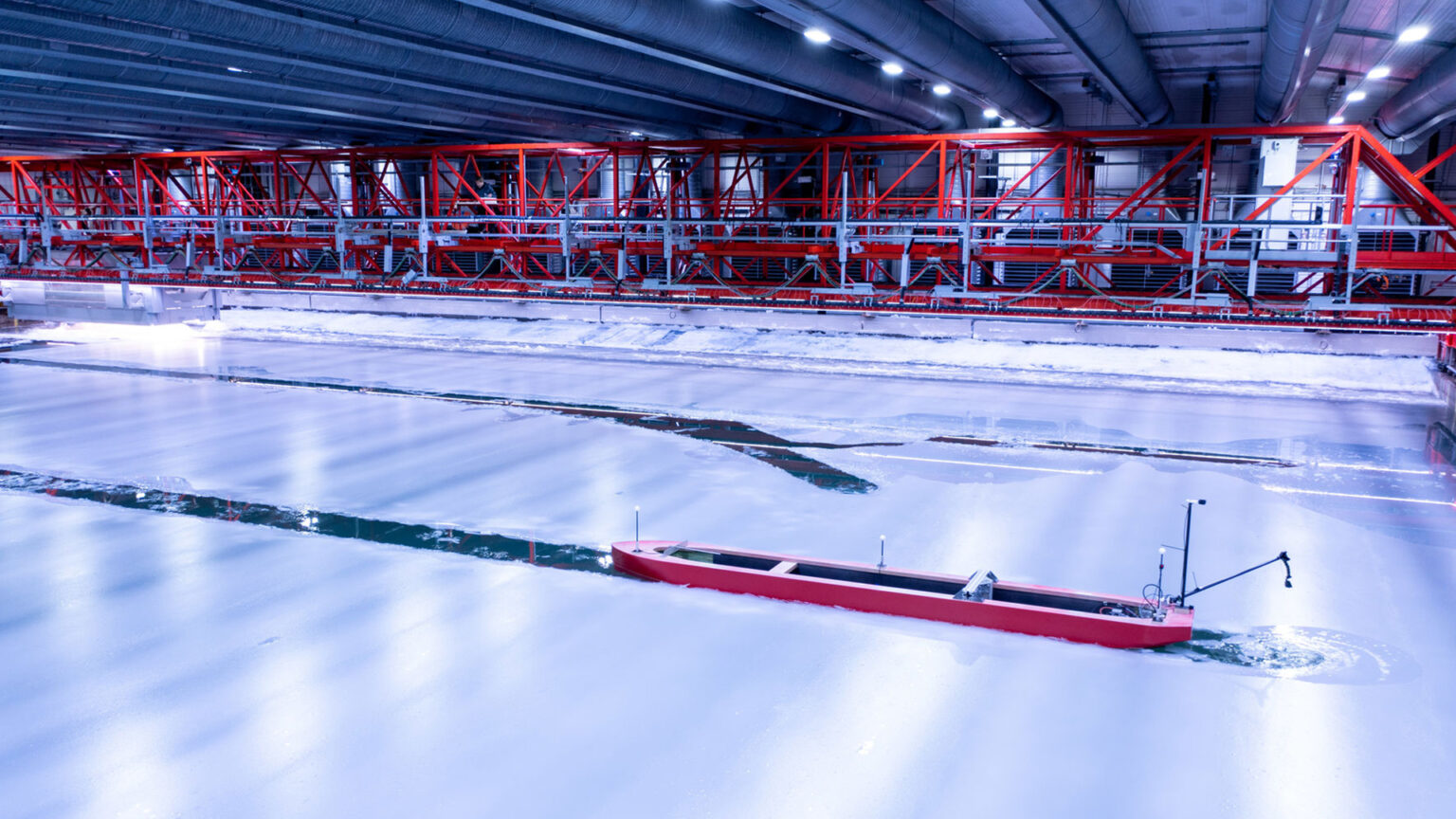
The Aalto Ice and Wave Tank in Espoo, Finland, measures 40 by 40 meters and is the world’s largest ice tank by surface area. As of last year, it’s also the only wide ice tank in the world capable of generating multidirectional wave fields alongside sea ice.
Interesting Engineering met Arttu Polojärvi, associate professor of ice mechanics at Aalto University, in March, at the tank itself. He’s spent 20 years here, and there are only five or six facilities like this operating anywhere in the world. “It allows us to do work that cannot really be done anywhere else,” Polojärvi tells me.
That work is becoming more urgent.
“Even if there’s less ice,” he adds, “there’s more activity.” More ships are entering waters they’re not equipped for. Offshore wind is pushing into ice-covered seas. The Baltic alone has tens of gigawatts of planned offshore wind capacity, and practically all of Finland’s trade arrives through ports that freeze every winter.
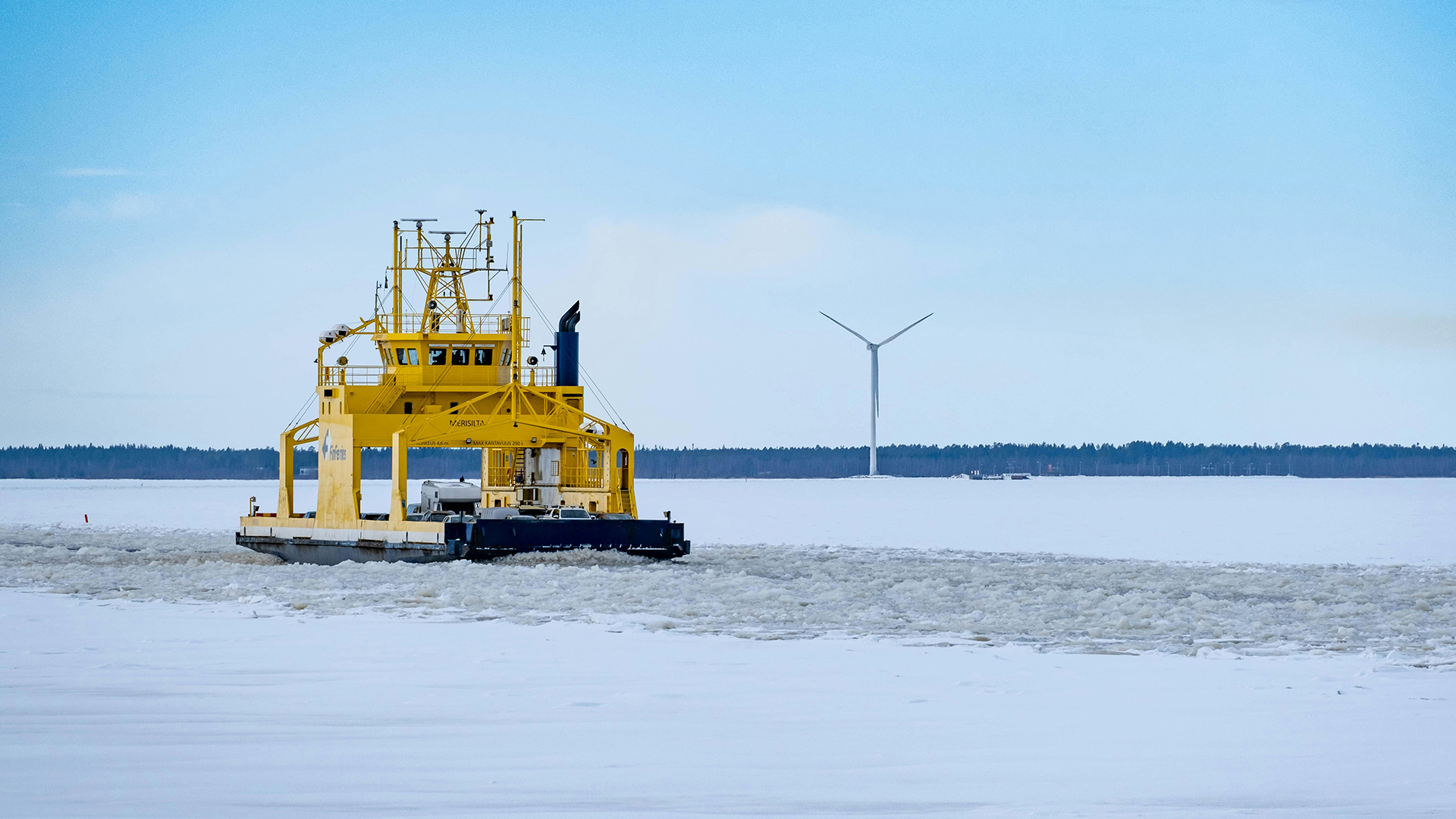 The ships being studied are primarily vessels optimized for open water that end up in ice. Credit: Touko Aikioniemi/Unsplash
Growing ice upside down
Natural ice forms from the top down. The surface freezes first, and the sheet thickens downward. In the tank, the process runs in the opposite direction.
A large orange structure called the bridge moves on rails across the water. Underneath it hangs a black pipe. “We actually spray a very fine mist of ethanol-doped water in the air,” Polojärvi explains. The droplets freeze as they fall, land on the water surface, and build up a thin layer. The bridge moves, sprays, and the sheet thickens until it reaches the target depth, typically between 2.5 and 7.5 centimeters.
The room sits at around -11 or -12 degrees Celsius. Once the sheet reaches the right thickness, temperature adjustments consolidate the ice properties. “That is a critical process where we can really control the ice properly,” Polojärvi says. The ethanol gives the air a faint solvent edge, and every couple of years, thousands of liters are added to the tank and allowed to evaporate slowly.
Experiments are typically run at a 1:30 scale, with ship models measuring about 5 liters in volume. The ice needs to replicate the mechanical properties of full-size sea ice, not its absolute hardness, so it’s intentionally weak. “You basically could go in the tank, stick your hand through the ice sheet, and pick up some ice, and it feels almost like slush,” Polojärvi says. “It’s not like this very hard ice, but it has scaled properties.”
Testing at the largest scale possible is a deliberate choice. “If we have a very large model, then it’s easy to say what the ice load would be in full scale for the real structure,” Polojärvi says. Smaller models make that translation harder and the conclusions less reliable.
The tank produces uniform ice fields by design, which is both a strength and a constraint. Real sea ice isn’t homogeneous. It has salinity variations and structural impurities that the tank doesn’t replicate. “These problems get so complicated with homogeneous material already, that if we then add the variability of the material on top of that, we end up having experimental results that are really, really difficult to interpret,” Polojärvi says.
The standard approach is to validate computational models against clean-tank results, then introduce controlled variability in simulations. The tank can also produce ice ridges, compressed piles that form when ice fields collide and can extend tens of meters deep, though that’s occasional rather than routine.
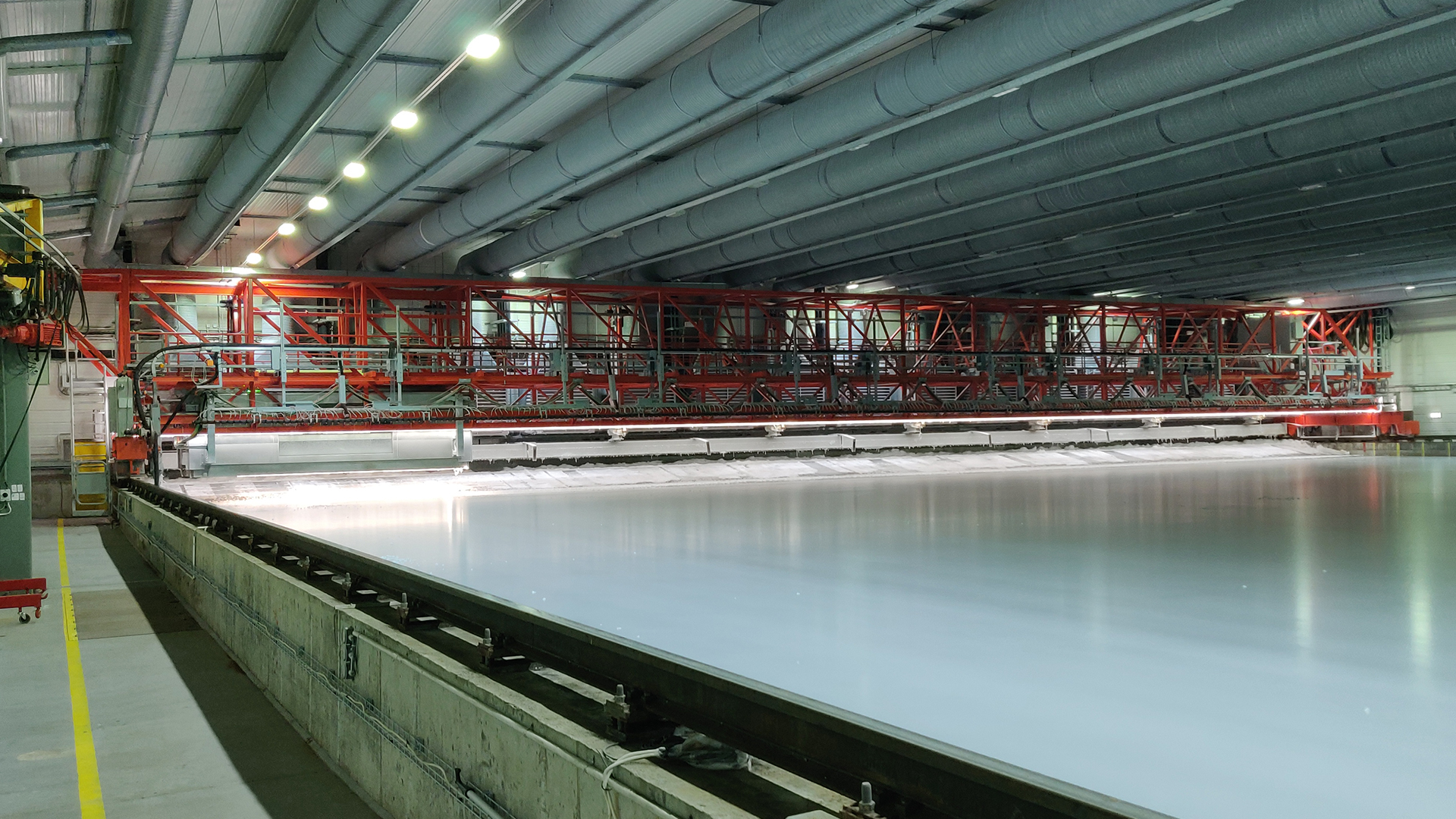 The room sits at around -11 or -12 degrees Celsius. Credit: Wikimedia Commons
Each sheet takes a full day to grow. Testing happens the following day, starting with measurements of flexural strength, Young’s modulus, and compressive strength on ice beams cut from the sheet. Testing then runs until the tank is full of broken fragments. The bridge pushes the pieces toward a sloped drain; they go into a melt tank beneath the offices; the water is recycled; and the process starts again. Two sheets a week is the normal pace. Three is possible, but it requires someone on a Sunday.
There are no windows in the facility. Any natural light would trigger biological growth in the water, compromising underwater visibility, already one of the hardest variables to manage during testing. Every couple of years, the water turns murky, regardless, and the whole tank has to be drained and refilled, explains Polojärvi.
What ice actually does to a ship
Most people who haven’t worked in this field imagine ice as an obstacle, something a ship pushes through. “It would cause a resistance to a ship in a way that it just becomes harder for the ship to move, and then you need to use more power,” Polojärvi says.
In a worst-case scenario, the ship stops and gets stuck. Combined with ice drift, ice fields pushed by winds and currents, a trapped vessel can end up moving with the ice rather than through it. In worst-case scenarios, the ice punctures the hull. “That could have even catastrophic consequences,” he adds.
“We can do ship maneuvers, we can make big turns with ships and really test their capabilities of not just going straight, but going through turns,” Polojärvi says. Channel breakouts, where a vessel has to deviate from a path cut by an icebreaker, are also testable here. Most ice tanks can’t accommodate that.
The ships being studied increasingly aren’t icebreakers. They’re vessels optimized for open water that end up in ice anyway, often with crews who have limited experience in those conditions. “There are more and more ships that need help from icebreakers because they simply do not have the capabilities of moving in ice,” Polojärvi says.
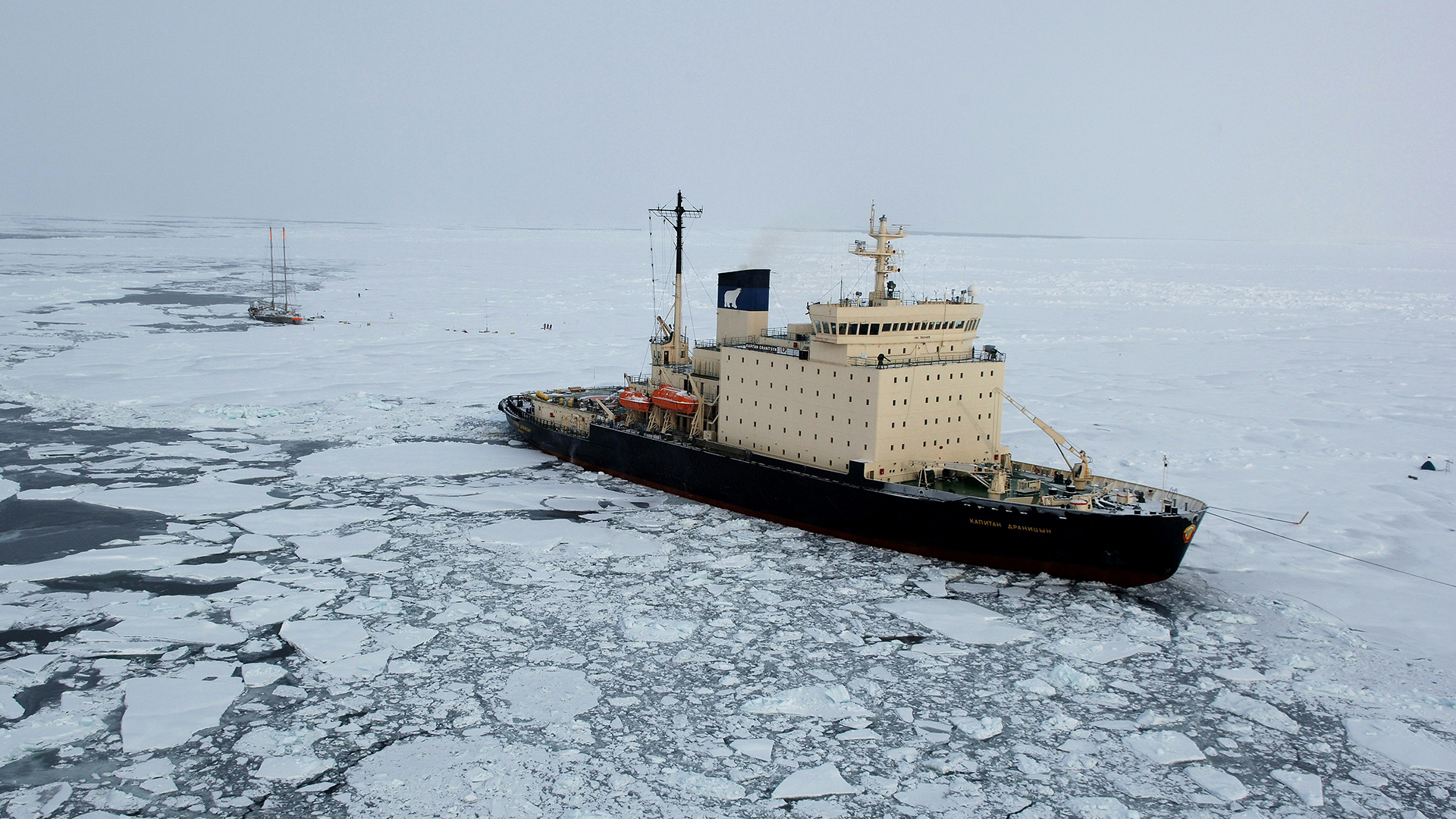 Real sea ice has salinity variations and structural impurities that the tank doesn’t replicate. Credit: NOAA
Ice itself is also changing in ways that complicate the picture. “Ice is actually very close to its melting point, and that actually makes dealing with it, from an engineering point of view, very challenging,” Polojärvi says. “It’s a material that behaves very challengingly.” As warming increases sea ice temperatures, the mechanical properties shift in ways that aren’t yet fully understood.
Wind turbines in a frozen sea
“If we want to have a carbon-free Finland, or any northern country, we must start building offshore wind on ice-covered sea areas,” Polojärvi says. Finland’s defense forces have restricted wind energy development near the eastern border, pushing planned capacity further north, where ice conditions are heavier.
“Offshore wind turbines are interesting engineering structures in that they are massive, but they are very slender, and they tend to start vibrating and really react to the environment,” he says. Sea ice is an extreme load on a structure like that. Understanding what force the ice exerts and how the turbine’s response changes that loading in turn is what the tank’s wind turbine experiments are working through.
Large-scale wind farms could also alter local ice dynamics, a concern Finland’s transport authority raised a few years ago. A single farm can cover hundreds of square kilometers and contain hundreds of turbines.
Polojärvi has built a geophysical simulation of the entire Baltic Sea to model the problem: ships can be run through it, ice conditions and wind farm structures varied. “How to make wind energy production fit together with winter-time traffic,” he says, “is a challenge.” There’s currently no legislation that addresses it.
Modeling at the meter scale
Polojärvi’s group uses discrete element modeling to simulate sea areas of roughly 100 by 100 kilometers at meter-scale resolution. “What that means is that we don’t have to average ice properties over large areas,” he says. “We can actually do meter-scale studies on sea ice behavior.”
The results feed back into the physical experiments at the tank, and the models are validated against the tank data before being used to study conditions and scales that the tank can’t physically reproduce.
Asked what experiment remains impossible even at this scale, he doesn’t offer a clean answer. “As a researcher, I like to think that we can do any kind of experiments; it depends a lot on how you can scale a certain problem.” How large a sea ice dynamics experiment can be brought into the tank and still yield reliable results, he says, is something they’re still working out.