
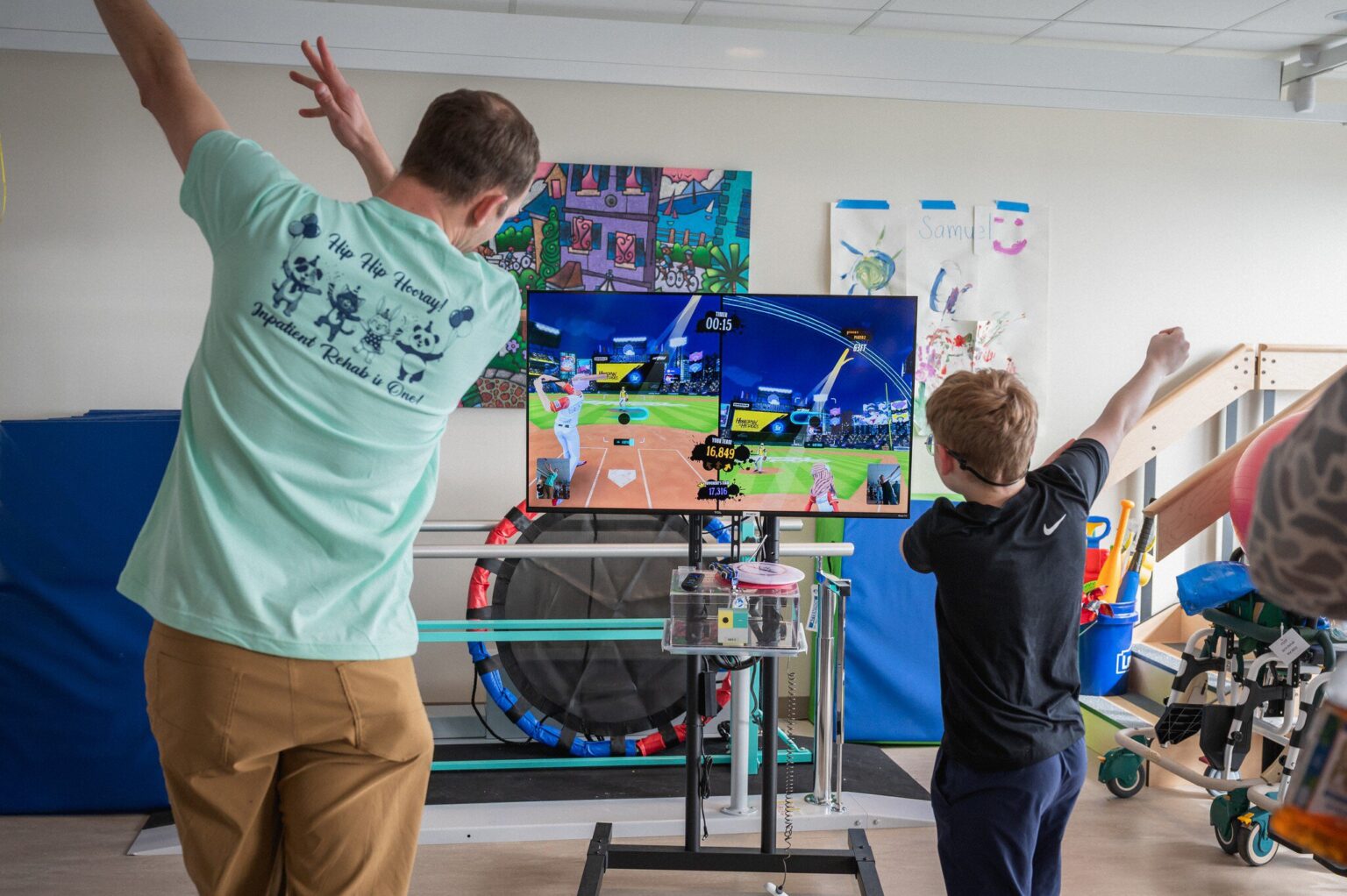
At a presentation titled “Patient Focused Creations in Gaming and Technology,” which took place at the end of Innovation Awareness Month on April 30, Mathews spoke about the importance of designing patient-focused creations in gaming and technology and the collaboration between his role at SJCH and the Dream Studio.
He explained that the purpose of his role is threefold: emotional support, physical support and accessibility and medical education.
Emotional support
When it comes to emotional support, Mathews said his role as gaming technology specialist is about improving a child’s quality of life while in the hospital. “We want the kids to feel like kids and not isolated in hospital rooms,” he said. “I listen to their interests and needs and basically normalize their childhood experience while they are in the hospital.”
Creating gaming paraphernalia, designing the child’s room to fit his or her individual tastes and assisting with celebrations are a few of the ways Mathews helps with emotional support.
With the assistance of the laser cutter for acrylic items in the Dream Studio, Mathews once successfully decorated a cancer patient’s room with memorabilia from his favorite team, the Kansas City Chiefs. Another patient was big into a game called the Ghost of Yōtei, so Mathews designed a 3D mask for him, along with some mini-figures on the resin printer.
Physical support and accessibility
Often done in collaboration with occupational and physical therapists, when Mathews creates aids for physical support and accessibility, it helps to normalize play for the children. The 3D printers can make prosthetics, accessories and gaming grips.
Accessible adaptations are often more than just physically beneficial; they also provide vital mental health support for the children.
Mathews works with medical staff and the Dream Studio to create items like gaming handles for patients with either smaller hands or weakened grips, or LEGO tools that help connect LEGO pieces when injured hands are healing. “Providing support allows for playing in more positions and removes barriers to physical needs while playing,” he said.
Medical education
Oftentimes, reducing stress and anxiety can allow patients to regain some control over their situations through knowledge and empowerment. Mathews and the Dream Studio can help with this by creating dolls showing where implants might go or even creating a heart that perfectly matches their own heart when they are facing a transplant. “They will ask if they can keep their heart somehow,” Mathews explained. “The resin printer aids in that desire. From a CT scan, we can create a model with computer software, which produces an exact replica.”
The Play-Doh molds, for example, created in the Dream Studio, can assist SJCH’s child-life specialists with educating the children about their current situations. The molds aid patients through medical play, helping to break down the diagnosis and treatment plans, which makes future medical appointments more tangible.