

Notes from Poland is run by a small editorial team and is published by an independent, non-profit foundation that is funded through donations from our readers. We cannot do what we do without your support.
Poland has signed its first contracts using funds from the European Union’s SAFE programme, which is providing the country with €43.7 billion (185 billion zloty) in loans for defence and security spending.
On Thursday, the defence ministry concluded agreements for products ranging from cybersecurity systems to drones and helmets. By Saturday, which is the deadline for most SAFE-funded deals to be concluded, it plans to have signed dozens of contracts worth around 100 billion zloty in total.
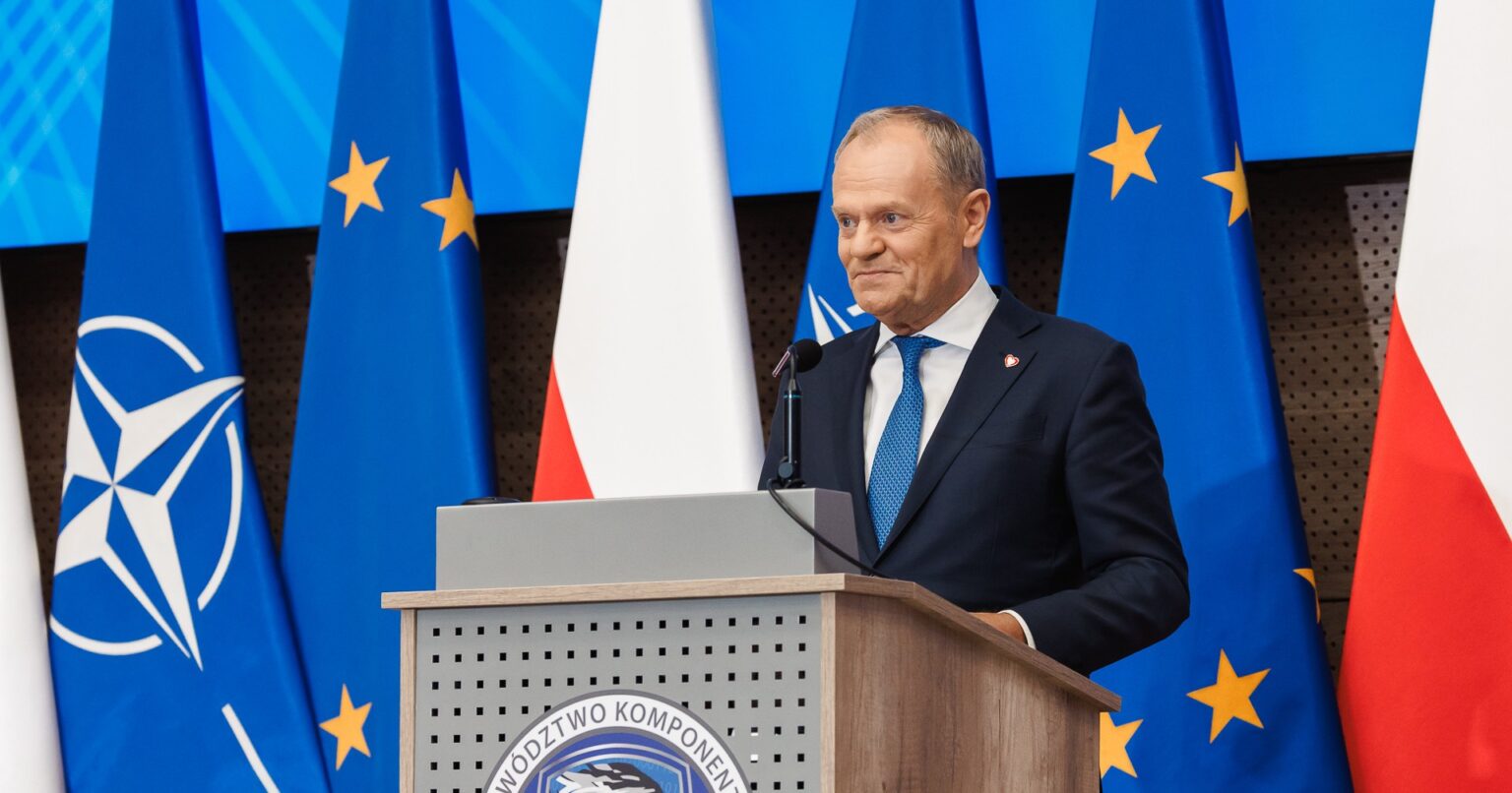
“Never before have so many funds been allocated to the modernisation of the Polish Armed Forces in such a short time,” said defence minister Władysław Kosiniak-Kamysz at a signing ceremony. Prime Minister Donald Tusk called it a “truly historic moment”.
Pierwsze umowy w ramach #PolskaSAFE podpisane! Do soboty będzie to 40 kontraktów na kwotę 100 mld złotych. Bronimy, nie gadamy. pic.twitter.com/WsE4uko7FR
— Donald Tusk (@donaldtusk) May 28, 2026
In early May, Poland signed an agreement with the European Commission to access its SAFE funds. The next step was to conclude contracts with suppliers of the equipment that it planned to buy with the loans.
The government has been rushing to do so, because the EU requires that contracts for SAFE funds being spent by a single member state – rather than jointly between two or more of them – must be signed no later than 30 May. The funds will then be distributed and spent by the year 2030.
On Thursday, the defence ministry announced that it signed several contracts, the first of which was a 3 billion zloty deal for four Polish companies to supply the Cyber Defence Forces (WOC) with a new data encryption system and a mobile cybersecurity laboratory, among other products.
Additional deals were signed with Makspol and Jelcz, two subsidiaries of the state Polish Armament Group (PGZ). The former will supply equipment including helmets and bullet-proof vests, while the latter will provide trucks for Poland’s armed forces.
The Polish government has previously said that around 90% of SAFE funds will be spent domestically, providing a boost to Poland’s defence industry. State assets minister Wojciech Balczun told Business Insider Polska earlier this month that PGZ would be the largest recipient.
On Thursday, Tusk declared that “over 10,000 Polish companies operating in Poland and paying taxes in Poland” would benefit from SAFE. Among them is WB Group, Poland’s largest private defence firm, which has now signed a contract to provide loitering munitions and drone systems.
Further contracts are expected to be signed on Friday. The government’s plenipotentiary for SAFE, Magdalena Sobkowiak-Czarnecka, meanwhile noted that, after the 30 May deadline expires, Poland will sign further contracts under joint procurements with other SAFE participants.
Among the priorities for the spending are Poland’s East Shield project to bolster defences on its borders with Russia and Belarus, as well as the creation of a new anti-drone system.
A mamy dopiero czwartek 😎
Jutro kolejne umowy. Stay tuned #polskasafe pic.twitter.com/BxcXb3Ujqr
— Magdalena Sobkowiak (@magdasobkowiak) May 28, 2026
The government has hailed SAFE as a major boost to Poland’s defence capacity and notes that the EU-backed loans will be on much better terms than Warsaw could secure independently. However, the programme has been embroiled in domestic political controversy.
The right-wing opposition has expressed concern that the terms of the loans are not known in advance. It also argues that the mechanism grants the EU more power to interfere in Poland’s domestic affairs.
In March, opposition-aligned President Karol Nawrocki vetoed a government bill intended to facilitate the receipt and disbursement of SAFE funds. That prompted the government to launch a “plan B” for ensuring that the money could still arrive.
On Thursday, Mariusz Błaszczak, head of the parliamentary caucus of the opposition Law and Justice (PiS) party, accused the government of “unlawfully” implementing SAFE given the president’s veto.
Pomijając bezprawność dzisiejszych działań rządu związanych z brukselskim programem SAFE — wynikającą z faktu, że pożyczka jest zaciągana bez podstawy prawnej i bez zgody Prezydenta — musimy mieć świadomość, jak bardzo rządzący łamią prawo również w innych obszarach.
Część, a…
— Mariusz Błaszczak (@mblaszczak) May 28, 2026
Notes from Poland is run by a small editorial team and published by an independent, non-profit foundation that is funded through donations from our readers. We cannot do what we do without your support.
Main image credit: KPMR/Flickr (under CC BY-NC-ND 4.0)

Olivier Sorgho is senior editor at Notes from Poland, covering politics, business and society. He previously worked for Reuters.