
Among the countries touched by Europe’s unexpected Catholic revival, few are as intriguing as Estonia. Long considered one of the world’s most irreligious nations, this historically Protestant Baltic country seemed an unlikely place for any Catholic resurgence.
This Easter, however, offered a sign that something may be shifting.
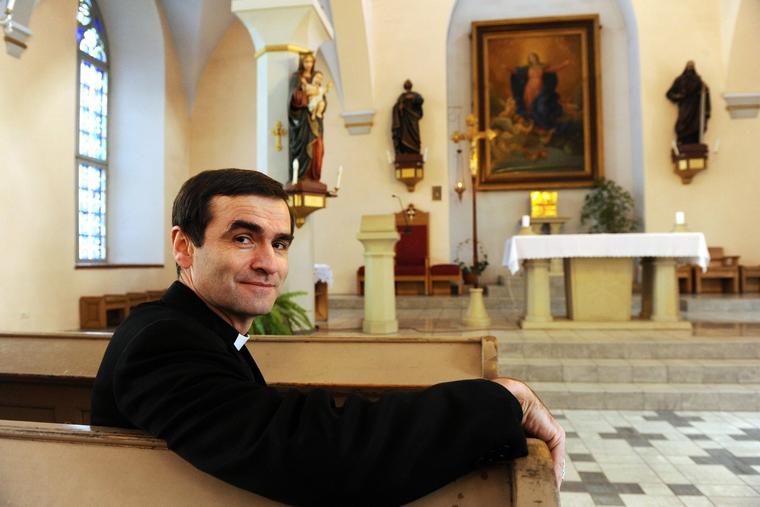
In the modest Catholic cathedral tucked inside the medieval old town of the Estonian capital of Talinn, Bishop Philippe Jourdan baptized 33 adults at the Easter vigil on April 4. On Easter Sunday, he received 15 more already-baptized Christians into full communion with the Catholic Church. “We had never had so many,” Bishop Jourdan told the Register.
Although the numbers may seem modest by the standards of France, where adult baptisms have surged massively in recent years, in Estonia, a country of just 1.3 million people, where Catholicism was nearly extinguished, they hint at a religious shift few would have predicted.
In 2011, Estonia was identified as the world’s least-religious country. A decade later, the country’s 2021 census found that only 29% of the population claimed a religious affiliation. The roots of that secularism run deep. The Protestant Reformation first effectively erased Catholicism over the course of the 16th century, while Soviet rule later accelerated the collapse of religious transmission across society. Studies suggest that in Estonia, faith is less actively rejected than simply absent.
“In Latin countries, one can speak of a revival,” said the French-born prelate, 65, who became Estonia’s first diocesan bishop in 2024. “Here, I would speak rather of a return of Catholicism.”
A Church of Converts
Unlike several European countries where many converts are in some sense rediscovering ancestral roots, Estonia offers almost no Catholic inheritance to recover. “The first conversions to Catholicism here date only from the 1920s,” Bishop Jourdan told the Register.
By the early 1970s, he said, citing German author Lambert Klinke’s study of the Catholic Church in Soviet Estonia, the number of ethnic Estonian Catholics was below 10. “Not 5,000, not 50, only five or six!” he said.
The Church that exists in Estonia today is therefore almost entirely a Church of converts, with very few families with traditional Catholic roots. “Catholics are converts, or children of converts, and now we are beginning to see the first grandchildren of converts,” Bishop Jourdan continued.
In the 2021 census, Catholics accounted for about 0.8% of Estonia’s population — roughly 10,000 people.
“When you consider where we came from,” the bishop commented, “one could say we have multiplied by a thousand.”
Unlike neighboring Sweden or Norway, where Catholic growth has been partly fueled by immigration, Estonia’s recent movement appears overwhelmingly local.
According to the Diocese of Tallinn, among the 33 adults baptized at the Easter vigil, all but one were Estonian; one was Russian. What has changed most noticeably in recent years is the profile of those approaching the Church.
“Previously, catechumens were often in the 30-to-40 age bracket,” Jourdan said. “Now, they are much more often in their 20s.”
The Impact of Papal Visits and COVID
The bishop explained this phenomenon partly by the visibility Pope St. John Paul II gave the country through his visit in 1993, just after the collapse of the Soviet Union. Pope Francis gave further impetus to the movement when he returned in 2018 and eventually erected a proper diocese in Tallinn.
“Estonians are very attentive to how the outside world sees them,” Bishop Jourdan said. “The fact that the Pope would come from Rome to Tallinn, despite there being so few Catholics here, made a very strong impression.”
But like in other European countries, the historical context also seems to have played a significant role. Bishop Jourdan believes the COVID era, followed almost immediately by Russia’s invasion of Ukraine in 2022, may have triggered broader existential questioning — particularly among the youth.
“Here, the war is not something abstract, but something we live much more directly than countries farther west,” he said. Estonia shares a border with Russia and has, indeed, welcomed a significant number of Ukrainian refugees. “People ask themselves: Beyond pandemics and wars, is there something else? Does life have something more to offer?”
He has also noticed a cultural shift in how religious commitment is perceived.
“A young person who asked for baptism four or five years ago might have been seen as weak, strange, perhaps even a little unwell,” he said. “Today, even if others do not share the faith, they may think: This is someone with conviction, someone with personality.”
The Appeal of Catholic Clarity
Asked why these younger generations are turning specifically to Catholicism rather than other Christian traditions, Bishop Jourdan pointed to the Church’s growing public presence and the attraction of doctrinal clarity.
“The Catholic Church is much more visible in Estonian society than it was 20 years ago,” he said. “They are attracted to a faith lived with clarity and with a certain exigence,” he said.
The Church’s educational presence may also be bearing fruit.
Estonia now has two Catholic schools — in Tallinn and Tartu — an unprecedented development in the country’s history.
“Students do not necessarily become Catholic immediately,” the bishop told the Register. “But later, as young adults, one sometimes sees that what was planted has remained.”
The Need to Be Prepared
Despite these encouraging signs, Bishop Jourdan is wary of triumphalism, as he remembers what happened when the Soviet Union collapsed. Religious interest surged, especially among Lutherans, as decades of imposed atheism abruptly ended. But, like in neighboring Latvia, the momentum quickly faded.
“The churches were not prepared,” he said. “People were baptized, but then they disappeared. If people are not accompanied, the soufflé collapses.”
It is a reality Catholic leaders elsewhere in Europe are increasingly confronting, particularly in France, where bishops are actively reflecting on how to integrate thousands of new adult converts through the Île-de-France provincial council, which has the “Catechumens and Neophytes: New Perspectives for the Life of Our Church” initiative that aims to rethink how to welcome and support new Catholics in the face of this historic surge in requests for adult baptism in France.
Even with the challenges, Bishop Jourdan remains convinced that something distinctive is happening in the Catholic Church across the region.
The fact that dozens of young adults are freely choosing Catholicism in a country where faith seemed to have died out until recently suggests that secularization is not the whole story.
“I would not be so bold as to claim this is the future of the Church, but Catholicism in Northern Europe has genuinely grown in visibility, influence and numbers.”