
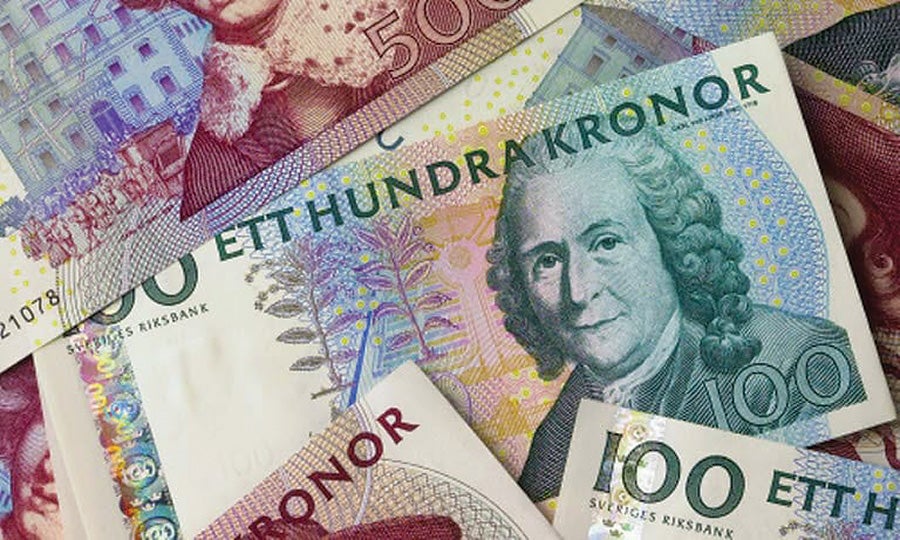
Brother, can you spare a dime? For a long time, if you asked that question in Sweden, the answer would have been no. The reason—Sweden is a leading nation in the cash-free revolution. It is estimated that Sweden has only 8% to 10% of citizens who use cash to make payments.
The bank note, as Europe and later the Americas came to know it, was introduced first in Sweden. Johan Palmstruch introduced the kreditiysedlar credit notes in 1661, issued through Palmstruch’s bank, Stockholms Banco, that replaced large and heavy plate money coinage.
Winding the clock forward to today, Sweden has morphed into being the world leader, marching towards a society in which we not only use fiat money exclusively, but that so-called money is digitized. The Bank of Sweden estimates the amount of physical cash now in circulation is about half of what was circulating in 2007.
You can thank the Avtalsfrihef or so-called freedom of contract laws that in Sweden allow parties to freely define the form and content of their agreements. Avtalsfrihef allows a merchant to refuse to accept cash should that merchant prominently display a “no cash accepted” sign. This legally flexible law has been successfully combined with digital payment methods to encourage Sweden’s cashless society. There is little statutory interference with this act.
The Swedish cashless society movement accelerated in 2012 when a group of banks colluded to create the mobile payment app, Swish. Five years later, coins and bank notes were, for practical purposes, redundant. Those individuals who, for one reason or another, clung to cash were said to be in a “cash bubble.” Persons in the cash bubble likely have no bank accounts. As a result, they have limited access to everything from parking to paying their bills.
If this cashless utopia is all it’s cracked up to be, then why, during early 2026, has Sweden been urging citizens to keep some bank notes on hand in case of what the Sveriges Riksbank has termed “in case of temporary disruptions, crisis, or in the worst case, war.”
The central bank is now recommending Swedes keep 1,000 kronor, which is about $150 in exchange value, per adult. The bank is also recommending keeping several additional so-called cashless methods handy, these being credit cards and cell phone-based internet payment services.
Sweden has also begun encouraging businesses to reconsider accepting payments in cash. On March 18, the government submitted a bill to parliament through which grocery stores and pharmacies would be required to accept cash. The same legislation would require banks to allow consumers to deposit, and for businesses to have access to services for depositing cash.
What triggered this, throwing the proverbial stick shift into reverse? Public Administration Minister Erik Slottner recently admitted, “The digitalization of society has gone very quickly and created many opportunities but has also entailed certain risks. A major risk is that digital exclusion is spreading, not least among the elderly,” adding that the acceptance of cash is “important for strengthening our preparedness.”
Sweden quickly welcomed its no-touch digital payment system at the time of the Covid 19 pandemic, which ebbed in 2023. Russia invaded Ukraine in 2022, bringing an entirely new aspect to what happens when a high-tech society suddenly uses its digital and electronic capabilities. Sweden has a maritime boundary of about 8.33 kilometers (less than 5.2 miles) between itself and the Russian exclave of Kaliningrad.
Once Russia began its war on Ukraine, Sweden overhauled its defenses and joined NATO. Since that time, every home in Sweden has received a copy of a brochure titled, If Crisis or War Comes. The brochure reads: “If you can pay in several different ways, you strengthen your preparedness.” Perhaps cold cash isn’t a relic out of ancient history after all?