

Who were the Hyksos? These enigmatic people are quite possibly important in biblical history, but their origin and interaction with biblical events have been questioned. Previously, they were thought to be foreign invaders who took advantage of a period of weakness to seize power in Egypt. The newly emerging paradigm is that they were insiders who staged a bloodless coup. The Hyksos ruled parts of Egypt as the Fifteenth Dynasty and then were overthrown by the Eighteenth Dynasty Egyptian Pharaoh Ahmose.
Like the Fourteenth Dynasty (discussed in the previous article), the Hyksos are hypothesized to be connected with the Bible’s Exodus account. During this time of history, much of northern (lower) Egypt was overtaken by foreigners, some known as the Hyksos, who are confirmed by the archaeological record. Concurrently, Upper Egypt (the southern part) was coming under siege from the Nubian king. This was perhaps the only time in the second millennium BC that Egypt, the regional powerhouse of the time, was dominated by a foreign power living inside of Egypt. .
But Manetho’s description of the Hyksos rulers invading the northeastern Nile Delta during the Second Intermediate Period more accurately describes the Fourteenth Dynasty rather than the Hyksos Fifteenth Dynasty, as we discussed in the previous article. Manetho conflated the Fourteenth and Fifteenth Dynasties, incorrectly viewing their invasion as a single event. As described in Fig. 1 (below), the inset box in column 3 labeled as Hyksos are the Fifteenth Dynasty.
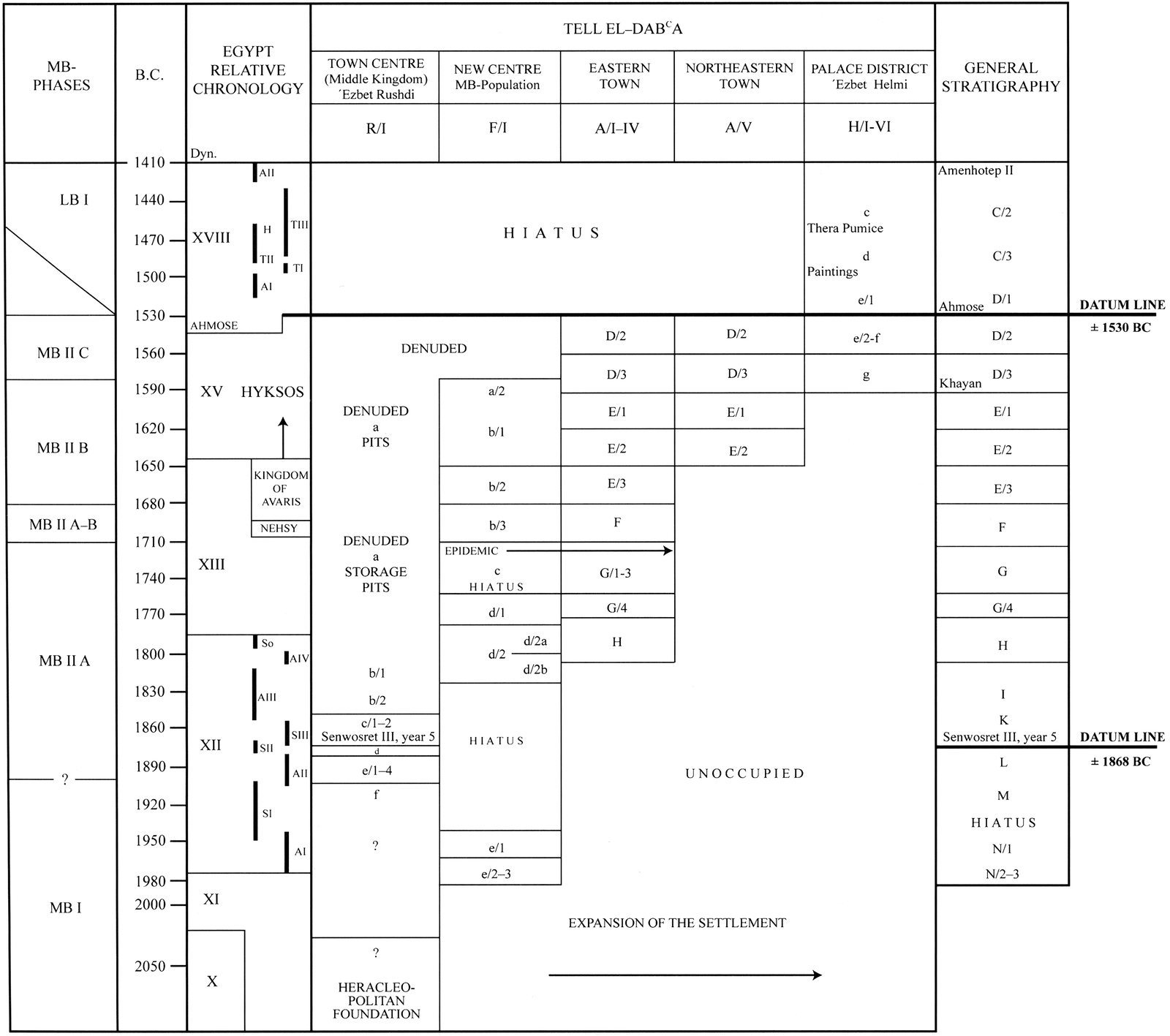
Fig. 1 The site stratigraphy system map of Tell el-Dabca. Courtesy of C. Stantis, A. Kharobi, N. Maaranen, G. M. Nowell, M. Bietak, S. Prell, et al., “Who Were the Hyksos? Challenging Traditional Narratives Using Strontium Isotope (87Sr/86Sr) Analysis of Human Remains from Ancient Egypt,” PLoS ONE 15, no. 7 (2020): e0235414, https://doi.org/10.1371/journal.pone.0235414.
The Fifteenth Dynasty of Egypt: The Amalekite Hyksos
We read in Exodus 17:8 that Amalek attacked Israel, seemingly out of nowhere. This happened in the second month after the Israelites crossed the Red Sea, when they were camping at Rephidim. This was even before they arrived at Mount Sinai. Living in a world of instant communication as we do now, it is sometimes hard to think of a slow spread of news. But if you put yourself into the 1400s BC, you might ask how the Amalekites knew where the Israelites were. While true that conservative biblical scholars estimate there were close to 2 million Israelites, they deliberately avoided going by way of the coastal route, which would have brought them through Amalekite territory and then into Philistia. It is possible that some Amalekites lived in the southeastern Sinai Peninsula, but they are not listed as doing so in Scripture. In fact, God stated that he did not take the Israelites through the northern Sinai Peninsula route so they wouldn’t see war and flee back to Egypt (Exodus 13:17). Of course, the Israelites were almost certainly not equipped with many weapons when they left Egypt, but after the Egyptian army drowned in the Red Sea, the Israelites likely scavenged some weapons from the dead bodies washed up on shore (Exodus 14:30).1 So the up-to-two-month delay between the exodus and the battle at Rephidim had enabled the Israelites to be better able to protect themselves (humanly speaking).
If some of the mixed multitude (Exodus 12:38) who came out of Egypt with the Israelites were Amalekites, a few could have easily slipped away from the crowd when the Israelites turned south, away from the Amalekite territories (Exodus 13:17–18). But a few likely stuck around to serve as spies and were present at the Red Sea miracle and afterward scurried to the Amalekite towns and notified them of the events that had happened at the Red Sea. If any spies slipped away immediately after crossing the Red Sea, they would have been unaware of the Israelites arming themselves with Egyptian weapons.
In this plausible scenario, if you’re an Amalekite enslaved (or at best, serving as a vassal serf) in Egypt and see the country rocked by plagues and an opportunity to leave comes up, why wouldn’t you take it? Then as things pan out, a large part of the Egyptian army is completely wiped out,2 and you are within a day or two’s march of your homeland. Not only would you tell your people about Egypt being ripe for the taking (and maybe freeing more of your countrymen in servitude there), but you would also tell them that there’s this ragtag group of unarmed people loaded down with riches they plundered from the Egyptians (Exodus 12:36). This attack against Israel appears to have been well-timed, coordinated, and calculated. It is also here that we read of God’s statement to Moses (and Joshua) that the Lord saw the Amalekite’s decision as a flagrant attack on his character (Exodus 17:14–16; Deuteronomy 25:17–19).
Several other historians have postulated that the Amalekites were the Hyksos people. Ashton and Down did so in their book Unwrapping the Pharaohs. In chapter 13 of that book, they also mention that Immanuel Velikovsky (1952 in Ages of Chaos) and Donovan Courville (1971 The Exodus Problem and Its Ramifications) had previously made the same hypothesis. Going back to 1951, we see journals citing evidences of Semitic (and possibly Canaanite) names for the Hyksos rulers.3 One name that appears frequently is Hur, who appears to have been an early Hyksos chancellor.4 Ironically, the name Hur, in addition to being an Israelite name, is also mentioned as one of the five kings of Midian (Numbers 31:8), and Midian was also occasionally aligned with Amalek in their battles against Israel (Judges 6:3, 6:33, 7:12).
Why Didn’t the Amalekites Immediately Attack Egypt and Take Over the Nile Delta?
What were the Amalekites doing for those 25–35 years of the Fourteenth Dynasty rule? In short, they were licking their wounds. While the Amorites had seized control of the delta (since they were already living there) and established the Fourteenth Dynasty, the Amalekites were recovering from the devastating loss they suffered at the hands of the Israelites (Exodus 17:13). When you consider that most of their warriors who died were also those of the most viable reproductive age, it is easy to see it would take a generation to replace the numbers that they had lost. While Israel wandered around the wilderness and the Amorites reigned, both in Egypt and in Canaan, the Amalekites slunk back to their homes in northern Canaan and waited to grow powerful enough to fight again.
Once the Amalekites did grow more powerful, they noticed that the delta region of Egypt was ripe for the taking because by this time, delta crops had been growing again, and the land had rebounded. The Fourteenth Dynasty had been at war with the Thirteenth Dynasty from the beginning. The time was right to attack the weakened Fourteenth Amorite Dynasty (for more information, see the previous article).
Clues for a Mid-Late Thirteenth Dynasty Exodus?
I should make clear that due to disagreement on the actual number of ruling pharaohs of the Thirteenth Dynasty, one person’s “mid-Dynasty” may be considered “late-Dynasty” or vice versa. Obviously if one considers that there were 60 pharaohs, then the 30th ruler would be considered “mid,” but if one only accepts 40 pharaohs, then 30 would be “late.” There are many other facets of the exodus pattern that fit this later Thirteenth Dynasty time frame. The reorganization of Egypt with the end of the powerful nomarchs and the centralization of power with the pharaohs occurred in the time of Senusret II or Senusret III (also called Sesostris II or III) late in the Twelfth Dynasty. This fits the overall time frame of the famine of Joseph and all the locals selling their lands to the pharaoh. The beginning of the Semitic settlement at Avaris in Area F happens at the same time in the later part of Dynasty 12 (as seen in Figure 1 above), with its Syrian-styled house followed by the palace of a Semitic high official with 12 main tombs (one being a pyramid tomb with the body removed) etc. This timing would mean the exodus would occur near the end of the Thirteenth Dynasty, not at its beginning.
The Semitic population at Avaris (linked to the Israelites) begins well off and mushrooms throughout the late Twelfth and Thirteenth Dynasty before falling on hard times (equated with their enslavement) early in the Thirteenth Dynasty. This is the same time we see the evidence of Israelite slavery in the Papyrus Brooklyn 35.1446—a Thirteenth Dynasty document. And a Thirteenth Dynasty pharaoh with no connection to the Twelfth Dynasty makes good sense for the pharaoh “who knew not Joseph” and enslaved the Israelites.
Specialists over the last half century or so have dated the Ipuwer Papyrus near the end of the Thirteenth Dynasty and not earlier. John Van Seters did a detailed study of the Ipuwer Papyrus in 1964 in “A Date for the ‘Admonitions’ in the Second Intermediate Period” (The Journal of Egyptian Archaeology, Vol. 50). He did an in-depth analysis of the document while noting the political and cultural situations it mentions. On page 14, he wrote, “There is, in fact, a more acceptable alternative which does full justice to the matter of the orthography and language. This is a date late in the Thirteenth Dynasty” (Van Seters 1964, 14, 23).
Miriam Lichtheim didn’t agree with all of Van Seters’ conclusions regarding the wording and intent of the Ipuwer Papyrus. However, writing in 1973 in Ancient Egyptian Literature, she also dated it as late Middle Kingdom, which she accepted as stretching to the end of the Thirteenth Dynasty (p. 113), and wrote that Ipuwer was a latecomer in its genre as the last and fullest composition on the theme “order versus chaos” (Lichtheim 1973, 149–150).
In The Literature of Ancient Egypt (Tobin 2003), Vincent A. Tobin writes that the text of Ipuwer is unlikely to be as early as the Twelfth Dynasty and that “a more probable, and more widely accepted, dating would place it at some point during the late Middle Kingdom” (i.e., late Thirteenth Dynasty).
Finally, the destruction of Jericho, Hazor, and many other conquest sites near the end of the Middle Bronze Age can be dated by scarab evidence found in the last burials at Jericho to the late Thirteenth Dynasty era. The whole pattern of evidence for the exodus appears to be consistent with this time frame.5
Who Was the Pharaoh of the Exodus?
Any potential Exodus pharaoh candidate must meet certain biblical criteria. The first such is that the ruling pharaoh’s oldest son could not succeed the Exodus pharaoh, as he would have been killed by the 10th plague. Nor could the pharaoh have been childless (Exodus 12:29). Finally, the pharaoh who succeeded the Exodus pharaoh must inherit a politically chaotic Egypt, and one that was ripe for invasion or secession, especially in the Nile Delta region (Lower Egypt).
So who fits that pattern? After careful consideration, I’m listing Merneferre Ay (also called Aya) as my choice for the Exodus pharaoh. There are several lines of evidence that point to him as an excellent viable candidate. He was the longest ruling pharaoh of the Thirteenth Dynasty (23–24 years), and his eldest son did not inherit the throne (and indeed this son died childless, likely meaning he was not very old). Also, Merneferre Ay was the last ruler of the Thirteenth Dynasty with attestations to ruling over both Upper and Lower Egypt (Schneider 2006). This is another criterion that adds more weight since this would have been before the Fourteenth Dynasty took control over the Nile Delta and before the Nubians encroached into Upper Egypt.6. It also comports well with the Scripture statements about “all of Egypt” being struck by the plagues.
In fact, Ryholt believes that by the end of Aya’s reign “the administration [of the Egyptian state] seems to have completely collapsed” and curiously the Pyramidion (Pyramid capstone) of Aya was found near Avaris, even though Aya ruled from Memphis.7 It is thus likely that when the Hyksos invaded Memphis, they looted the tombs of the pharaohs and carried them back to Avaris.8
Both the rulers before Merneferre Ay and the later rulers of the Thirteenth Dynasty all had extremely or moderately short reigns and the earlier rulers before Ay may be what is meant when God told Moses to “go back to Egypt, for all the men who were seeking your life are dead” (Exodus 4:19). Unlike many who postulate (or insist) that this verse is speaking of a single pharaoh, I am taking this statement to read as if the dynastic line was terminated, not just that a single pharaoh (and/or his advisors) were dead.
If Moses did flee Egypt under the reign of Sobekhotep IV (10 years), then the next two pharaohs were his eldest son Merhotepre Sobekhotep (3-year reign) and younger son Khahotepre Sobekhotep VI (4-year, 9-month reign). The next pharaoh was Wahibre Ibiau (10-year, 9-month reign), who may have been a son of Khahotepre Sobekhotep, making him the grandson of Sobekhotep IV, totaling approximately 28 years. The next pharaoh was then Merneferre Ay who appears to have usurped the throne from Ibiau and was not related (ruled 24 years, for a total of 52 years from Sobekhotep IV–Aya, more than enough for the 40 years while Moses was in Midian). Therefore, the family line (“all the men”) that sought the life of Moses was dead, just as Scripture states. When looking at all these different criteria, Merneferre Ay checks all the boxes as the most probable pharaoh of the Exodus.
Answers in Genesis and Exodus (and the Rest of Scripture)
If these hypotheses based upon Scripture, archaeology, and extra-biblical sources are correct, then the Bible provided the clues all along to the identities of both the Fourteenth and Fifteenth Dynasties.
If these hypotheses based upon Scripture, archaeology, and extra-biblical sources are correct, then the Bible provided the clues all along to the identities of both the Fourteenth and Fifteenth Dynasties. And with a little recalculation using a Revised Egyptian Chronology (REC), we can piece together the time period from Joseph to the exodus to the completeness of the iniquity of the Fourteenth Dynasty Amorites and to the Fifteenth Dynasty of Amalekite Hyksos.
And since the Bible is right and trustworthy with historical details, it is also right and trustworthy when speaking authoritatively on the sinfulness of man and humanity’s need for a redeemer. The Bible speaks hundreds of times about God’s deliverance of Israel from bondage in Egypt just as today it speaks to us about our bondage to sin (Romans 6:20–22) and the gift of God that frees us from sin and delivers us from death to life (Romans 6:23).
Note: This article is adapted from Troy Lacey, “The Hyksos—Does the Bible Shed Light on Who They Were?,” Answers Research Journal 18 (February 2025): 97–124, https://answersresearchjournal.org/ancient-egypt/hyksos-bible-who-they-were/. For a more full treatment of the Twelfth through the Fifteenth Egyptian Dynasties, including tomb paintings and correspondence, concerning the (then-current) events in Egypt, please see this journal article.