
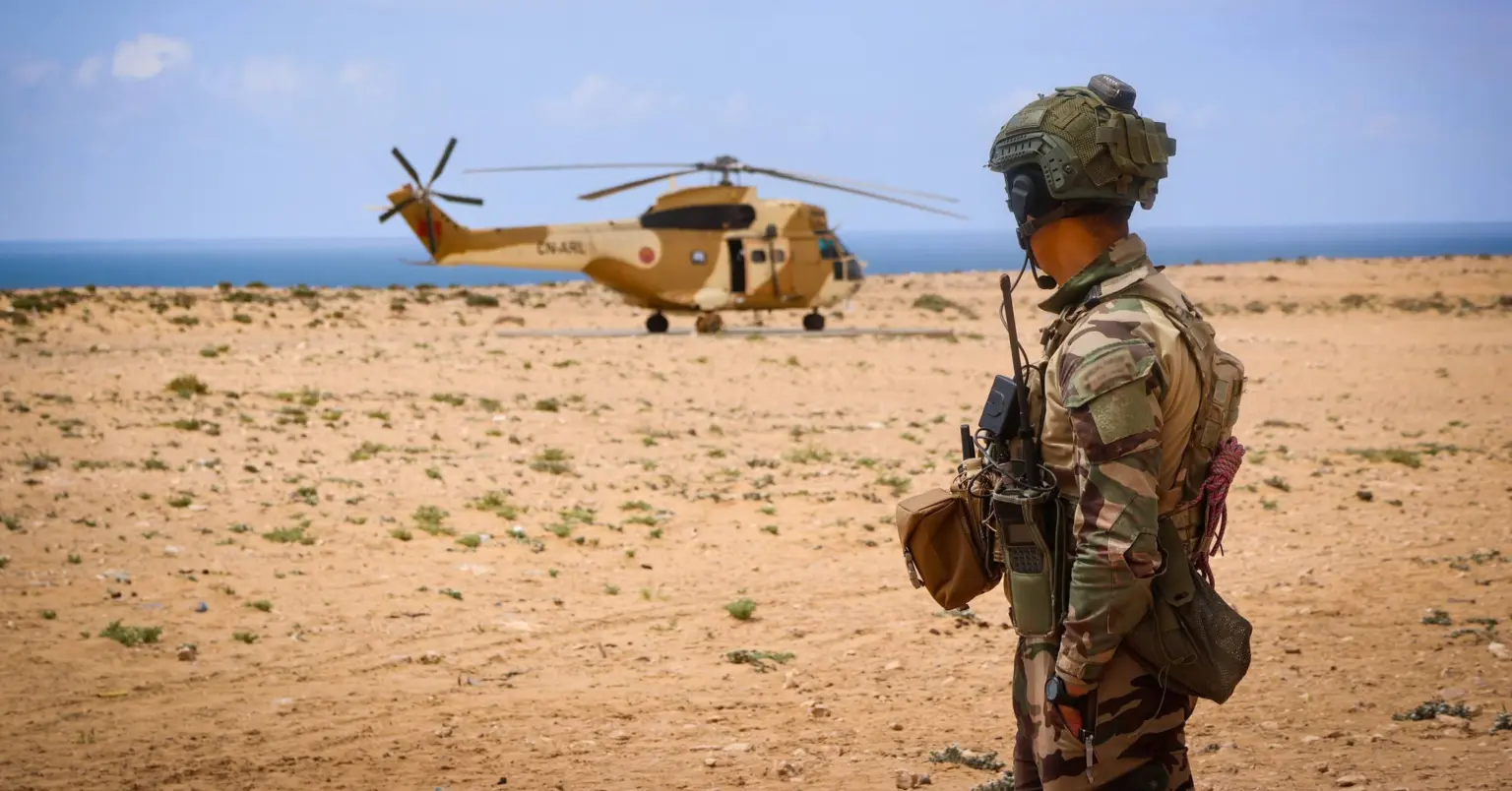
Marrakech – Spain’s state-owned news agency EFE dedicated an exhaustive dispatch this week to Morocco’s accelerating military modernization, cataloguing and mapping out the kingdom’s expanding arsenal, its multi-layered air defense architecture, and the strategic calculus driving the buildup.
Titled “Morocco strengthens its military muscle to consolidate itself as a strategic hub,” the coverage arrives amid a discernible shift in Spanish institutional attention toward Rabat’s swelling defense footprint.
This fixation has intensified since the conclusion of African Lion 2026, the continent’s largest multinational military exercise, and the signing of a new 10-year US-Morocco defense cooperation roadmap covering 2026-2036.
Morocco now ranks as Africa’s second-largest arms importer. Its military spending reached $6.3 billion in 2025, a 6.6% year-on-year increase that consumed 3.5% of GDP, according to figures from the Stockholm International Peace Research Institute (SIPRI) cited by EFE.
The agency flagged satellite imagery recently circulated by specialized portals showing Israel’s Spyder anti-aircraft system deployed at a base near Rabat. The system carries a range of up to 80 kilometers and radar detection extending to 180 kilometers.
It slots into a broader multi-layered air defense network that includes Israel’s Barak MX, China’s FD-2000B, and the Sky Dragon 50. Rabat has also acquired Harpoon Block II missiles from France and a string of American platforms – F-16 fighter jets, AH-64 Apache helicopters, and HIMARS rocket launchers.
On the industrial front, EFE detailed Morocco’s push to localize drone production near Casablanca. Israel’s BlueBird is establishing a manufacturing line for its SPY-X tactical drone, while Turkey’s Baykar will produce the Bayraktar Akinci combat drone through local joint venture Atlas Defence.
King Mohammed VI reinforced the trajectory earlier this month. In a letter marking the 70th anniversary of the Royal Armed Forces (FAR), the monarch described the development of the country’s defensive capabilities as a “great priority” and a pillar of ongoing modernization.
Rachid El Houdaigui, an analyst at the Policy Center for the New South, told EFE that the program reflects an “adaptation to the new geoeconomic orientations of the state” and to shifting geopolitical and security realities. Morocco’s ambition to position itself as a “strategic hub connecting Africa, Europe, and the rest of the world” requires upgraded protection of its logistics, energy, and digital connectivity infrastructure, he noted.
‘Defensive deterrence’
The strategic logic is twofold, El Houdaigui explained. On one axis, it consolidates traditional territorial defense through deterrence. On another, it confronts asymmetric threats such as terrorism. “The objective is not so much to increase the size of the forces as to improve their operational effectiveness, their capacity for reaction, and their strategic credibility,” he told the agency.
Linking the military upgrade to the Western Sahara dispute and the standoff with Algeria, El Houdaigui characterized the acquisitions as part of a “gradual strategy of capacity consolidation.”
Certain systems enable surveillance of the buffer zone – representing 20% of the Sahara along the Algerian and Mauritanian borders – with the ability to conduct operations without ground presence, deterring insurgents and suffocating Polisario separatist movements without breaching the ceasefire.
Other components, EFE reported, allow Morocco to deploy saturation tactics in a high-intensity scenario with Algeria, enabling rapid neutralization of Russian-supplied S-400 and S-300 air defense systems to secure aerial superiority.
El Houdaigui framed the overall doctrine as “defensive deterrence” – designed to make any hostile action prohibitively costly rather than to project power beyond Morocco’s borders. The modernization also entails a pivot toward an “access denial” logic built on multi-layered air defense, precision long-range fire, and enhanced intelligence dominance.
As if to placate an increasingly uneasy Madrid, the analyst stressed that Morocco’s buildup does not constitute an arms race or an attempt to rival any NATO member state.
He instead noted Rabat’s longstanding institutional ties with the alliance through the NATO+1 and NATO+7 frameworks, concluding that regional stability could actually further deepen economic integration between Morocco and Spain – and, by extension, with Europe.
Read also: Morocco’s Royal Armed Forces Celebrate 70 Years of Service, Modernization