
Spain are beginning to look like a force again, with a new generation of players reviving memories of the country’s most successful era. For many years, La Roja set the benchmark in international football, dominating the sport between 2008 and 2012 with a team packed with legends such as Xavi, Andres Iniesta, Sergio Ramos, Gerard Pique, Iker Casillas, Carlos Puyol and David Villa. That side achieved what few national teams ever have, winning Euro 2008, the 2010 FIFA World Cup and Euro 2012 in succession.
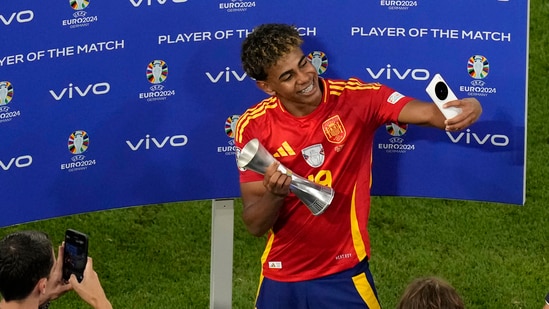
Lamine Yamal holds the key for Spain in 2026 World Cup. (AP)
The team was built around a core of players from Barcelona and Real Madrid, but its style was heavily influenced by Barca’s possession-based approach. Spain controlled matches through technical superiority, patience and an exceptional midfield, making them one of the most admired teams in football history.
However, every great cycle eventually comes to an end. The decline became evident at the 2014 World Cup in Brazil, where Spain suffered a shock group-stage exit. Their crushing defeat to the Netherlands, highlighted by Robin van Persie’s memorable diving header against Casillas, symbolised the end of an era. The golden generation was ageing, and Spain suddenly looked vulnerable.
The years that followed were marked by uncertainty. While the team still possessed quality, it struggled to establish a new identity. At the 2018 World Cup in Russia, Spain appeared caught between generations. The side retained elements of its old style but lacked the authority and cohesion that had defined its peak years. Their campaign ended in the Round of 16, where hosts Russia knocked them out on penalties.
A clearer rebuilding process began ahead of the 2022 World Cup. Young talents started to emerge, offering hope for the future. Yet the tournament also exposed their inexperience. Spain suffered a surprise defeat to Japan in the group stage and were later eliminated by Morocco on penalties in the Round of 16. It was another painful setback, but unlike previous disappointments, there was a sense that the foundations of a new project were being laid.
That promise turned into reality at Euro 2024. Under Luis de la Fuente, Spain arrived with one of the youngest squads in the competition but played with confidence and maturity beyond their years. Lamine Yamal announced himself on the biggest stage, while Pedri, Rodri, Dani Olmo and Mikel Merino provided balance, creativity and control in midfield. Spain’s football combined the technical quality of previous generations with a greater directness and intensity.
Despite entering the tournament behind favourites such as France, England and Portugal, Spain rose to the occasion. Victories over France in the semi-finals and England in the final secured a record fourth European Championship title. More importantly, the triumph confirmed that Spain’s new generation is no longer a team for the future – it is a team ready to shape the present.
However, the challenge ahead is much bigger, and Luis de la Fuente has already shown he is willing to make bold decisions. The Spain coach raised a few eyebrows with the composition of his squad, particularly with the limited representation from Real Madrid. While the club does not currently have many Spanish internationals, experienced defender Dani Carvajal and young centre-back Dean Huijsen were among the names many expected to play a key role. De la Fuente, though, appears committed to backing the group that delivered success at Euro 2024.
Spain’s biggest weapon at the 2026 World Cup is likely to be 18-year-old Lamine Yamal. The teenager was one of the stars of the European Championship, producing a stunning goal against France before setting up a crucial strike in the final against England. His performances confirmed what many already suspected- he has the ability to change games on his own.
Yamal has shown that quality repeatedly at Barcelona, but Spain cannot rely solely on moments of individual brilliance. As the tournament moves into the knockout stages, the team around him will need to create the conditions for him to thrive. History has shown that successful World Cup teams often maximise the strengths of their standout player. Argentina did that brilliantly with Lionel Messi in 2022. Yamal is not at that level yet, but he possesses the talent and influence to become the focal point of Spain’s ambitions.
Spain vs Cape Verde – 15 June 2026
Spain vs Saudi Arabia – 21 June 2026
Uruguay vs Spain – 26 June 2026
Goalkeepers: Unai Simon (Athletic Club), David Raya (Arsenal), Joan García (Barcelona)
Defenders: Marc Cucurella (Chelsea), Pau Cubarsí (Barcelona), Aymeric Laporte (Athletic Club), Álex Grimaldo (Bayer Leverkusen), Pedro Porro (Tottenham Hotspur), Eric García (Barcelona), Marcos Llorente (Atlético Madrid), Marc Pubill (Atlético Madrid)
Midfielders: Gavi (Barcelona), Rodri (Manchester City), Pedri (Barcelona), Martín Zubimendi (Arsenal), Fabián Ruiz (PSG), Álex Baena (Atlético Madrid), Mikel Merino (Arsenal)
Forwards: Lamine Yamal (Barcelona), Nico Williams (Athletic Club), Dani Olmo (Barcelona), Ferran Torres (Barcelona), Mikel Oyarzabal (Real Sociedad), Yéremy Pino (Crystal Palace), Borja Iglesias (Celta Vigo), Víctor Muñoz (Osasuna)