
The 31st May commemoration marks the day in 1992 when Bosnian Muslims in the Prijedor municipality of north-west Bosnia were ordered to wear white armbands and hang white sheets from their homes, marking them out for persecution during a campaign of ethnic cleansing.
For campaigners, the symbolism remains chilling. Nearly half a century after the Holocaust and the Nazi regime’s use of the Star of David to identify Jewish people, Bosnian Muslims in Prijedor were being visibly marked because of who they were; singled out for persecution.
READ MORE:
According to official information from victims’ associations, 3,176 civilians were killed in Prijedor while around 31,000 people were detained in camps across the area, including members of Ms Kadic-Mackenzie’s own family.
The Research and Documentation Center in Sarajevo states that from 1991 to 1995, 5,209 citizens of Prijedor were killed or disappeared in direct military actions, of which 4,093 were Bosnian Muslims.
Speaking at an event marking the 10th anniversary of Beyond Srebrenica in Glasgow this week, Ms Kadic-Mackenzie reflected on a childhood that began in a peaceful multi-ethnic community before being overtaken by division and violence.
Born and raised in Sanski Most, she described an upbringing alongside Serb, Croat and Muslim neighbours that was “unremarkable in the best possible way.”
Marking 10 Years of Beyond Srebrenica. (Image: Martin Shields)
But as war approached, the changes became impossible to ignore.
“From my perspective as a young girl, life started to change when the birthday invitations began to dry up from friends who I’d grown up with, with whom I went to school.
“That sounds so simplistic in the context of war- but those are the things that stay with you.”
She recalled how friendships fractured, neighbours became hostile and entire communities were slowly torn apart.
The situation worsened dramatically as Bosnian Muslims became targets.
“Pretty soon, Bosnian Muslims would be ordered to wear white arm bands in public to make them easier to identify. Easier to target.”
Ms Kadic-Mackenzie fled Bosnia with her mother and sisters, carrying little more than the clothes they were wearing. Her father was forced to stay behind, while many members of her extended family were later detained in camps.
One of her most vivid memories came after the family reached safety in Slovenia. Watching television reports, her mother briefly experienced relief after spotting a 12-year-old cousin alive on screen, only to discover he was being held at Trnopolje camp near Prijedor.
The camp would later become one of the most notorious symbols of the atrocities committed in north-west Bosnia.
“Aunts, uncles and my beloved grandparents were also held at Trnopolje – or processed as their captors called it.
“Captors who they recognised as their neighbours, teachers, friends.”
Eventually, a church group helped bring the family to the UK, where they rebuilt their lives. Ms Kadic-Mackenzie later studied journalism in Scotland and now lives in Linlithgow with her husband and daughters.
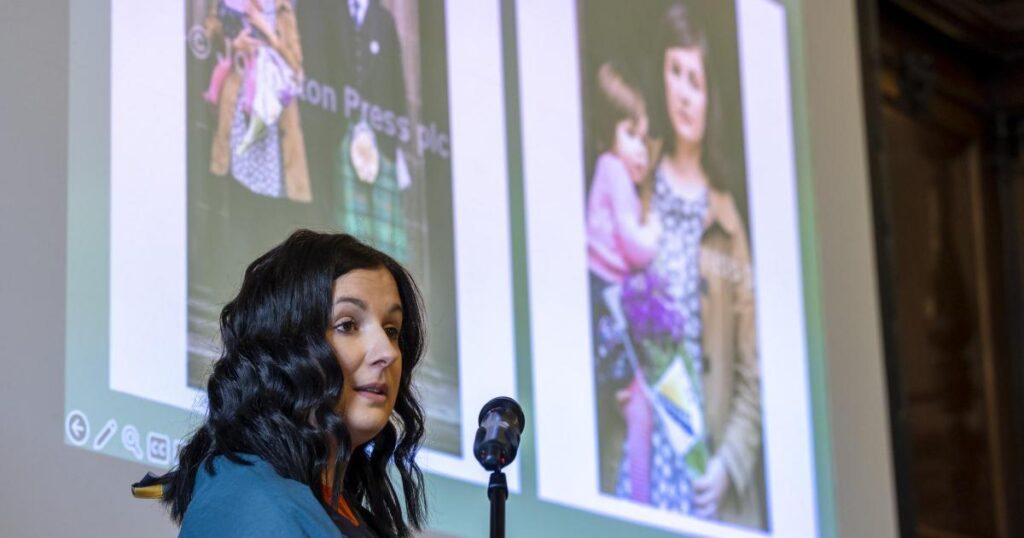
Her connection with Beyond Srebrenica began in 2015 when, while on maternity leave, she attended a remembrance ceremony outside St Giles’ Cathedral in Edinburgh carrying her toddler daughter and flowers bearing the Bosnian flag. A photograph taken that day captured the moment.
A decade later, she recreated the image alongside the charity’s founding chair, the Rev Dr Lorna Hood, and her eldest daughter Elsa, now approaching her teenage years, with the original photograph projected behind them.
Marking 10 Years of Beyond Srebrenica, Sabina Kadic-Mackenzie with her eldest daughter Elsa and former chair of the the charity, Rev Dr Lorna Hood. (Image: Martin Shields)
Today, she chairs the charity that first welcomed her through its doors that summer afternoon.
Addressing guests this week at the event in commemoration of White Armband Day, Ms Kadic-Mackenzie said the lessons of Bosnia remain urgently relevant.
“Genocide and acts of hatred happen to ordinary people.
“I think it’s important to remember though that ordinary people make them happen.”
More than three decades after the order was broadcast across Prijedor, campaigners continue to raise awareness of the atrocities committed there and to seek recognition for the victims.
Bosnia remains politically divided along ethnic lines, with some leaders continuing to dispute or downplay the genocide and other wartime crimes.
For Ms Kadic-Mackenzie, remembrance is not only about honouring those who were killed, but also about ensuring future generations understand how quickly ordinary lives can be torn apart by hatred.
“It is our duty to remember, to educate, and to act so that the past informs a more just and peaceful future for all.
“And to remind the world of these words: ‘Zakopali su nas, ali nisu znali da smo sjeme.’
“’They buried us. But they didn’t realise that we are seeds.'”
While the genocide at Srebrenica remains the most widely recognised atrocity of the Bosnian War, Beyond Srebrenica was founded to ensure the stories of victims across Bosnia are not forgotten.
Through educational programmes, remembrance events and study visits, the Scottish charity works to raise awareness of the genocide and war crimes committed not only in Srebrenica, but also in communities including Prijedor, Foča, Ključ and Sanski Most -places where thousands of lives were devastated by ethnic cleansing and persecution.