
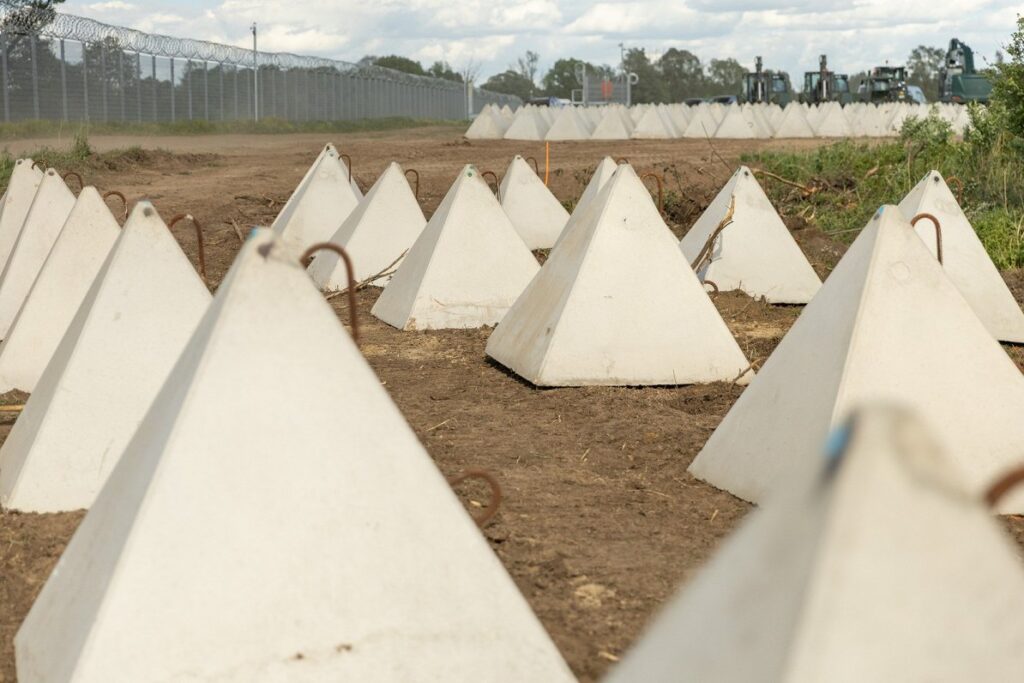
This month, the National Armed Forces (NBS) began deploying the first anti-mobility barriers, so-called dragon’s teeth, on the expropriated territories along the Latvian-Russian border, LSM’s Latgale editorial reports on May 28.
The land was previously expropriated for national defence purposes, as the construction of the Baltic Defence Line’s infrastructure is planned directly along the border, including areas where private property is located.
The barriers, arranged in three rows approximately ten meters wide, are intended to prevent the movement of military equipment across the border. Each of the “dragon’s teeth” weighs about one and a half tonnes. Military officials noted that the gaps between them are small so that military vehicles cannot drive through.
The construction and delivery of anti-mobility barriers to their deployment sites began as early as 2024, but their physical installation on state and municipal territories began in 2025. Several factors have delayed the work so far – the border construction process, coordination with the State Border Guard, and the locations of the sites.
One of the biggest challenges has been land expropriation, as part of the infrastructure is being built on private property. Military officials emphasised that the Law on the Establishment of Anti-Mobility Infrastructure has significantly accelerated the process.
“Until the Law on the Establishment of Anti-Mobility Infrastructure was adopted, we faced restrictions. We could not come in and begin deploying these mobility barriers on private land. At this point, that has been resolved,” noted Colonel Andris Rieksts, the officer in charge of the Baltic Defence Line project.
Owners will receive fair compensation for the expropriation of land needed for infrastructure construction, to be determined by a special commission with the assistance of a certified real estate appraiser.
The purpose of the defence line is not only to deter a potential adversary but also, if necessary, to stop and destroy it while it is still at the border.
“If something does happen, we need to be able to destroy them here, because we see that in Ukraine – once we give up land, it’s practically impossible to get it back,” said Colonel Rieksts.
He noted that in modern warfare, it is not only defence against drone and missile attacks that is essential, but also control of the ground.
“They won’t be able to conquer us with drones. In Ukraine, we see that there are hundreds of drone and missile attacks every day, but as long as the land is held and no one physically comes and drives people out of their homes, that land is ours,” Rieksts noted.
In addition to the “dragon’s teeth,” anti-tank ditches are also planned for construction in the future.
Latvia’s border with Russia and Belarus is approximately 450 kilometres long in total. This year, the National Armed Forces (NBS) plans to construct more than eight kilometres of anti-mobility infrastructure.
The Baltic Defence Line project is being implemented in cooperation with Lithuania, Estonia, and Poland. The project began about two years ago, and all planned work is expected to be completed by 2028.
Select text and press Ctrl+Enter to send a suggested correction to the editor
Select text and press Report a mistake to send a suggested correction to the editor
Tell us about a mistake