
Illustration: Mark Antonius Puhkan
The Women’s Voluntary Defense Organization’s drone unit is waiting for us in a small grove of trees. There are five of them. They sit on tussocks, leaning their backs against the trees — just as I do when I am on an exercise.
You are all from the Women’s Voluntary Defense Organization, but now you are wearing camouflage uniforms. How does that fit together? We are used to seeing you in the smart formal uniforms of the organization.
“That is ceremonial — what we wear at parades. When we are working, we wear the Defense Forces’ field uniform.”
That image is a bit outdated, isn’t it — that the Women’s Voluntary Defense Organization means ladies handing out soup.
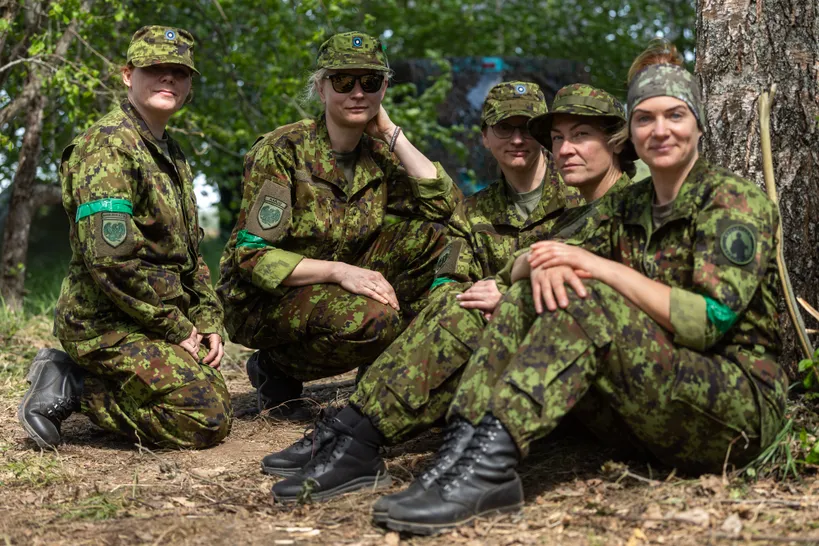
The Harju District drone unit of the Women’s Voluntary Defense Organization during the Spring Storm exercise. Photo: Martin Pedaja
What are your living conditions like? Where do you sleep?
We sleep in a section tent. It is literally down to earth. We sleep in sleeping bags on the ground.
I interviewed Ukrainian drone operators in the summer and asked how many Russian soldiers they had killed. I’ll ask you as well: how many enemy troops have you destroyed?
That is up to the umpire to decide; we do not directly make that call.
Right, but on the screen you have seen when the enemy has been hit?
Oh yes, there have been plenty. We have not counted them. A lot. Even with that same Ukrainian drone standing over there.
Can you see that on your own screen as well?
When they go flying, they send the feed to us. We can see the video feeds from all the drones.
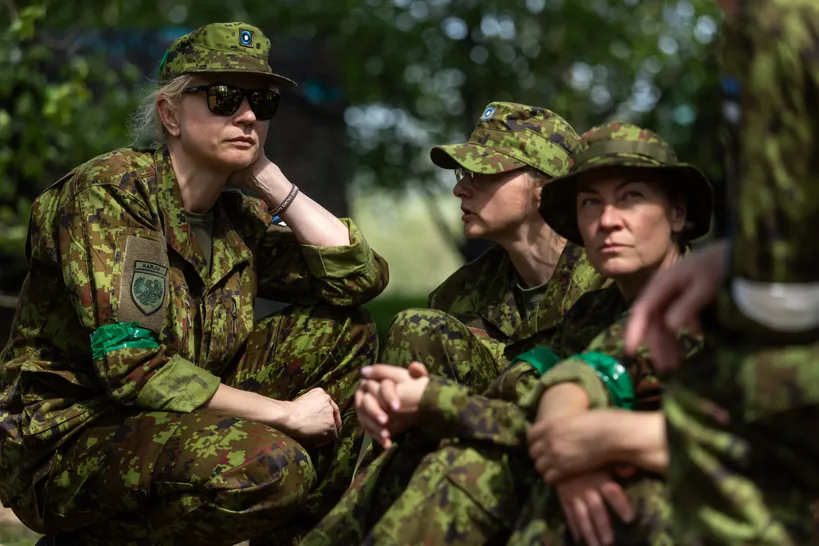
Photo: Martin Pedaja
But what do you do with that image next?
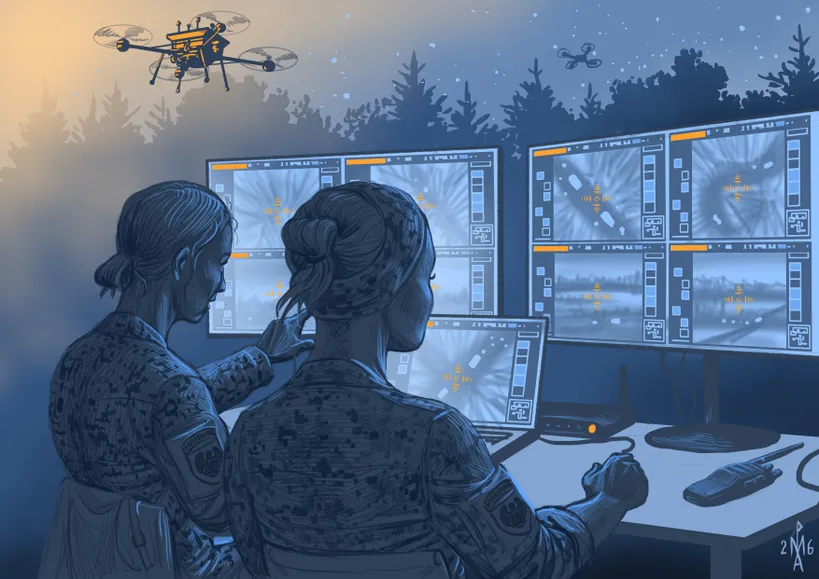
We have forward observers next to us, as well as people working in reconnaissance and intelligence analysts. They have the bigger battle plan and their own areas of interest. Our job is to guide the drones to the right place and ask them to look at one thing, then another, then a third. Then we summarize it and pass it up the chain.
The battalion command post cannot deal with every single thing itself. They need to see the big picture, and our job is to filter out for them the most important information that can be seen from those drone feeds.
What has been the most striking moment? You were on watch — what happened?
When we found a target and sent a drone after it. Usually the drone is left there to observe once fire has been called in. Then you see the “tennis balls” — the bombs — falling.
And it was they who dropped them, those same Ukrainians?
Yes.
But how do you know it is the enemy? What if they are friendly forces?
That has been determined for us.
There is no room for error?
No.
What has been the most surprising thing about this exercise?
How quickly the information moves. Everyone is aware of what is happening, videos come in, you see where people are, you pass on where they need to go. It all happens so fast. At the same time, fire is already being called in.
We understand that this is a game. But in reality, we are rehearsing a situation that could become real. When you think about that, it is a little frightening. But it is very good to know that we can make our contribution.
But if other women read this and think that what you are doing is still very military, what would you say to them?
Even if it seems too military, we should think about how each of us can contribute to national defense. I get a lot of feedback from acquaintances saying how great it is that I am there, but my immediate counter-question is: what are you doing? When people say that after the war in Ukraine so many women joined, the fact is there are still only 4,000 of us. That is not many. The number could be much higher.
We cannot all just run away from here — and there is no point. Where would we go?
Yes, look at the map — where would we run to?
It is better to know and have information so you can protect yourself.
It is better to be aware than to be panicked and afraid.
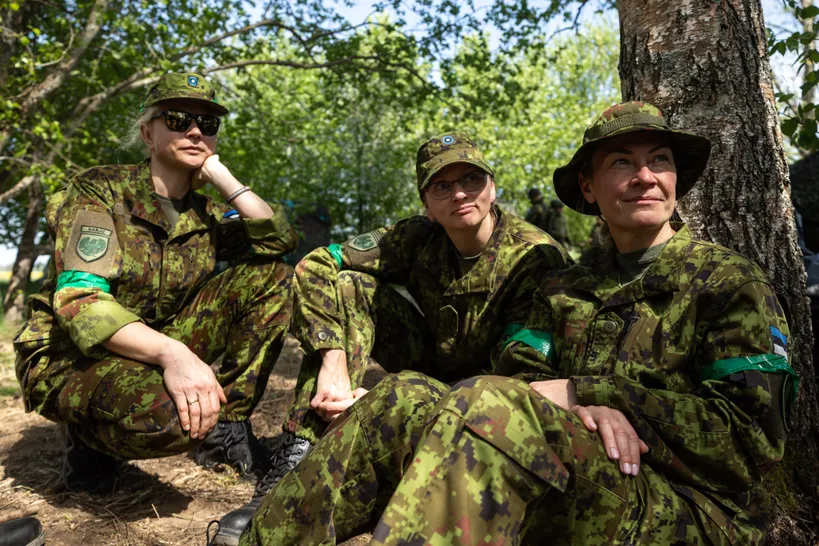
Photo: Martin Pedaja
What would you say to those who are reading this and thinking, “Well, if war ever breaks out, I’ll come and help then”?
By then, it is already too late to start thinking about it. Training should begin today.
Given how few people there are in Estonia, everyone should know how to do something.
Every nut and bolt counts (laughs). After all, we want Estonia to remain free.
Perhaps some women are thinking, “I certainly don’t want to go out into the woods with all those men.”
There is nothing to be afraid of. The men are very supportive. And what difference does it make who you are here with — men, women, children. Children might be more difficult (laughs).
They are the same kind of men you have at home. The only difference is that you do not have to come here with your spouse, because your husband might be somewhere else in the forest.
This is not some kind of dating scene.