
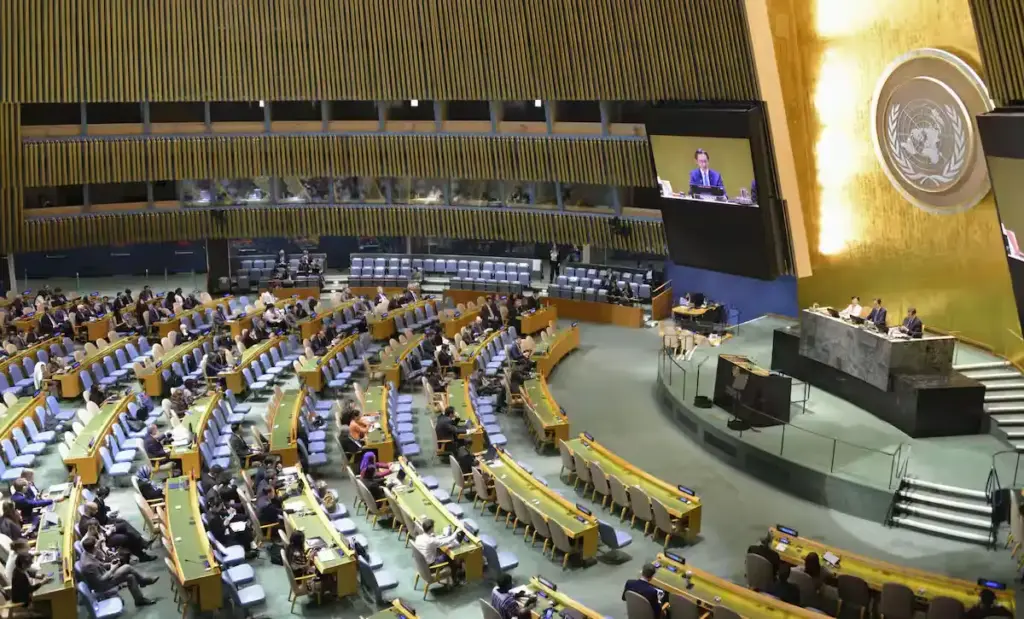
On May 22, the Review Conference of the Treaty on the Non-Proliferation of Nuclear Weapons (NPT) ended without adopting an outcome document outlining shared goals for all member states.
It was the third consecutive time that the conference, held once every five years, had collapsed without producing such a document. Many have warned that this marks a serious blow to the NPT framework, which is intended to advance nuclear disarmament and nonproliferation.
But Japan cannot afford to simply lament the failure. What it needs now is an effective nuclear deterrence posture. Above all, Japan should strengthen its alliance with the United States, which provides extended deterrence, to ensure that the country is not subjected to nuclear attack or nuclear coercion.
A Flawed Treaty Under Strain
The NPT is inherently unequal. It permits only the five “nuclear-weapon states”—the United States, Russia, Britain, France, and China—to possess nuclear arms, while denying that right to all other “non-nuclear-weapon states.” Although the nuclear-weapon states are obliged to pursue nuclear disarmament negotiations in good faith, progress has been painfully slow.
Outcome documents at NPT Review Conferences are adopted by consensus. In this case, the United States pushed for wording stating that Iran’s development or possession of nuclear weapons could not be tolerated. Iran, which maintains that its nuclear program is solely for peaceful use, and Russia demanded that the language be removed. The resulting standoff prevented the document from being adopted.
Iran’s acquisition of nuclear weapons could pose a threat to the entire world. It is regrettable that the conference failed to adopt an outcome document that addressed the issue.
Even so, it is difficult to believe that such a document would have done much to advance nuclear disarmament. When the world had only two nuclear superpowers—the United States and the Soviet Union, later Russia—there was still room for arms reduction.
Today, however, there are three major nuclear powers: the United States, Russia, and China. Each must take into account the nuclear forces of the other two, making negotiations extraordinarily difficult. China, meanwhile, is rapidly expanding its own nuclear arsenal and has shown little appetite for joining such talks.
The draft outcome document had other problems as well. In the final version, for example, language rejecting North Korea’s possession of nuclear weapons was removed at Russia’s request.
Deterrence Still Matters
Until midway through the negotiations, the draft even included language proposed by China on the no-first-use of nuclear weapons. When an aggressor is prepared to attack with overwhelming conventional force, leaving open the possibility of nuclear retaliation can, in practice, help deter aggression.
That was the reality in Europe after World War II. Nuclear forces also help deter the use of other weapons of mass destruction, including biological and chemical weapons. Abandoning these forms of deterrence would be far too dangerous.
Given the current level of science and technology, nuclear deterrence remains essential to preventing the horrors of nuclear war. Any serious pursuit of peace must be grounded in that reality.

RELATED:
(Read the editorial in Japanese.)
Author: The Sankei Shimbun
Continue Reading