Clear evidence found that some supermassive black holes form without a stellar collapse
https://www.earth.com/news/clear-evidence-found-that-some-supermassive-black-holes-form-without-a-stellar-collapse/

Clear evidence found that some supermassive black holes form without a stellar collapse
https://www.earth.com/news/clear-evidence-found-that-some-supermassive-black-holes-form-without-a-stellar-collapse/
3 Comments
[https://science.nasa.gov/missions/webb/nasas-webb-reveals-black-hole-that-formed-before-its-galaxy/?utm_source=chatgpt.com](https://science.nasa.gov/missions/webb/nasas-webb-reveals-black-hole-that-formed-before-its-galaxy/?utm_source=chatgpt.com) Instead, the observations favor the idea of a **direct-collapse black hole**, where a huge cloud of primordial gas collapses almost directly into a massive black hole without first forming normal stars. Another possibility discussed by researchers is a **primordial black hole** origin, though that remains more speculative.
This doesn’t surprise me. The thing about black holes is that a sphere’s volume increases with the radius while gravity decreases by the square.
So if you compress matter enough anything can be a black hole. This is the swarzchild (spelling) radius. The smaller the mass the more dense it will be. If earth could be compressed to a marble around 2cm (about an inch) it would be a black hole. But the density is more than that of neutrons.
For super massive black holes like the one at the center of the galaxy. The density is that of normal matter. Just gas or water in its natural state would be enough.
Astronomer here! Ok this is really cool! [And the NASA press release is a far better read btw.](https://science.nasa.gov/missions/webb/nasas-webb-reveals-black-hole-that-formed-before-its-galaxy/)
It’s a curious fact of the universe that we see two kinds of black holes out there- “stellar mass” black holes which form when a supermassive star many times the Sun collapses at the end of its life (<100x mass of Sun) and supermassive black holes (SMBH), which are at least a *million* times the mass of the Sun. There’s like… ~10 cases in between, which are things like [a 225x mass of sun black hole found by LIGO](https://www.caltech.edu/about/news/ligo-detects-most-massive-black-hole-merger-to-date), thought to be formed by the merger of stellar mass black holes. But the point is, if you assumed black holes would span the entire mass range and we should see black holes a couple thousand times the mass of the sun, you’d be *very* much wrong.
Now with that there’s an obvious question of how to form SMBH. There are two choices- first, that stellar mass black holes in the early universe merged like crazy like the LIGO one, and we ended up with SMBH. The second option is in the very early universe, where we know tiny fluctuations ended up in large changes in density in mass, you had some densities *so* high that you had the direct collapse of material into black holes. This situation is something that would have only been possible in a brief moment in the very early universe, and has been less favored by theorists because in the absence of evidence there’s a few things just too “convoluted” that have to happen to make the direct collapse scenario work over the merger one (at least, that’s what the theorists have told me). This has huge questions for galaxy formation and not just black holes- if every galaxy has a SMBH at its center, as appears to be the case for normal galaxies, does the SMBH form from the galaxy or does it “seed” the gas around it as an intergalactic anchor?
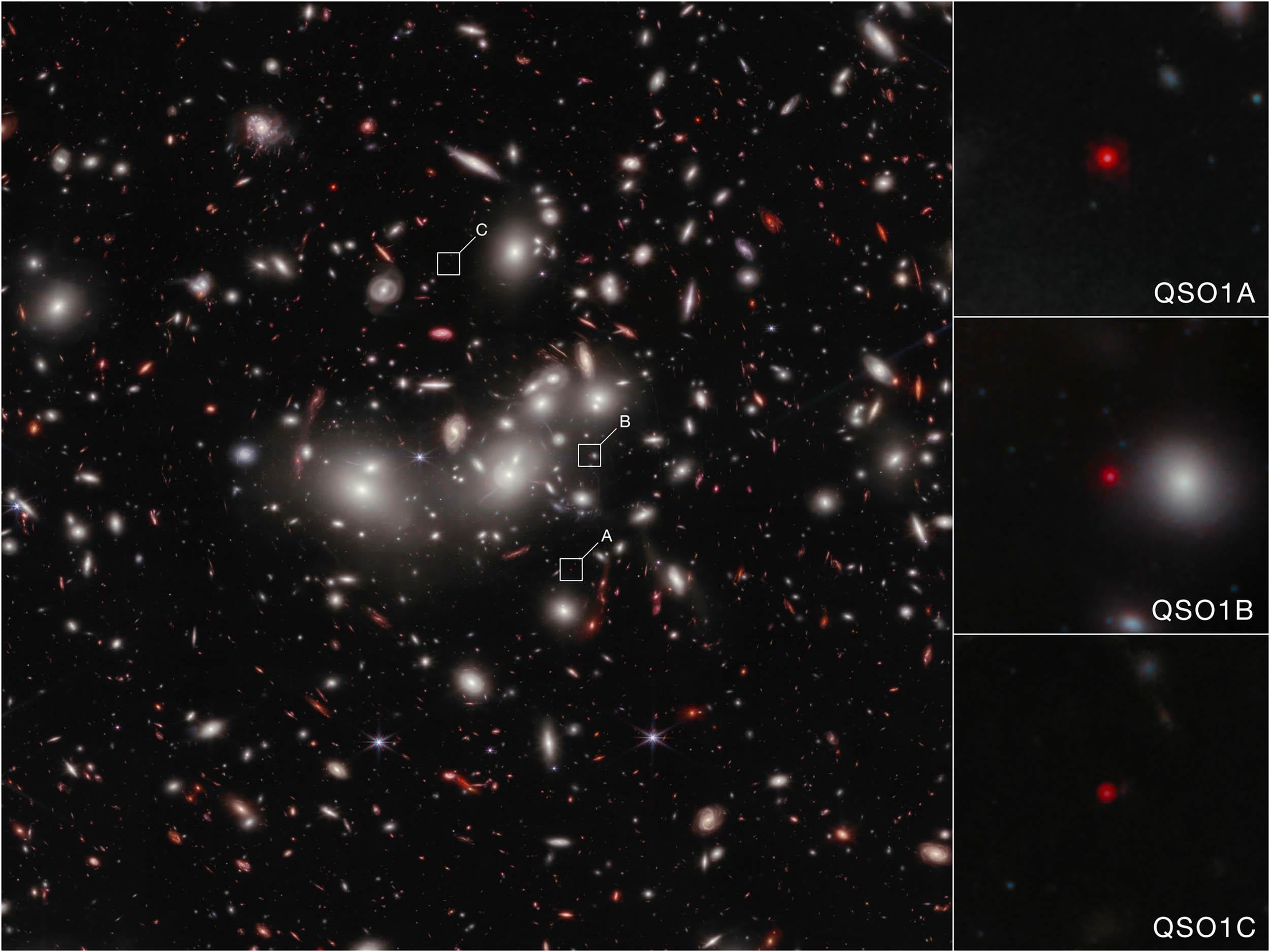
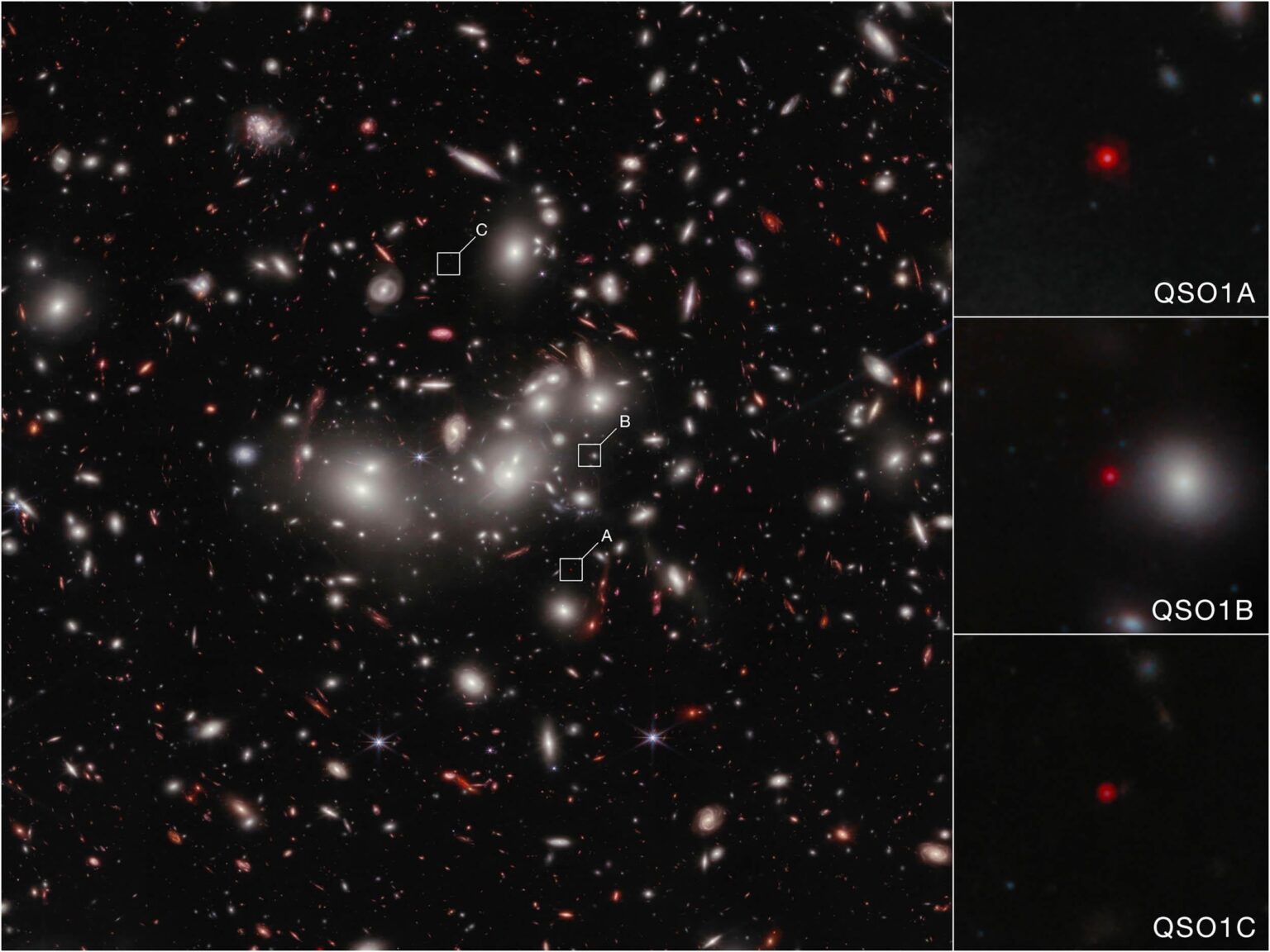
Luckily the universe doesn’t care what we think, as shown by [this exciting paper!](https://www.nature.com/articles/s41586-026-10579-4) The astronomers used JWST to study a black hole called QSO1, just 700 million years after the Big Bang, which this study argues is a black hole with gas swirling around it. So much gas in fact that it follows Keplerian motion- ie how orbits for planets work- so it’s an easy calculation to show this black hole is 50 million times the mass of the sun (ie very definitely a SMBH). What’s more, they can use the spectrum of the source to establish that it’s basically all hydrogen and helium- the materials from when the Big Bang occurred, with no trace of heavier elements formed in stars (which astronomers call “metals” believe it or not- yes this means oxygen and carbon are metals to us!). What’s more, this is one of the lowest metal environments ever measured- there’s just no *way* enough stars have died around the SMBH to form it because a ton of metals would have been ejected. So- direct collapse looks really darn convincing here!
So, I’m really excited about this one! Full confession time as to why, I always really preferred direct collapse for SMBH formation, which as I said has been less favored but I always felt made more sense. I’m not a theorist though, nor do I work in formation, nor does the universe care what I think, so it’s been one of those preferences in science that humans who do science are allowed so long as they’re not taken seriously. But hah- the universe doesn’t care what our best theoretical understanding is either! Gonna be really cool to see how this shakes out. 🙂