
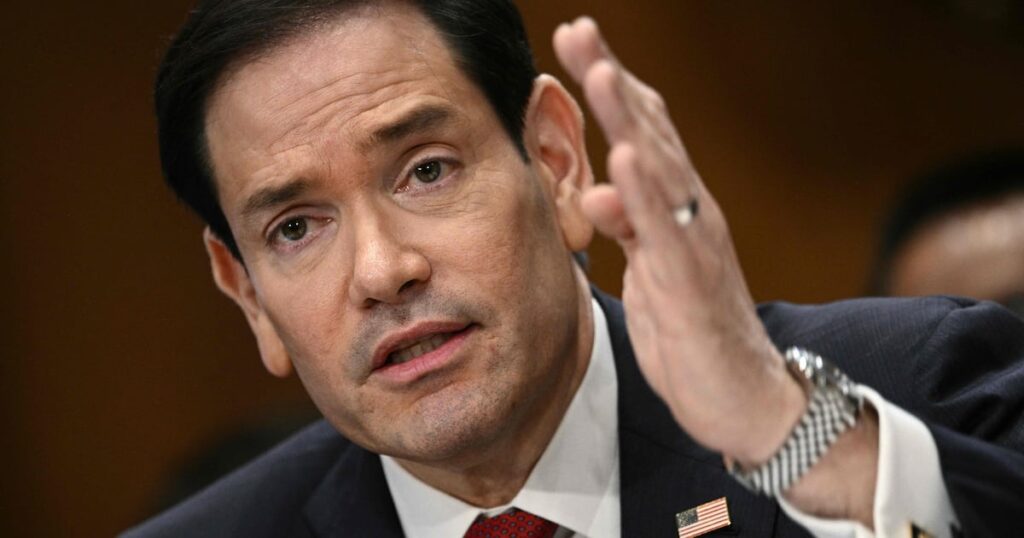
US Secretary of State Marco Rubio on Tuesday said Iran must commit to negotiating “severe and long-term” limitations on its nuclear programme as part of a peace deal.
Speaking to the Senate Committee on Foreign Relations, Mr Rubio also said technical talks could take months to finalise.
Under an initial understanding the US is pursuing with Iran, Tehran would agree to reopen the Strait of Hormuz. Once that happens, a second phase of talks for a durable peace deal would start.
“Phase two is they [Iran] have to commit to very specific negotiations on [the] disposition of the highly enriched uranium that still is buried deep in a mountain somewhere,” Mr Rubio said.
“They have to agree on negotiating severe and long-term limitations and, or, cancellation of enrichment in activity in the second phase of negotiations.”
He said such highly technical matters could not be worked out in a few days. “That would require a team of experts to meet over a 30, 60, 90-day period and work out the details, but they have to commit to their willingness to do that,” Mr Rubio said.
Mr Rubio said US President Donald Trump‘s negotiating team has not offered Iran any sanctions relief in exchange for reopening the Strait of Hormuz.
He insisted any sanctions relief was tied to Tehran giving up its nuclear programme. Mr Trump has long said Iran can never have a nuclear weapon.
Mr Rubio’s testimony came as the Trump administration seeks congressional approval for its proposed 30 per cent cut to the foreign affairs budget and a 50 per cent increase in military spending.
His testimony marked the first time since January, the month before Mr Trump and Israel launched the war on Iran, that Mr Rubio had testified in front of politicians.
He said Iran’s supreme leader Ayatollah Mojtaba Khamenei is now taking a more active role in his country’s affairs after he was severely wounded in an Israeli strike on February 28, the opening day of the Iran war.
“We haven’t seen him publicly,” Mr Rubio said, noting that was understandable given the number of Iranian leaders killed by Israeli and US strikes. “Being very public is probably not something that’s recommended for them”
“But that said, I think there are indications out there that he is increasingly engaging at some level, although all of his communications have been in writing and through intermediaries,” Mr Rubio added.
Iran on Monday said it was suspending talks to end the war, now in its fourth month, because of continuing clashes between Israel and Hezbollah in Lebanon, which Tehran has said must end as part of a broader peace deal.
USAID cuts
In a statement released before a separate hearing in front of a House panel later on Tuesday, Mr Rubio made no mention of Iran, Israel or the Middle East – instead touting the January raid that captured Venezuela’s then-president Nicolas Maduro and the fight against drug cartels.
He also cast the closure of the US Agency for International Development and the reorganisation of the State Department – which included significant layoffs – as transformative successes of his tenure.
But Senator Jeanne Shaheen, the senior Democrat on the Senate Committee on Foreign Relations, said USAID cuts may have fuelled the current Ebola outbreak in several African countries.
“At this budget hearing last year, you testified that no one had died as a result of foreign aid cuts,” Ms Shaheen said. “Sadly, I think we’re seeing in real time that that’s not true today. There are more than 1,000 cases, more than 200 Ebola-related deaths.”
The Trump administration last year pulled funding for Gavi, the Vaccine Alliance, but Mr Rubio said a decision had been made a few weeks ago for the US to re-engage.