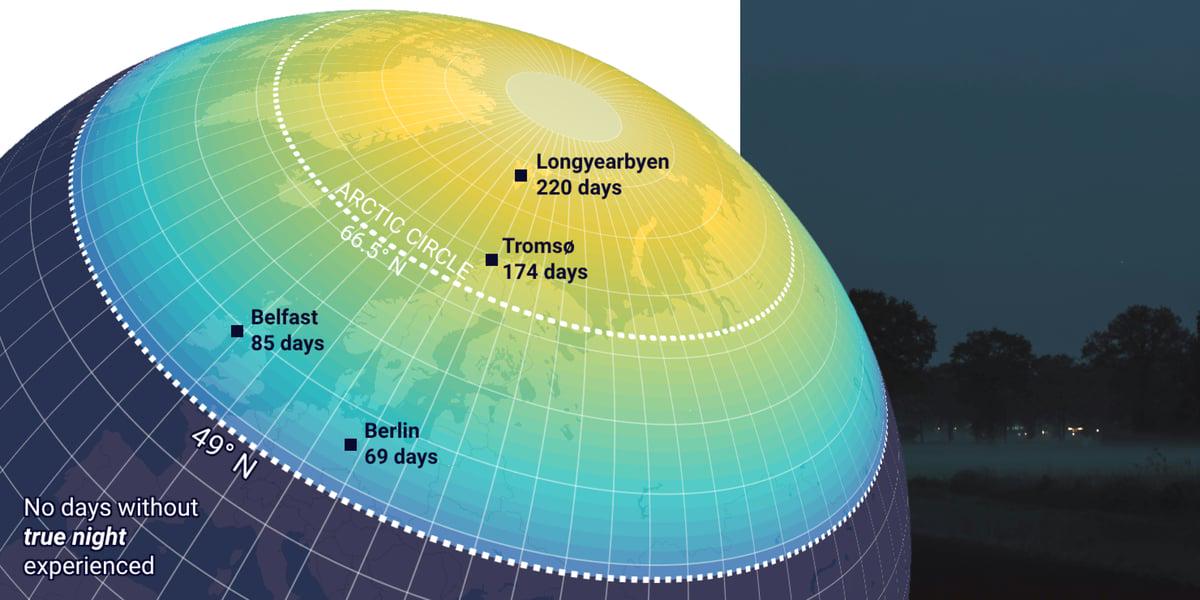
TIL that for multiple decades of my life I was going over 2 months a year without night.
p00p00kach00 on
That’s pretty cool.
Back in my astronomer days, to get the really low light stuff, you also need to observe around the new Moon phase because even moonlight can make very faint objects elsewhere in the sky harder to see (and the problem with a full Moon is that it’s in the night sky the whole night).
If you’re wondering why it’s the 49 degree latitude (north or south), it’s pretty simple. Earth’s tilt is 23.5 degrees. Add 18 degrees to get to the edge of astronomical twilight. That’s 41.5 degrees. Since you’re measuring from the pole, you do 90 degrees minus 41.5 degrees (hence why the arctic and antarctic circles are 66.5 degrees N/S). That’s 48.5, which I assume they just round to 49 degrees.
The jump from 0 days of true night to 30 confuses me a bit though.
Edit: I’ve used /u/seedless0’s link to find a latitude where they have one night of “true night”, and it’s only 1 minute on the summer solstice (June 21): 48°33’53.3″N 8°41’35.9″E
So it’s just a very steep gradient. It doesn’t suddenly jump from 0 days of true night to 30 over a line, but it does change extremely steeply right there.
HeyLittleTrain on
I don’t get how somewhere can have more than half a year without true night. Shouldn’t it be extra dark for the other half of the year?
Zagrebian on
I lived above the “no days without true night” line without knowing it.

5 Comments
Very handy tool to check the day/night length of each day at a location: https://www.timeanddate.com/sun/germany/berlin
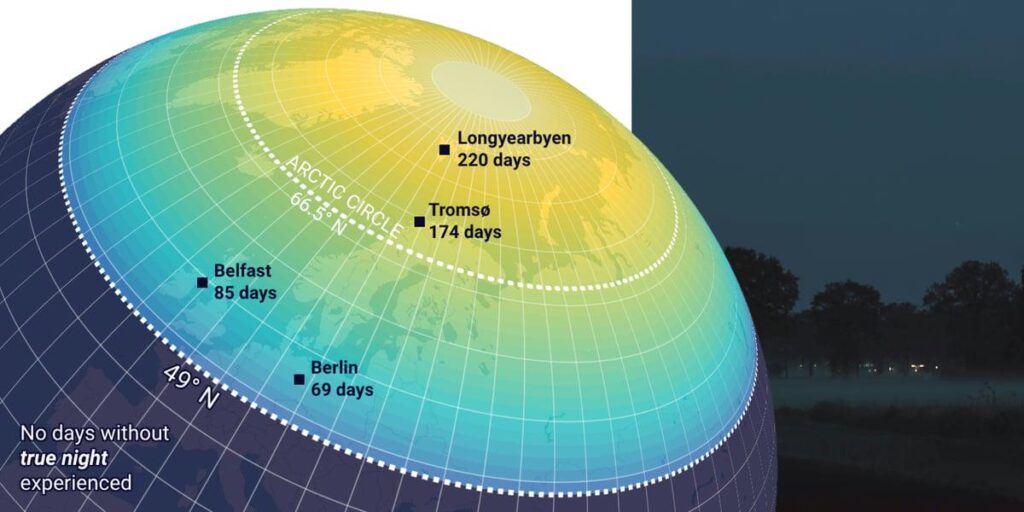
TIL that for multiple decades of my life I was going over 2 months a year without night.
That’s pretty cool.
Back in my astronomer days, to get the really low light stuff, you also need to observe around the new Moon phase because even moonlight can make very faint objects elsewhere in the sky harder to see (and the problem with a full Moon is that it’s in the night sky the whole night).
If you’re wondering why it’s the 49 degree latitude (north or south), it’s pretty simple. Earth’s tilt is 23.5 degrees. Add 18 degrees to get to the edge of astronomical twilight. That’s 41.5 degrees. Since you’re measuring from the pole, you do 90 degrees minus 41.5 degrees (hence why the arctic and antarctic circles are 66.5 degrees N/S). That’s 48.5, which I assume they just round to 49 degrees.
The jump from 0 days of true night to 30 confuses me a bit though.
Edit: I’ve used /u/seedless0’s link to find a latitude where they have one night of “true night”, and it’s only 1 minute on the summer solstice (June 21): 48°33’53.3″N 8°41’35.9″E
https://www.timeanddate.com/sun/@48.5648,8.69331
If I go just 110 meters to the north (https://www.timeanddate.com/sun/@48.5648,8.69331), they have two nights without “true night”.
So it’s just a very steep gradient. It doesn’t suddenly jump from 0 days of true night to 30 over a line, but it does change extremely steeply right there.
I don’t get how somewhere can have more than half a year without true night. Shouldn’t it be extra dark for the other half of the year?
I lived above the “no days without true night” line without knowing it.