
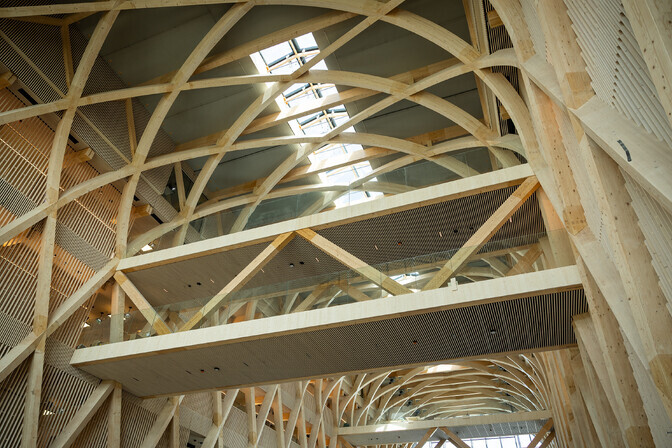
The new Nature House in Tallinn, right next to the Seaplane Harbour will be completed this year, and the Natural History Museum will open during 2027.
The Nature House Taru complex consists of three buildings connected by an underground level, with a total floor area of nearly 25,000 square meters. In addition to the Natural History Museum, several institutions related to the Ministry of Climate and the Language Board will also find a new home there.
The complex was designed by architects Siiri Vallner, Indrek Peil, Kristel Niisuke, and Ko Ai from the architecture firm Kavakava.
The building is constructed largely from wood, which will store 3,900 tons of carbon over the long term and demonstrate the possibilities of modern timber construction.
Smart solutions have been used in the construction. For example, the storage walls are coated with clay plaster made from clay excavated from the foundation pit, helping maintain proper humidity levels even in the event of a temporary power outage.
“We see many glass surfaces here that are dotted, one reason being to prevent birds from flying into them. The facades also include nesting boxes for swifts and bats, and soil has been brought in from the Rail Baltica project area,” said Heidi Jõks, director of the Natural History Museum.
A natural outdoor area surrounds the buildings, serving as an introduction to the museum’s exhibits.
“This area features elements of Estonia’s natural habitats — you can find all native trees and shrubs here. In the distance, a meadow habitat is taking shape, and a bit further away, a heath forest habitat. Essentially, it’s an introduction to the entire environmental theme that is thoroughly covered inside the building,” Jõks explained.
An international design competition was held to create the new permanent exhibition.
“We received submissions from across Europe, including Estonia. The winning concept came from an Austrian-Italian team based in Amsterdam, so it has truly been a multicultural effort,” said Evelin Pääsukene, creative lead for exhibition projects at the museum.
“We will tell the story of coexistence — meaning that as an innovative and modern museum, we will bring in the human perspective. We won’t speak only about the natural environment, but about how humans relate to nature,” Jõks added.
The more than 3,000-square-meter Natural History Museum is expected to open its doors to visitors in about a year. For the first time, all museum collections — currently scattered across the city — will be brought together under one roof in proper storage conditions. Instead of the current 50,000 visitors per year, the fully accessible museum is expected to welcome 200,000 to 250,000 visitors annually.
The construction of Nature House will cost €54.3 million (excluding VAT).
—