

For the last eight months, The Athletic has been investigating the threat of fixing to the integrity of sport. In this fourth article in the series, we look at how a fixer claimed to have relegated dozens of clubs in Brazil as part of his profit-making scheme.
Also in this series:
The quotations from William Pereira Rogatto, Romario and Dayana Nunes Feitosa are taken from testimony to the Brazilian senate, which was translated by The Athletic.
The fixer’s face is bulbous as he testifies via video link, his features fisheyed by the camera’s lens. Behind is the brushed leather and minimalism of luxury. This man was born William Pereira Rogatto, but his activities have earned him another name.
“I win by losing games, by handing them to the opposition,” he explains. “I have relegated 42 football clubs since 2009, including some big ones. That’s why they call me the Relegation King.”
On the other end of the call, the suited politician leading proceedings is impassive. He is only faintly recognisable now, with thinning grey hair rather than the shaved head and crazed eyes of 30 years before. The odd flash of rage is still visible as he addresses Rogatto, disdain dripping from his questions.
Romario’s life has been wild and winding. Football legend, winner of the 1994 World Cup and that tournament’s Golden Ball (awarded to the World Cup’s best player), the 60-year-old now sits as a senior senator for Rio de Janeiro as a member of the Jair Bolsonaro-aligned Liberal Party. For decades, interactions with the former Barcelona forward have demanded either respect or fear. Rogatto opts for neither, leaning even further into the camera and addressing him with an uncanny directness.
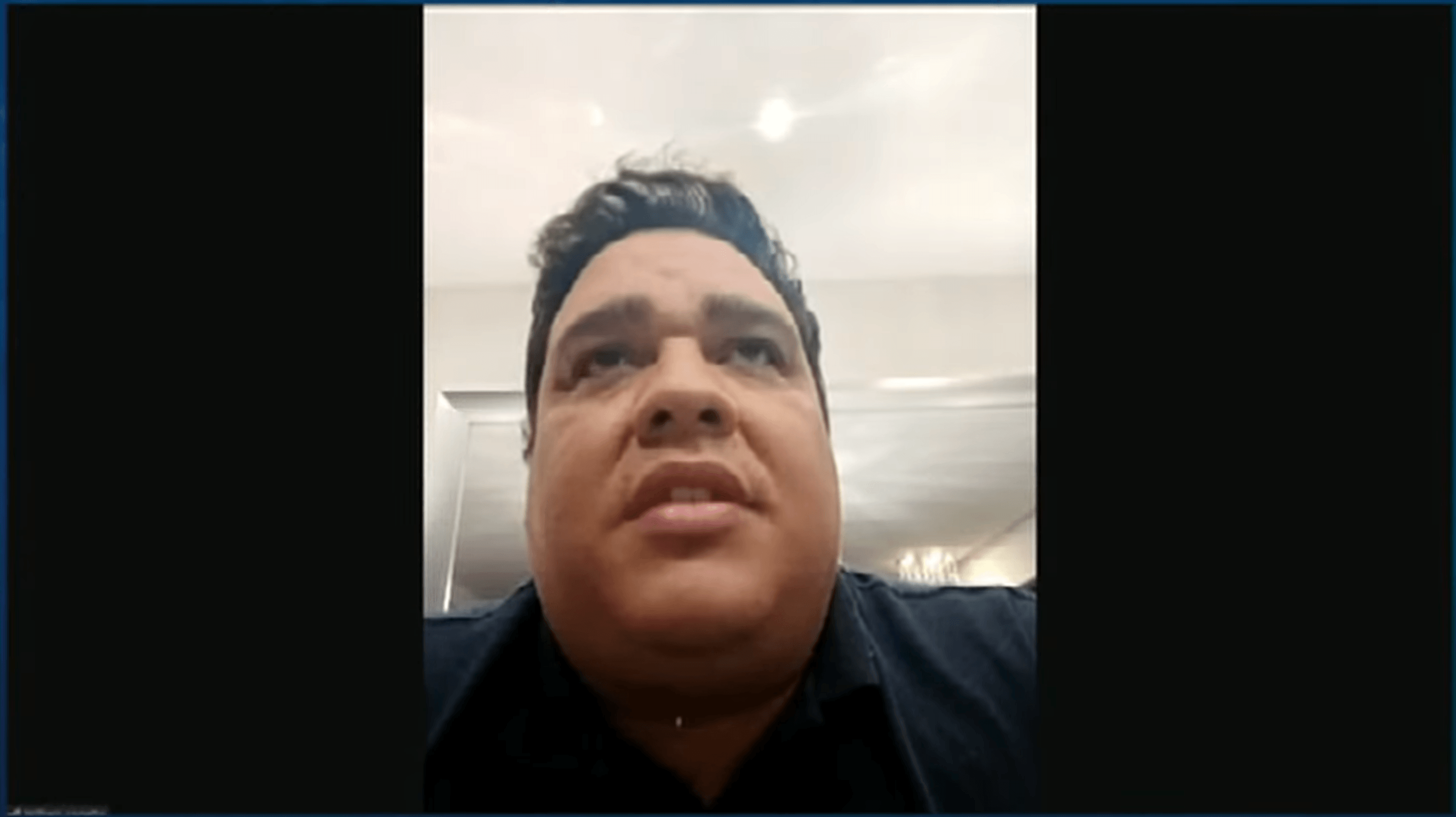
Rogatto addressing Romario and other Brazilian politicians over video link (Credit: TV Senado)
“I’m sorry, Romario, with all respect for you as a player and a person, I have to tell you that this won’t achieve anything,” he says. “It will create victims of the system and in the end, nothing will change. Why? Because this isn’t new. It’s been around for 30, 40 years. You know this. Let’s not try and block the sun with a sieve. This has existed for a long time.”
There is truth behind Rogatto’s bluster. This inquiry, held in October 2024, is Brazil’s latest reckoning with match-fixing. That year, the nation topped multiple regulators’ global lists of suspected manipulation. Sportradar, for example, detected 109 cases, down from 153 the year before.
In this context, Rogatto is an arapaima, a big fish, the top predator and rarely seen. “I believe that if I wasn’t the biggest in Brazil, I was certainly the most organised,” he proudly tells the senators. Later, he extends an invitation for investigators to see his “complex system”, including photos, videos, and audio recordings, as if hosting an episode of MTV Cribs.
Here, speaking from his own self-imposed exile in Dubai, Rogatto believes he is safe to talk. He has chosen to give evidence to the inquiry, set up to investigate the wider landscape of fixing within Brazil. He claims at one point to have fixed matches in all of Brazil’s states, that several top-flight stars were in on the scheme, and that some of the country’s biggest clubs were also involved.
“Do you understand that the system is much bigger than what we’re doing here?” he says, when pressed on whether there was potential wider involvement from officials and politicians, in a tone verging on frustration.
“You also know that I can’t say every name, for my security. I’m not crazy. But I’m here to help. The big players, the powerful people aren’t here, so it falls on me. Do you understand that this interview might cost me my life?”
Rogatto arrived in Las Vegas in 2009, his head filled with dreams of neon lights and windfalls. He told the commission that it was here he fell in love with gambling, that he wanted to open a betting shop of his own. And then he paused.
“I started to analyse the numbers, the odds. I saw that if a team conceded a certain number of goals, the (win) multiplier was higher. It could be 10 times, 15 times as much. What does that mean? If I put R$1,000 (about £150 or $200) down, I could get R$15,000 (£2,213/$3,050) back. In my head, I started to think about how I could do something different.”
According to him, he attempted his first fix later that year in the Campeonato Paulista, the state league governing the Sao Paulo region, featuring historic clubs such as Palmeiras, Corinthians, and Santos. He did not reveal which games he targeted — but was happy to discuss, gloat even, over his methods.
Step one: “So I would take a team that has financial difficulties, without the money to compete for trophies. They pay a fortune to put a team out and often don’t have enough to pay the players’ salaries. There are 12 big clubs in the country, five with quality, five more with potential, and the rest is a load of…”
Step two: “I would go in like someone who didn’t want anything in return. ‘OK president, shall we try for promotion?’. I would invest, I would take control. I had an agency, WR10. I told these players they would earn well with me, but they would have to facilitate results for me. At the start, they didn’t understand. But they were not always getting their salaries. They said, ‘OK, let’s try and do it’.”
Step three: “I set up an office in Sao Paulo. There were maybe 50 or 60 different computers each day, for each game. And then I would lay the bets. I was always in hiding. I presented myself as a nobody, because that’s how you do it right? A wolf in sheep’s clothing.”
He would often ask his players to record a video confirming the fix, or to appear on a video call, to be used as potential leverage if they reneged on the deal.
“I wasn’t going to deprive myself of proof,” he told the inquiry. “When I started, I was alone, with my own money. I didn’t need anyone. But there is a thing called greed, and it took over. I didn’t want another million; I wanted two. When I won two, I wanted five. Then I wanted 50. To do that, I had to place more people in the system… Only politics and drug trafficking are more lucrative than match-fixing.”
Rogatto has made a lucrative career of selling himself. Now, in front of the Senate, he is doing the same again, spinning between arguments with dizzying speed. At points he appears desperate to project himself as a mastermind, other times as a vigilante.
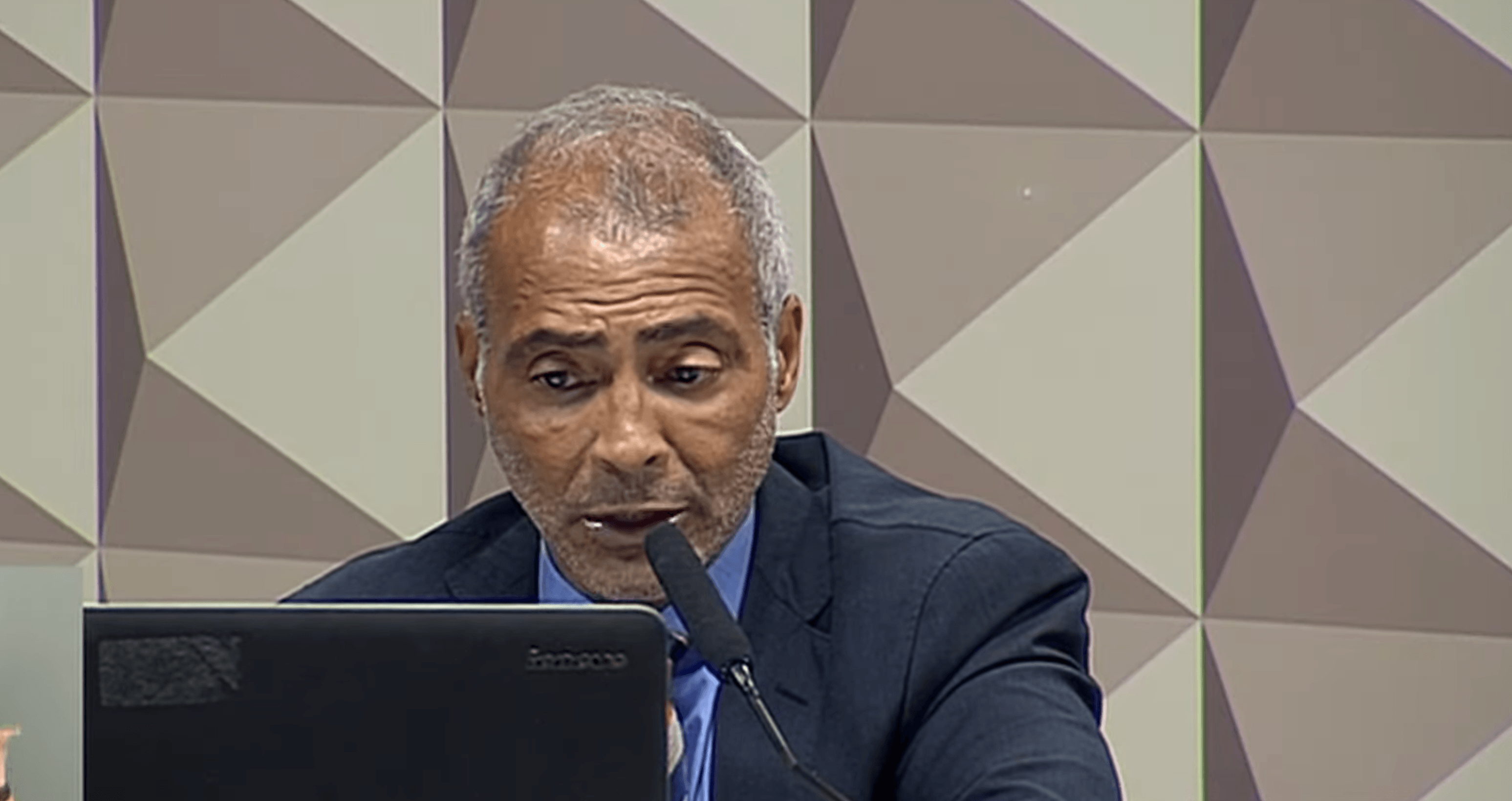
Romario speaking at the Senate hearing (Credit: TV Senado)
One argument takes aim at the betting industry itself, claiming what he does is no worse in terms of immorality. “I’m not taking from anyone. I’m going head to head with a machine and I found a gap for myself. I’m building on top of the system. I don’t mind being called a match-fixer but don’t call me a criminal or a bad person. I’m here so at least my son, when he is born, can say, ‘My dad was a man. He died as a man, not as a rat’.”
In his self-imagination, Rogatto often represents a Robin Hood figure, the generous bandit, redirecting money from club owners, federation administrators, and gambling executives to the players and referees themselves.
“When clubs aren’t able to pay salaries… sorry, my friend, but opportunity is what makes a thief,” he says to Romario. “Unfortunately, if you open the door, I’m going to go in. I’m a machine offering easy money to players and giving them the dignity of being able to feed their families.
“Is that so wrong? I don’t know. I don’t think so. There are people committing worse crimes. Murder, rape, drugs. I’m a system, a machine. Betting companies ruin people’s lives, people who don’t have the intelligence to deal with them. I take from the betting companies. It’s an exchange. The companies take from people and I take from them.”
There is only one moment, in over two hours of testimony, that the bluster slips.
“I would just like to say sorry to the president of Santa Maria and her husband, who had a serious health problem, if she’s listening. Sorry for tricking her. That’s my job.”
Dayana Nunes Feitosa sits herself down in the Senate next to Romario, staring at the former footballer as he orders his notes. She is composed as she prepares to give her deposition, but earlier looked on the verge of tears as she arrived in the room.
“I have suffered a lot,” she tells the inquiry, looking into the middle distance. “It has affected my mental state. I have been taking five prescription drugs; it affects my work, my life. Anyone who sees me today knows how my body is now: extremely swollen, fat, all because of my mind, the medication I take, everything I’ve been through.”
Santa Maria was Nunes’ club, her husband, Erivaldo, sitting as president. It was a difficult way to make a living. Competing in Brasilia’s regional state league, known as the Candangao, Santa Maria are professional but small, the sort of club, according to Nunes, where every ball kicked into a hedge needed to be accounted for.
At the end of 2023, Nunes’ husband suffered a stroke and entered a rehabilitation clinic. “I had to take over everything: our home, the team, everything that was his responsibility,” she says.

Dayana Nunes Feitosa giving evidence to the Brazilian Senate (Credit: TV Senado)
Shorn of attention, it was evident that the club was struggling — Nunes making it known on the grapevine that she needed help, both in terms of time and investment.
“Oddly enough, William (Rogatto) called me,” she testified. “He knew everything that was going on with the team. He asked what I had to offer him: if Santa Maria had a training centre, where we trained, several questions, and I told him, ‘There’s no point in asking me, because we have nothing. We don’t even have a ball’. That was the reality at that moment, especially because I had another concern, which was Erivaldo’s rehabilitation.”
Rogatto made his proposition known — he wanted to buy Santa Maria. “My husband was practically in a coma, and it was the greatest passion of his life. I told him that I wouldn’t do that, because doing that with him ‘asleep’ would be a kind of betrayal.”
But Nunes felt a sense of urgency. If they did not finalise their team by the start of the season, Santa Maria would be automatically relegated. So instead, the duo reached another deal — that Rogatto would help manage Santa Maria, but that any prize money from the state championship would be his. “I told him that was fine, because we had never made any money from football in Brasilia.”
The agreement was finalised. Rogatto began to put money into the team: buying new kit, adding staff members, signing players.
“To trick someone, you have to let them have a taste of the honey,” Rogatto had told the inquiry earlier in the day. “Sometimes (Nunes) would need something for the club and I would say, ‘I’m here. Stay calm because you won’t have any financial problems’. I would make bank transfers to her, give her a taste of honey, so she would never realise that I was going to fix matches. It’s as simple as that.”
Just one thing initially gave Nunes pause — that Rogatto fired the team’s coach, Christian Ramos, just before the start of the season, blaming him for getting involved in administration. Busy taking care of her husband, however, she chose to trust her benefactor.
“Everything was very calm,” she remembered. “I was working in peace, I was seeing things happen, and what put me most at ease was our first game, because it was against Samambaia, a big team, and we won.
“At the end of the month, it was one of the first times in 14 years that we had not found it difficult to keep up with the payroll.
“Today, looking back, I can see these victories were their way of buttering me up.”
Slowly, Santa Maria began to lose — and once they started, they did not stop until they were relegated. Defeats in their final eight games included scores of 0-5, 6-0, 0-4, and 7-1.
“We lost lopsided games, we lost to the bottom teams,” Nunes reported blankly. “On the day of that game, against Real Brasilia, I remember sitting with one of Rogatto’s coaches and telling him this match was do or die. If we won, Real would go down and we would be saved. He told me not to worry.
“That game was the final straw for me. That’s when I gave up everything. I didn’t want a car anymore, I didn’t want a phone anymore. I was hospitalised. I couldn’t understand how a person could do such harm to another.
“I had said, ‘William, I’m opening my heart to you. I have a husband who can’t walk, who is in diapers’. I opened my heart to William. He heard everything I said to him and what did he see? Vulnerability. He saw a wounded woman.”
Rogatto openly admitted to the inquiry that he instructed Santa Maria players to make errors.
“What makes me money is relegating teams,” he told them. “The woman was totally defenceless. I don’t earn money by winning games.”
On November 8 2024, Rogatto was arrested in the United Arab Emirates by Dubai police, before being extradited to Brazil on fraud charges. Exactly a month before, when speaking to the government inquiry, he had interjected when Romario asked him the question of guilt: “Guilty, as charged, totally.”
In criminal court, he was shocked to learn the judge had ruled that this public testimony was deemed “an extrajudicial confession”.
Judge Germano Oliveira Henrique de Holanda, in his verdict in March, ruled that though parts of his recollection contained “clear exaggerations”, “hyperbole”, and “self-promotion”, that the core nonetheless corresponded with the state’s case.
Rogatto was not alone in the dock. Also there were two former Santa Maria defenders, Nathan Henrique Gama da Silva and Alexandre Batista Damasceno, another of Rogatto’s associates, Amauri Pereira dos Santos, who looked after day-to-day operations at Santa Maria, and a fifth defendant — Nunes.
Despite her visible distress during Senate proceedings, Brazilian prosecutors were seeking to discover, given her closeness to events, whether she was aware of the fix.
Evidence gathered by Brazilian police’s organised crime division was explosive — the court was told that the president had secretly tried to communicate with Rogatto during his detention, and was shown messages that suggested the pair had entered an “alleged romantic relationship”. Nunes admitted that both these occurred, but testified that it was a by-product of her poor mental health — she had been hospitalised in a psychiatric clinic over previous months.
Ultimately, the judge agreed, calling the relationship “consistent with the hypothesis of emotional manipulation, deception, and exploitation of vulnerability of the accused by (Rogatto)”.
They added that, while Nunes’ conduct was “extremely reckless” and “warrants suspicion and even severe criticism”, that it did not demonstrate beyond reasonable doubt that she deliberately participated in match-fixing. She was acquitted on all charges.
For Rogatto it went differently. “This is not a case of episodic, peripheral, or limited participation in corruption,” the judge ruled. “On the contrary, (Rogatto) conceived, structured, and led a scheme in which the management of the club itself was instrumentalised as a criminal platform. It not only affected the internal affairs at Santa Maria, but proved capable of undermining public confidence in the integrity of the competition itself.”
He was sentenced to 13 and a half years in prison. Of his co-defendants, his right-hand man was given 11 years, both footballers seven years each.
“If I have to pay for (my involvement), I will return to Brazil and pay for it,” Rogatto had told Romario just over a year earlier. “I am just a tool; the world of football is much more complex than we think.
“Nothing will change. It will never end.”