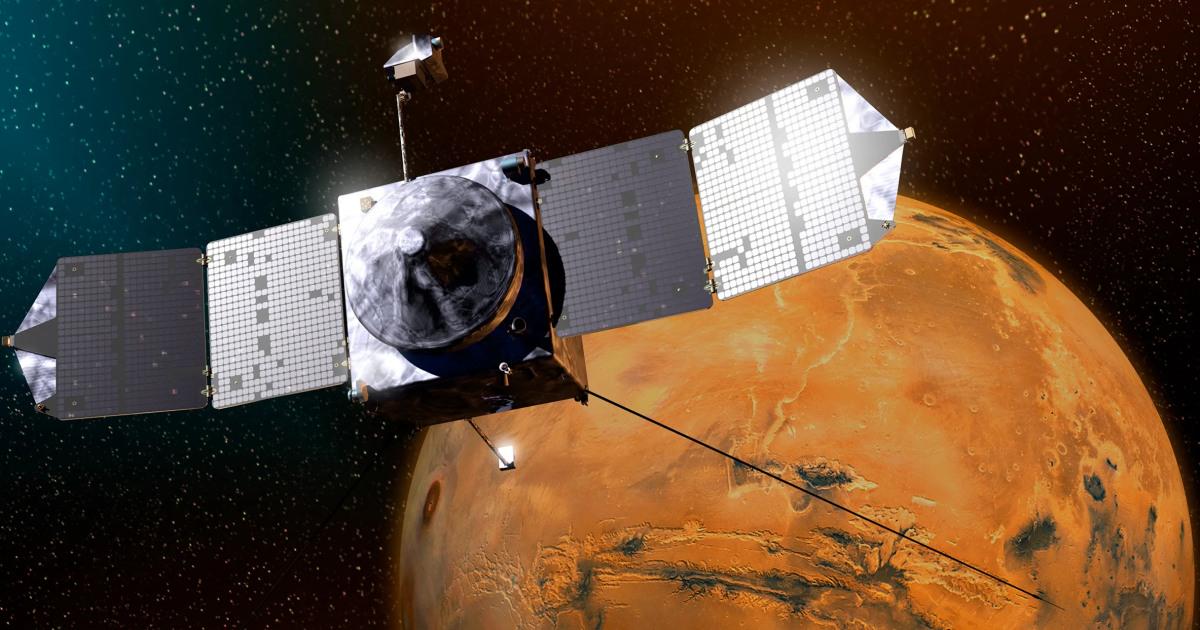
NASA declares its Mars Maven spacecraft dead after 6 months of silence
https://www.nbcnews.com/science/space/nasa-mars-maven-spacecraft-dead-rcna348286

NASA declares its Mars Maven spacecraft dead after 6 months of silence
https://www.nbcnews.com/science/space/nasa-mars-maven-spacecraft-dead-rcna348286
4 Comments
MAVEN fulfilled her two-year prime mission in 2016. She had a good run.
That’s really unfortunate. And the 2001 Mars Odyssey is supposed to run out of fuel soon, given an article in 2023 (though they estimated the end of 2025 at the time). Then there will only be 1 active Mars orbiter from the US, and that will impact communications between Curiosity/Perseverance and Earth.
I hope Rocket Lab and Blue Origin can pull through with their telecommunications spacecraft. Maybe they can be fitted with instruments as well to continue studying Mars. Blue Origin’s, at least, can fit up to 1,000 kg of payloads. That’s more than Maven’s dry mass of ~800 kg. And it only has 65 kg of scientific instruments, that’s plenty of room.
MAVEN spent 11 years mapping how Mars lost its atmosphere. the data it collected basically confirmed that solar wind stripped away the magnetic field and then the atmosphere over billions of years, which is a big part of why Mars went from potentially habitable to what it is now. 11 years of that kind of science from one spacecraft is a good run.
Anyone wanting to know more about MAVEN’s scientific output, mission and end can check out NASA’s press release, it’s very good.
[https://www.nasa.gov/news-release/nasa-says-farewell-to-maven-mars-mission-hosts-media-call-today/](https://www.nasa.gov/news-release/nasa-says-farewell-to-maven-mars-mission-hosts-media-call-today/)