
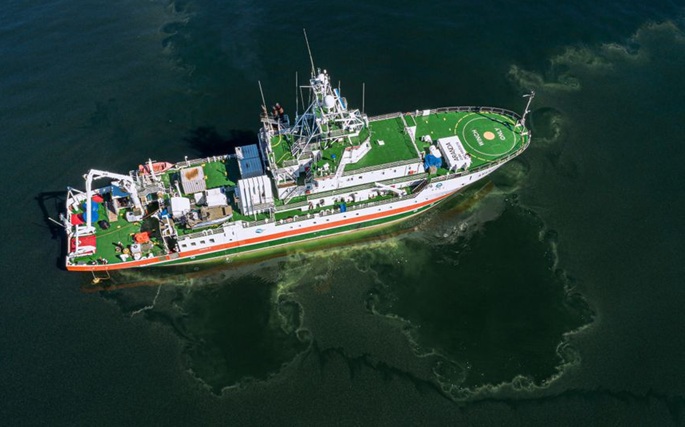
Extensive blue-green algae blooms are likely to occur in the open sea areas close to Finland during the summer as the nutrient situation continues to maintain a high risk, said the Finnish Environment Institute (SYKE) on Thursday.
In the Gulf of Finland, the risk of blue-green algae blooms is significant.
The risk of large blue-green algae blooms is high in the northern part of the main Baltic Sea basin, to the south of the Archipelago Sea and in central parts of the Bothnian Sea.
The risk is significant in the Gulf of Finland and remains low in the Bothnian Bay. Large blooms may occur locally throughout the coastal area.
Phosphorus bioavailable for phytoplankton remained in surface waters after the spring bloom in the open sea areas of the north, with the exception of the Bothnian Bay. This nutrient surplus provides a good springboard for blue-green algae growth.
Due to the weather conditions last winter, the water layers in the Gulf of Finland did not mix. This reduced the amount of phosphorus from the water layers close to the bottom that ended up in the surface water, and the phosphorus concentration close to the surface was lower in the Gulf of Finland than in the previous year.
“Despite the positive development in the surface water status, the risk of blue-green algae blooms in the Gulf of Finland was only reduced slightly, or to the level of significant risk. The reason for this is the generally high phosphorus level in the Gulf of Finland, which has persisted throughout the 2000s. This is why extensive blue-green algae blooms are possible in favourable weather conditions every summer,” said Jouni Lehtoranta, Senior Research Scientist of the SYKE.
The risk of blue-green algae occurring in the Bothnian Sea has increased significantly over the past decade. In the Bothnian Bay, the scarcity of phosphorus still does not favour mass occurrences of blue-green algae in the open sea.
The blue-green algae species in the blooms occurring along the Bothnian Bay coast have differed from those in other coastal areas of Finland. The reason for this may be the extremely low phosphorus levels in the waters of the Bothnian Bay.
“Phosphorus is the limiting factor for algae growth in the Bothnian Bay, whereas in other open sea areas close to Finland, this factor is nitrogen. The dominant blue-green algae species in nitrogen-limited areas include Nodularia spumigena, Aphanizomenon flosaquae and Dolichospermum spp. These species may produce large blue-green algae blooms in the open sea. The dominant species on the phosphorus-limited Bothnian Bay coast are those in the genera Planktothrix and Phormidium, which are incapable of nitrogen fixation”, said Sirpa Lehtinen, Senior Research Scientist, who coordinates phytoplankton monitoring for marine resources management.
Blue-green algae blooms most commonly occur between Midsummer and late August.
The cell division of blue-green algae accelerates when there is plenty of sunlight and the sea water is warm.
Blue-green algae blooms occur after a few weeks of warm and sunny weather, especially if winds are slack during this period.
Algal blooms mainly consist of blue-green algae cells that are in poor condition and no longer able to regulate their depth position in water. Blue-green algae blooms may also occur well into the autumn and even under the ice in winter.
SYKE will not publish weekly blue-green algae bulletins due to austerity measures
This summer, the Finnish Environment Institute will not publish weekly bulletins of the general blue-green algae situation.
The reason for this is government funding cuts. Blue-green algae observations will be available in online services.