
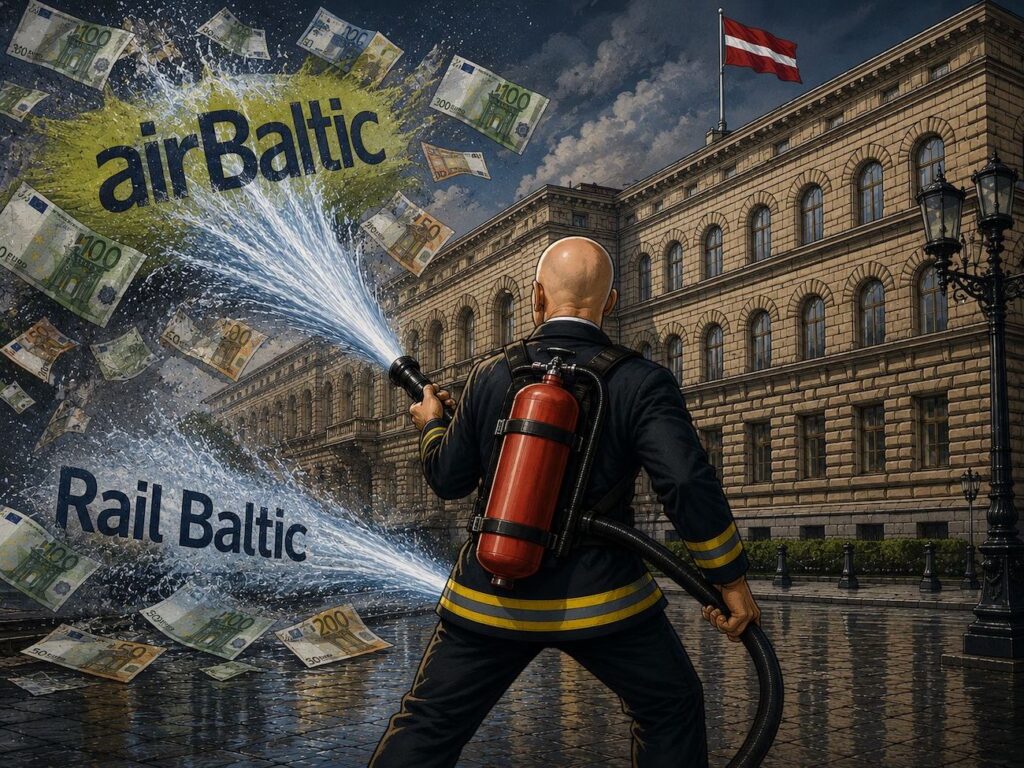
Latvia’s new government led by Prime Minister Andris Kulbergs has completed its first week in office. Under normal circumstances, such a short period would be insufficient to draw meaningful conclusions. However, according to political analyst Filips Rajevskis, the current political situation leaves little room for a gradual start, forcing the government to work in what he describes as a “firefighter mode” ahead of the parliamentary elections.
Speaking to BNN, Rajevskis said the government has launched its work with remarkable energy.
“They started very dynamically. We haven’t seen this kind of momentum for quite some time,” the political analyst noted.
As examples, he pointed to Kulbergs’ pledge to hold government meetings up to three times a week—on Tuesdays, Thursdays, and Fridays—as well as the Prime Minister’s daily video updates outlining the government’s progress.
“These are quite ambitious commitments.
They inevitably create enormous public expectations, which always carries significant risk. If he manages to deliver even half of what he is promising, that would already be a very strong result,” Rajevskis said.
Asked whether such an intensive pace can realistically be maintained until the parliamentary elections on the 3rd of October, Rajevskis referred to Latvia’s recent political history.
He recalled the period following the collapse of Banka Baltija in 1995, when businessman and newly appointed Prime Minister Andris Šķēle introduced a similarly fast-paced style of governance.
“He set an extremely high tempo and managed to deliver results, becoming a highly popular politician at the time.
There are historical examples showing that it can be done. Andris Kulbergs is also relatively young and has all the prerequisites to demonstrate both speed and quality of work,” Rajevskis said.
The analyst believes that the success of Kulbergs’ government could significantly influence the electoral prospects of United List.
“If he performs well, he could be the person who turns United List into one of the leading forces in the next election,” Rajevskis said.
At the same time, he cautioned that it remains too early to make firm predictions, although the potential certainly exists.
Rajevskis was also asked whether the fact that New Unity, despite having the largest parliamentary faction, was forced to settle for only four ministerial posts and relinquish its dominant role in government signals the beginning of the party’s decline.
According to the analyst, the party’s main challenge lies elsewhere.
“New Unity’s biggest problem at the moment is its internal restructuring ahead of the elections,” he said.
“It is no secret that discussions about changing the party’s leadership are taking place. Replacing leaders just 100 days before an election is an extremely ambitious and difficult undertaking.”
For that reason, Rajevskis believes the party faces a particularly challenging period.
“It is difficult to predict how this will develop, but it would be hard to argue that New Unity is currently in its strongest electoral form.”
Another issue attracting considerable public attention is whether Finance Minister Māris Kučinskis will succeed in implementing a stricter fiscal discipline regime and ensuring that state institutions reduce unnecessary spending.
Rajevskis believes
there is a strong possibility that the current government will also be responsible for preparing and adopting the next state budget.
“Therefore, it is entirely realistic that they will work on a budget which they themselves may have to implement next year,” he said.
According to the analyst, this creates a strong incentive for the government to pursue responsible fiscal policies while demonstrating to voters that it is capable of delivering tangible results within a very limited timeframe.
With less than four months remaining until the elections, Rajevskis argues that Latvia’s new government has effectively entered a high-pressure test of both its efficiency and political credibility. Whether the current pace can be maintained—and translated into visible achievements—may ultimately determine not only the government’s legacy but also the electoral fortunes of the parties that support it.