
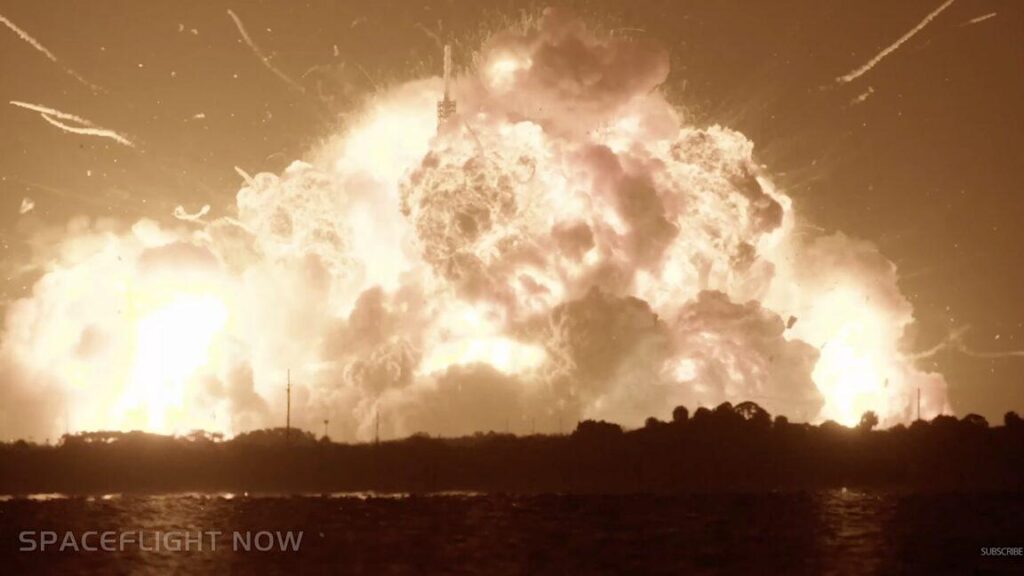
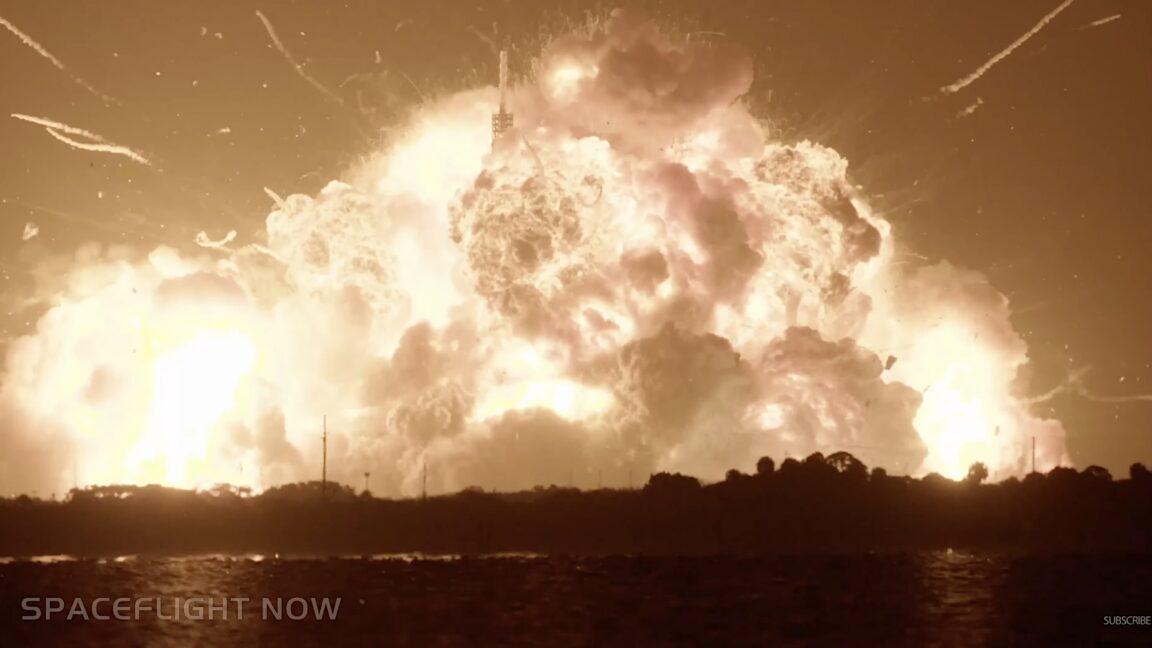
Safety officials finally have a good idea of what a big rocket explosion can do | Overpressure from the Blue Origin blast shattered windows at a hangar about a mile away from the pad.
https://arstechnica.com/space/2026/06/safety-officials-finally-have-a-good-idea-of-what-a-big-rocket-explosion-can-do/
13 Comments
-Last week’s explosion of a New Glenn rocket at Cape Canaveral, Florida, was clearly a setback for Blue Origin and NASA, but it was a learning experience for safety officials looking to open up the spaceport to hundreds more launches per year.
The launch base on Florida’s Space Coast is gearing up for a flurry of new arrivals. SpaceX is building multiple launch pads for its super-heavy Starship rocket, which will operate within a few miles of launch pads operated by SpaceX rivals Blue Origin and United Launch Alliance. Two other companies, Stoke Space and Relativity Space, are also developing launch sites along a narrow stretch of coastline at Cape Canaveral Space Force Station.
All of them have, or will soon have, rockets burning methane or liquified natural gas, replacing legacy launch vehicles fueled by kerosene, liquid hydrogen, or solid propellants. There are good technical reasons for making the switch, but until last week, engineers had scant real-world data on the damage that millions of pounds of methane and liquid oxygen would cause if a fully loaded rocket exploded on the launch pad or soon after liftoff.
By 2036, the Space Force projects that the spaceport could support up to 500 launches per year, five times last year’s total. The combination of these lofty launch forecasts and the Space Force’s conservative safety protocols has caused some tension at the Cape Canaveral spaceport.
The rocket had roughly 3.5 kilotons TNT equivalent energy on board, I wonder how the effects of this explosion would compare to handbook data for a tnt explosion of this size. Likely a decent bit less due to lower peak pressure, but the liquid oxygen is a significant accelerant compared to typical LNG fires.
Imagine explaining to insurance why your windows shattered from a rocket a mile away
> Outside of the launch pad itself, Chatman said the overpressure from the New Glenn blast shattered windows at a Space Force hangar now used as a museum about a mile away from the pad. There was also damage to a weather balloon facility at the base.
If anything, that makes it sound like they’re underestimating the damage. It did minor damage outside the 100% TNT equivalent blast radius. The 25% TNT equivalent was always nonsense.
I had credentials for the STS-6 launch and stood near the countdown clock. There was a map in the Press Office with a circle around the pad, enclosing the VAB and Press site, about 3 miles radius. That was the blast debris zone. We were issued light plastic tarps to protect cars from acids in the SRB exhaust, should the wind carry it to us. The people had no protection. The launch was the brightest and loudest thing I have ever heard in my life.
That sounds weird. This isn’t the first pad explosion. We already know what can happen! There are also several known cases of explosions directly after launch, which can wreak a lot of havoc.
Here’s the infamous Delta II explosion:
[https://www.youtube.com/watch?v=mTmb3Cqb2qw](https://www.youtube.com/watch?v=mTmb3Cqb2qw)
It rained solid booster parts all around the area. Absolute nightmare.
Like what my favourite HS science teacher said, never let a catastrophic failure go wasted!
Too bad Jeff Bezos is too poor to afford his own launch pad. 😢
No shit………………………………………………………
You can literally see the blast wave in the video
Finally? They’ve FINALLY learned that a large explosion can blow out windows that are far away from the explosion?!?!?!
Little more technical detail.
We need to understand how well the liquid methane and LOX will mix, detonate, and deflagrate in a failure like this. If tank bulkheads rupture, and the MethaLOX mixes thoroughly before ignition, you get a lot of detonation before the materials separate enough to just deflagrate. This means high TNT equivalent. The corollary is also true.
We have models for this mixing and TNT equivalent, but we generally like to validate the models with test data. This failure will be a great data point for the MethaLOX detonation models.
Acronyms, initialisms, abbreviations, contractions, and other phrases which expand to something larger, that I’ve seen in this thread:
|Fewer Letters|More Letters|
|——-|———|—|
|[AFB](/r/Space/comments/1txmgfr/stub/opxx5so “Last usage”)|[Air Force Base](https://en.wikipedia.org/wiki/Military_airbase)|
|[BO](/r/Space/comments/1txmgfr/stub/opxtn0z “Last usage”)|Blue Origin (*Bezos Rocketry*)|
|[LNG](/r/Space/comments/1txmgfr/stub/opwsr9n “Last usage”)|Liquefied Natural Gas|
|[LOX](/r/Space/comments/1txmgfr/stub/opxiezl “Last usage”)|Liquid Oxygen|
|[SRB](/r/Space/comments/1txmgfr/stub/opwuhcq “Last usage”)|Solid Rocket Booster|
|[STS](/r/Space/comments/1txmgfr/stub/opwuhcq “Last usage”)|Space Transportation System (*Shuttle*)|
|[VAB](/r/Space/comments/1txmgfr/stub/opwuhcq “Last usage”)|Vehicle Assembly Building|
|Jargon|Definition|
|——-|———|—|
|[methalox](/r/Space/comments/1txmgfr/stub/opxcjfo “Last usage”)|Portmanteau: methane fuel, liquid oxygen oxidizer|
Decronym is now also available on Lemmy! Requests for support and new installations should be directed to the Contact address below.
—————-
^(8 acronyms in this thread; )[^(the most compressed thread commented on today)](/r/Space/comments/1txlw3j)^( has 10 acronyms.)
^([Thread #12483 for this sub, first seen 5th Jun 2026, 17:10])
^[[FAQ]](http://decronym.xyz/) [^([Full list])](http://decronym.xyz/acronyms/Space) [^[Contact]](https://hachyderm.io/@Two9A) [^([Source code])](https://gistdotgithubdotcom/Two9A/1d976f9b7441694162c8)