
Following the formalization of the EU-Mexico Modernized Global Agreement, Poland is executing a strategic foreign policy pivot toward Latin America, leveraging its market-driven transition model to position itself as a trusted commercial partner. This structural shift seeks to expand and diversify a US$2.72 billion bilateral trade baseline beyond traditional automotive manufacturing into highly sophisticated sectors. Key stakeholders, including advanced manufacturing firms, automotive corporations, and digital technology enterprises, stand to benefit from new avenues in clean energy value chains and exportable cybersecurity frameworks.
_____
Latin America and the Caribbean has become a strategic region for Poland’s foreign policy amid increasing geopolitical challenges and supply chain disruptions, says Poland’s Deputy Minister of Foreign Affairs, Wojciech Zajączkowski. According to Zajączkowski, the region is in line with Poland’s values for the defense of a rule-based international system and serves as the anchor for the country’s value chain strategies.
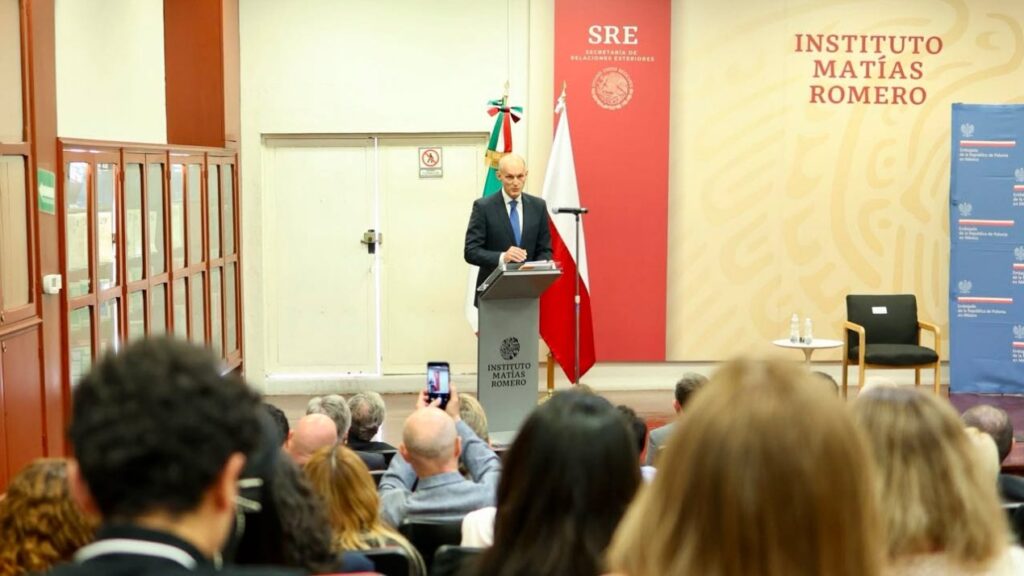
During a presentation hosted by the Ministry of Foreign Affairs’ (SRE) Matías Romero Institute, Deputy Minister Zajączkowski outlined Warsaw’s foreign policy strategy for 2026 to 2030, signaling a concerted pivot toward Latin America with a strong emphasis on mutually beneficial trade, critical raw materials, and clean energy value chains.
Highlighting Poland’s trajectory from post-communist economic contraction to becoming the world’s 21st largest economy, Zajączkowski positioned the central European nation as a trusted, non-colonial business partner uniquely equipped to share the lessons of market transformation with developing economies.
The diplomatic push aligns with a major institutional milestone. On May 22, 2026, the European Union and Mexico formally signed the Modernized Global Agreement (MGA) and an Interim Trade Agreement (iTA) in Mexico City, opening a multi-year framework designed to strip away regulatory barriers and catalyze bilateral investments across mechanical engineering, electronics, and automotive sectors.
Zajączkowski contextualized Poland’s modern foreign policy by contrasting its transition model with that of global economic powers, specifically pointing to China. He pointed out that, while both nations have achieved over three decades of uninterrupted growth, Poland executed its economic transformation through entirely distinct structural means. “China decided to reform what was necessary to be reformed and to maintain its political system, in particular, the role of the state in the economy. Conversely, we chose to completely transform our country and unleash our economy, making it purely market-driven,” Zajączkowski explained.
This economic transformation followed a period of intense diplomatic contraction. Following the collapse of Soviet dominance in 1989, Poland faced hyperinflation, severe scarcities of basic consumer goods, and international insolvency. The initial democratic governments were forced to pull back global diplomatic presence, closing numerous missions near Europe’s borders to pool fiscal resources into domestic structural reforms.
Decades of democratic and institutional modernization culminated in Poland joining NATO in 1999 and entering the European Union in 2004. Today, Poland stands as a major economic success story, with official data from the Ministry of Economy (SE) showing that total bilateral trade between Poland and Mexico reached US$2.72 billion in 2025, driven by US$2.23 billion in Mexican imports and US$488 million in exports.
Defending the Rules-Based International Order
A core pillar of Poland’s Latin American strategy is a shared commitment to international law and territorial sovereignty. Zajączkowski lauded Mexico’s consistent support for UN General Assembly resolutions seeking a lasting peace in Ukraine since the onset of Russia’s military aggression.
Poland views medium and medium-large powers like Mexico as essential counterweights to unilateral global coercion. “The preservation of international law is of particular importance. States that are not global military powers have a strong interest in maintaining a system in which legal norms, rather than coercion or military strength, determine relations between countries,” Zajączkowski said, adding that the rules-based order provides smaller and medium-sized states with security, viability, and the possibility to pursue their interests on an equal footing.
Supply Chain Reconfiguration
Beyond shared geopolitical values, Poland is seeking to leverage Latin America’s vast reserves of critical raw materials to build resilient, diversified value chains. Poland’s industrial presence in the region is anchored by its largest state-backed enterprise, KGHM Polska Miedź, through its subsidiary KGHM Chile SpA. There, the company holds a 55% controlling stake in Sierra Gorda SCM, a major open-pit copper and molybdenum mining operation located in the Antofagasta Region.
In Mexico, the commercial relationship remains heavily anchored in advanced manufacturing. The automotive sector continues to be the primary engine of bilateral trade, hosting several major Polish industrial facilities, while Mexican corporations maintain two flagship investments in Poland centered on cement production and automotive components.
Looking ahead, Zajączkowski emphasized that Poland seeks an open, horizontal partnership devoid of legacy colonial friction. As a nation that openly acknowledges the costly mistakes made during its own economic transition, Warsaw is offering its technical blueprint as a model for countries navigating complex democratic or economic shifts.
“As a medium-sized country with no colonial past, we do not wish to lecture our partners. We simply wish to share what we have done well while openly acknowledging the mistakes made during our own transformation process,” Zajączkowski concluded.
Mexico-Polish Economic Synergy Potential
When MBN questioned Deputy Minister Zajączkowski about areas with potential to deepen exchanges, he said that the commercial baseline between Poland and Mexico reflects a relationship rooted in high-value diversification rather than reliance on a single sector. The exchange of goods spans a highly resilient mix of industrial and commercial products, including radio navigation equipment, turbojet engines, furniture, agri-food products, synthetic rubber, and medical equipment.
The true catalyst to elevate Polish-Mexican economic ties to a new level lies in the digital technologies sector, a critical dimension currently underrepresented in the bilateral landscape. Poland has carved out a highly sophisticated digital ecosystem, driven both by technological innovation and the rapid, successful digitalization of its own public services, including healthcare infrastructure, tax administration, and governmental communication platforms.
This digital evolution has been stress-tested under extreme conditions. Given Poland’s geopolitical position, its relations with Russia and Belarus have involved persistent elements of hybrid warfare, including highly targeted digital incidents. This environment forced the country to rapidly build elite, defensive competencies in cybersecurity that are now highly exportable.
“We have had to develop advanced competencies in the sphere of cybersecurity. This is why we are exceptionally strong in this area; we can offer proven operational experience and mature digital products,” Zajączkowski noted, adding that the country is already deploying these capabilities through active cooperation with several Latin American countries, and it represents a massive opportunity to elevate Polish-Mexican economic cooperation to an entirely new level.
“Poland stands ready to deepen its cooperation with many like-minded partners across Latin America, including Mexico, in a spirit of respect, openness, and mutual benefit. By working together and learning from one another, we can contribute to a more stable and balanced international order, one in which the rights of all nations are equal,” Zajączkowski concluded.