
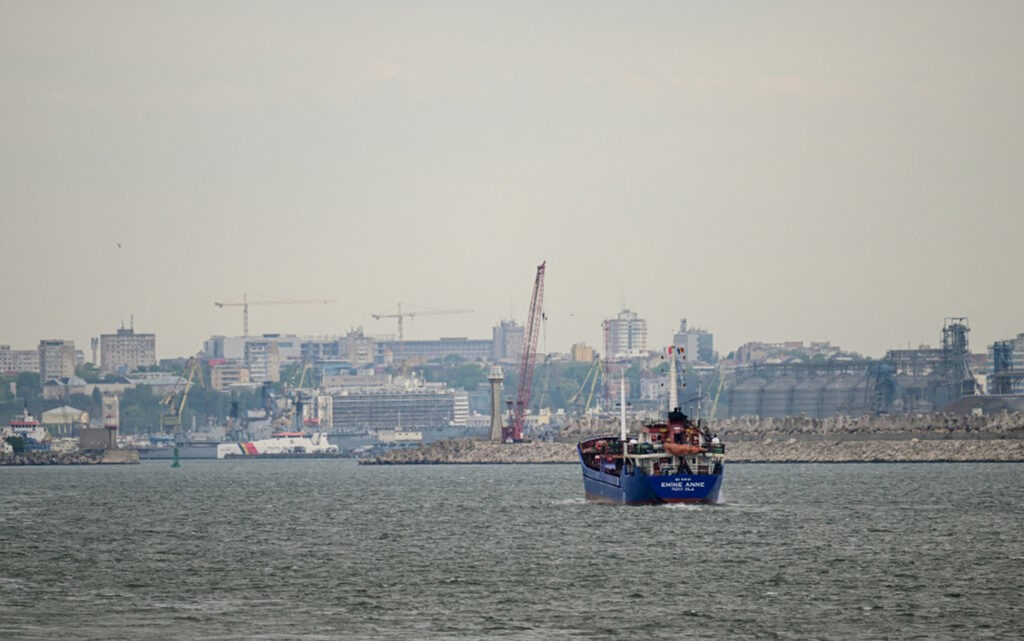
The Romanian presidency has mobilized senior national security and defense officials for an emergency meeting in the port city of Constanța on Saturday, June 6, after a naval drone explosion occurred within Romanian territorial waters, Digi24 reported.
Analyzing the Constanța port incident
The working meeting is scheduled to begin at 12:00 at the headquarters of the 243rd Radioelectronic and Surveillance Brigade “Callatis”. The participant list includes representatives from ministries and agencies responsible for national defense, border management, and intelligence.
Follow our coverage of the war on the @Kyivpost_official.
The primary objective of the gathering is to review the specific circumstances surrounding the maritime detonation and evaluate its impact on both domestic and broader Black Sea security. Furthermore, the working group will assess practical options to rapidly enhance Romania’s maritime surveillance, electronic tracking, and rapid-response capabilities along its vulnerable coastline. The president is scheduled to hold a press conference immediately following the conclusion of the briefing.
EW interference blamed for stray vessel
The urgent security review follows official confirmations regarding the origin and trajectory of the detonated hardware. On Friday, June 5, the Ukrainian Navy released a statement acknowledging that the unmanned surface vessel (USV) belonged to its maritime forces. According to Ukrainian military planners, the drone was actively executing a combat mission in the Black Sea operational area when it encountered localized Russian electronic warfare (EW) suppression.

Other Topics of Interest
Russian Drone and Bomb Attacks Kill Two Civilians in Sumy Region
Russian aerial attacks killed two civilian residents in Ukraine’s northern Sumy region on Saturday, June 6, 2026. In the Khutir-Mychailivska community of the Shostka district, law enforcement officers recovered the body of a 77-year-old woman from the ruins of her home, which had been destroyed by a strike drone the previous evening. Separately, a morning bombardment combining drones and guided aerial bombs targeted the Vorozhba community, killing a male civilian on the grounds of his private property.
The Russian electronic interference caused the craft to lose navigation controls and communication links, ultimately forcing it off course until it drifted to the coast of Romania and detonated inside the port of Constanța. While the explosion prompted immediate deployments by Romanian intelligence services, the coast guard, and military units to seal off the area, local emergency services confirmed that no casualties were reported at the scene.
Concurrently, the prosecutor’s office attached to the Constanța Court of Appeal initiated a formal investigation into the maritime breach.
Accumulating border violations on NATO’s flank
The maritime detonation is the latest in a series of cross-border security incidents stemming from the war in Ukraine to impact Romania, a NATO member state sharing extensive land and maritime frontiers with the conflict zone.
Just last week, Romanian defense officials confirmed that a separate drone incident had directly impacted civilian infrastructure. During a coordinated Russian aerial assault targeting nearby Ukrainian Danube ports, a Russian drone breached Romanian airspace and crashed into a residential apartment block in the eastern city of Galați, sparking a structural fire and an explosion.
While the Ministry of National Defense noted that the asset could not be intercepted due to the extremely limited tracking window, the strike forced emergency medical teams to treat residents for panic attacks.
Since the beginning of Russia’s full-scale invasion of Ukraine in 2022, Romanian authorities have documented numerous instances of stray military hardware, missile components, and drone debris impacting their sovereign territory. Saturday’s emergency session at the “Callatis” electronic surveillance brigade highlights growing pressure on Bucharest to fortify its early-warning infrastructure and ensure that naval operations do not disrupt neutral European shipping corridors.