post_date=”June 06, 2026 05:21″
pUrl=”https://www.fairobserver.com/united-states/fo-talks-can-canada-learn-from-the-iran-war-and-develop-a-self-reliant-military-industry/” pid=”162829″
post-content=”
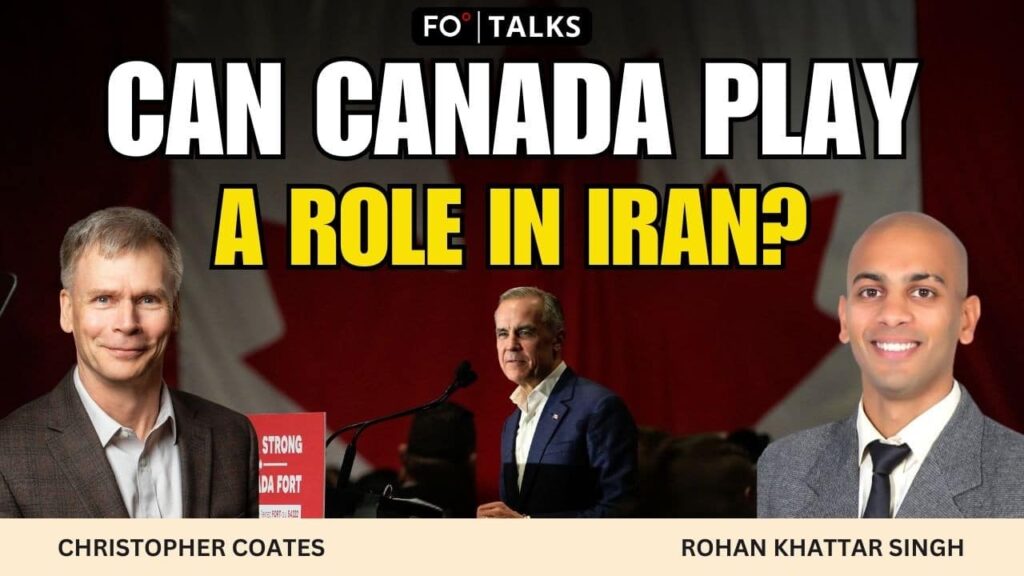
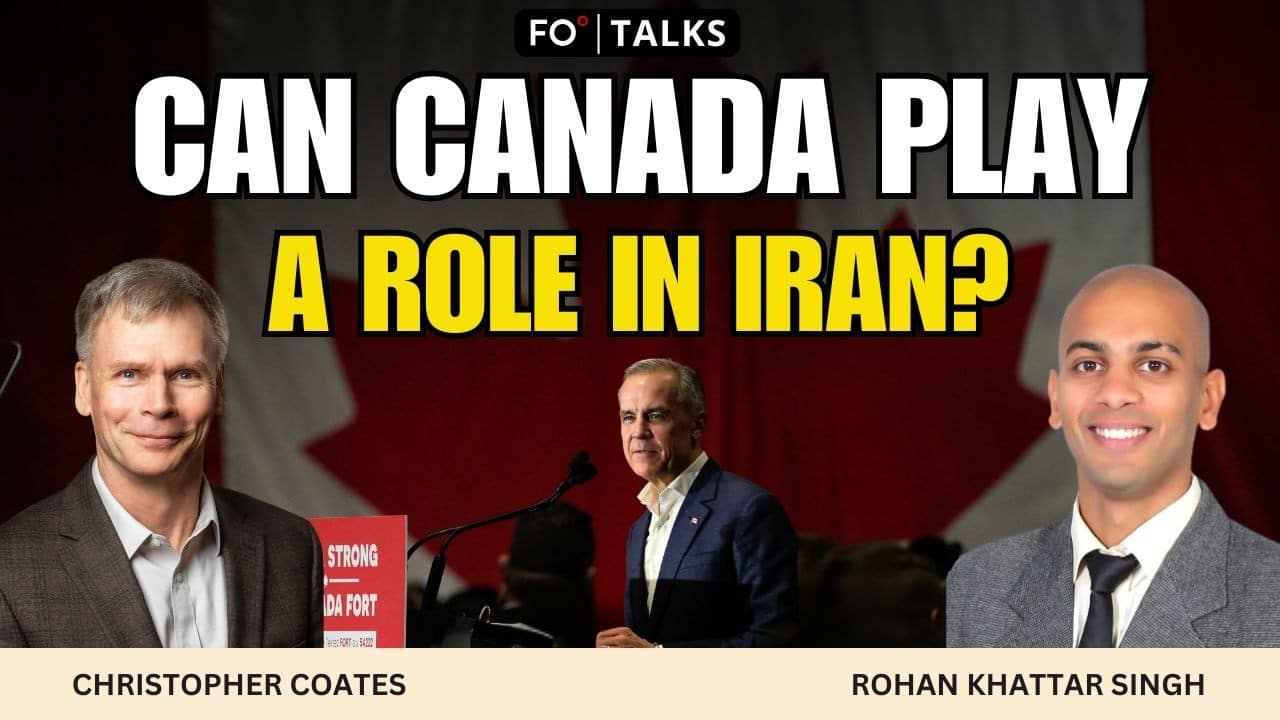
Fair Observer’s Video Producer Rohan Khattar Singh speaks with retired Lieutenant General Christopher Coates, former deputy commander of the North American Aerospace Defense Command (NORAD), about modern air power, defense industry and the limits of military sustainability. They discuss Canada’s defense procurement debate as well as the US–Israel air campaign against Iran, where tactical sophistication is colliding with industrial constraints. Coates argues that advanced systems can deliver extraordinary effects, but only if states can produce, replace and sustain them at wartime speed. The episode asks whether modern militaries are preparing for the wars they may actually have to fight.
A defense strategy or an industrial strategy?
Khattar Singh opens with Canadian Prime Minister Mark Carney’s pledge to stop spending so much of Canada’s defense money in the United States. Coates sees the logic. Canada’s armed forces need major investment after years of underfunding, and Ottawa wants more of that money to benefit Canadian firms.
Yet he argues that the policy is not primarily driven by military requirements. “The defense investment strategy that says that is far more of a domestic industrial strategy than it is a defense strategy,” Coates says. The plan begins with jobs rather than capabilities. That may make political sense, but it risks producing equipment Canada can build rather than the military Canada needs.
The problem is also structural. Canada spends about $60 billion a year on defense, with roughly $10 billion going to acquisitions. Between 60% and 75% of that acquisition spending currently goes to the US. Simultaneously, Canadian firms benefit from access to the American defense market under a 1956 production-sharing framework. If Ottawa pushes too aggressively to exclude US firms, Coates warns, Canadian companies could face pressure in return.
The fighter jet dilemma
That tension is clearest in the debate over replacing Canada’s aging CF-18 Hornet aircraft. The F-35 had been chosen as the planned replacement, but the decision has become politically contested, with renewed public interest in Sweden’s Gripen.
Coates doubts the Canadian government would delay the replacement. The CF-18 fleet has a finite service life, and Canada had planned its transition around the arrival of the F-35. As pilots, crews and resources begin shifting toward the next platform, the existing fighter force becomes harder to sustain. The air force can manage risk, but not indefinitely.
For Coates, interoperability matters more than symbolism. Canada does not need to fly exactly the same platforms as the US, but it must operate systems that can integrate with American and Five Eyes networks — intelligence-sharing alliances comprising Australia, Canada, New Zealand, the United Kingdom and the US. A Canadian-built fighter is not a realistic near-term option. That leaves Ottawa balancing industrial ambition against operational necessity.
Air power meets industrial limits
The discussion then turns to Iran, where Coates sees both the promise and the fragility of modern air power. The US–Israel campaign has displayed remarkable coordination, intelligence integration, refueling capacity and precision strike capability. He describes it as “exquisite military capability,” a demonstration of what advanced air forces can do.
But there’s a deeper logistical lesson to be learned here. The rate at which advanced weapons are being used appears to exceed the rate at which they can be produced. Stockpiles are falling, and industrial capacity cannot be switched on instantly.
That creates an opening for asymmetric warfare. Iran’s use of cheaper drones and missiles forces the US, Israel and regional partners to respond with far more expensive interceptors and high-end systems. A Shahed-style drone may cost tens of thousands of dollars, while the missile used to destroy it can cost millions. Coates argues that this imbalance exposes an unresolved problem: advanced militaries have not yet created a fully sustainable “system of systems” for long wars against cheap, numerous threats.
NORAD and the drone problem
Khattar Singh asks whether NORAD could defend North America against the kinds of drones and missiles seen in the Iran conflict. When he served at NORAD, Coates bluntly explains, it could not fully meet that challenge.
Modernization is underway, including over-the-horizon radars and updates to the North Warning System. But small drones create a different problem from Soviet bombers, cruise missiles or post-September 11 air threats. Domestic airspace is shared with commercial, civilian and law enforcement users. A suspicious track might be a drone, an aircraft, a balloon or even a bird.
This means NORAD is becoming less a single defender than an organizer of sensors, agencies and authorities. As Coates puts it, NORAD now acts as “a bit of an orchestrator,” coordinating with others to identify threats and direct the right response.
NATO, Hormuz and Canada’s limits
Khattar Singh also raises NATO divisions, noting that several allies closed their airspace to US aircraft involved in the Iran campaign. Coates does not see this alone as the beginning of the end. Similar tensions occurred before, including during the Libya conflict. He views the closures as diplomatic signaling rather than a rejection of NATO itself.
The Strait of Hormuz crisis exposes another Canadian vulnerability. Canada is a net oil exporter, so it is unlikely to face shortages, but Coates notes that fuel prices have still risen sharply. Canada also lacks the pipeline and export infrastructure to move energy to allies such as India at scale.
That limits Ottawa’s geopolitical role. Coates says Canada may have good ideas, but leading a coalition requires resources, assets and military mass. For now, Canada remains better positioned to contribute to others’ coalitions than to lead one itself.
[Lee Thompson-Kolar edited this piece.]
The views expressed in this article/video are the author’s own and do not necessarily reflect Fair Observer’s editorial policy.
”
post-content-short=”
Fair Observer’s Video Producer Rohan Khattar Singh speaks with retired Lieutenant General Christopher Coates, former deputy commander of the North American Aerospace Defense Command (NORAD), about modern air power, defense industry and the limits of military sustainability. They discuss…”
post_summery=”In this episode of FO Talks, Rohan Khattar Singh and Christopher Coates argue that modern warfare reveals an imbalance between technology and conflict sustainability. While the US–Israeli air campaign against Iran demonstrates extraordinary coordination, the depletion of expensive munitions against cheap asymmetric weapons raises doubts about whether it’ll hold. Industrial strength and economic resilience may be integral to winning future conflicts.”
post-date=”Jun 06, 2026″
post-title=”FO Talks: Can Canada Learn from the Iran War and Develop a Self-Reliant Military Industry?” slug-data=”fo-talks-can-canada-learn-from-the-iran-war-and-develop-a-self-reliant-military-industry”>

post_date=”June 05, 2026 06:16″
pUrl=”https://www.fairobserver.com/economics/fo-exclusive-the-39-trillion-trap-the-terrifying-reality-of-americas-bond-market/” pid=”162805″
post-content=”
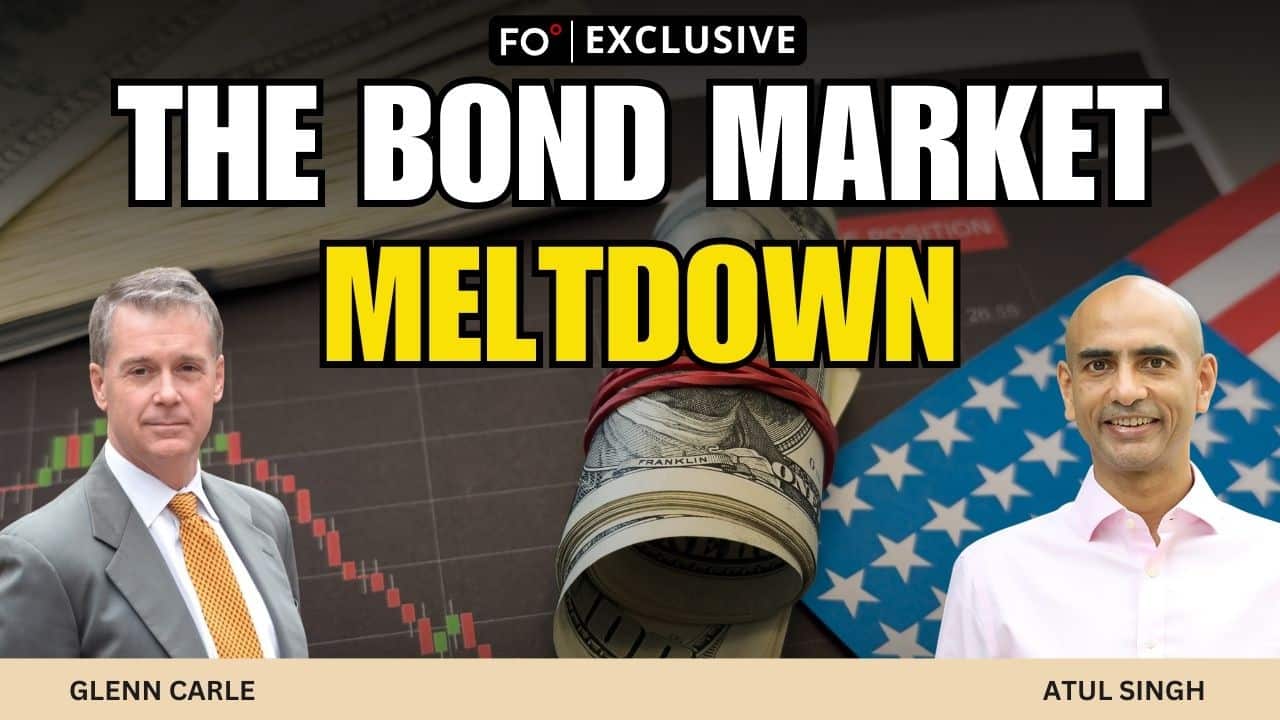
Editor-in-Chief Atul Singh and FOI Senior Partner Glenn Carle, a retired CIA officer who now advises companies, governments and organizations on geopolitical risk, examine a global economy under mounting strain. Inflation is accelerating after the US/Israel–Iran war triggered a supply shock through the Strait of Hormuz, government bond markets are flashing warning signs across multiple advanced economies and Wall Street continues to rally despite growing concerns about valuation and financial excess. Both analysts examine how geopolitical shocks, fiscal imbalances and market behavior are affecting both advanced and developing economies.
Inflation returns as the Hormuz crisis reverberates
Global headline inflation is projected to reach roughly 4.4%–5.2% in developing economies and around 2.9% in developed ones. The US has already seen inflation accelerate sharply. Annual inflation rose from 2.4% at the beginning of 2026 to 3.8% in April, the highest level in three years. Fuel oil prices increased by 5.8% in April compared to March.
The immediate trigger is clear. The US/Israel–Iran war and the resulting closure of the Strait of Hormuz have created a major supply shock. Over 20% of oil and gas, about 33% of fertilizers and numerous other commodities pass through the strait. Thanks to the war, energy prices have risen, transportation costs have increased and real wages have decreased across much of the developed world.
The shock is arriving on top of longer-term structural weaknesses. Years of persistent fiscal deficits and mounting debt have left governments vulnerable. Simultaneously, concerns have emerged over the Trump administration’s political interference with the Federal Reserve. This combination of geopolitical disruption, fiscal imbalance and political interference with the central bank threatens the global economy.
Bond markets flash a warning
One of the most dramatic developments of the month has been the simultaneous repricing of long-term government bonds of many countries. The yield on the 30-year US Treasury bond has climbed above 5%, its highest level since 2007. In the UK, the yield on the 30-year gilt reached 5.81%, the highest since 1998, while the benchmark ten-year gilt rose to 5.13%, the highest since 2008. Long-term sovereign yields in Germany, Japan and France have also moved sharply higher, with yields ranging from roughly 3.5% to 6%.
This is not an isolated national event. Four countries, four political systems and four central banks are experiencing similar pressures. As one analyst summarized, the developed world has “too much debt, too little fiscal discipline, and no political appetite for fixing either.”
Rising yields matter because governments must pay more to service their debts. As borrowing costs increase, less money remains available for public services, infrastructure, defense or social spending.
In the case of the US, the Trump administration has exacerbated longstanding structural problems. Federal debt has surpassed $39 trillion, with the latest trillion dollars accumulating at a record pace. Tax reductions have reduced revenues while spending has continued to rise, particularly because of the costs of the war with Iran.
The US is weakening several of the foundations that supported decades of economic growth. Trade restrictions and tariffs have made the economy less efficient, cuts to federal research and development spending lower innovation, and attacks on institutions that historically underpinned American economic strength damage long-term growth prospects.
Structural pressures on households
In addition to the government, household budgets are also facing immense pressures. One of the reasons is restricted immigration. Recent studies estimate that immigrants have contributed a net $15 trillion to the US economy since 2010. Workers who have harvested crops that have given Americans low-cost food have vanished. As a result, food costs have increased. Fertilizers now cost more because of the closure of the Strait of Hormuz. The inflationary pressures of the war are increasing interest rates, pushing up mortgages. They are also pushing up fuel costs, although not as much as in Europe or Asia. Food, housing and transportation costs, the three most important expense items for households, are now causing pain to millions of American families.
Many households increasingly rely on debt to make ends meet. Consumption accounts for 67% of the US GDP. This is bound to suffer as pressures on households rise, making an economic downturn imminent.
Yet Wall Street surges
Despite the many woes in the economy, equity markets continue to rally. The top five mega-cap technology companies now represent roughly 30% of the entire S&P 500 and the Magnificent Seven account for approximately 35%. This is the highest degree of market concentration seen in half a century. NVIDIA alone has surpassed a $5 trillion valuation, making it worth more than the GDP of most countries.
The AI investment boom continues to accelerate. Microsoft, Alphabet, Amazon and Meta are expected to spend between $660 billion and $700 billion on AI infrastructure and data centers in 2026 alone. Between 2026 and 2029, cumulative AI infrastructure spending is projected to exceed $1.1 trillion.
Atul points to valuation metrics that increasingly concern investors. The Shiller price-to-earnings ratio, which adjusts earnings over ten years and accounts for inflation, has risen above 40 for the first time since the dot-com crash. The ratio currently sits near 42:1, a level that has historically preceded major market corrections.
Yet generative AI applications are generating only about $12–15 billion in direct consumer and enterprise software revenue annually. Critics are rightly questioning whether revenue growth can justify the scale of investment currently taking place and the sky-high market valuations.
Supporters of the boom point to several counterarguments. S&P 500 operating margins remain near historic highs of approximately 16%. Technology companies are financing investments largely from enormous cash flows rather than speculative borrowing. Many firms also expect AI to generate significant cost savings by automating workflows across sectors ranging from manufacturing to healthcare.
Glenn adds another important qualification. Outside the Magnificent Seven, valuations appear considerably less stretched. The remaining 493 companies in the S&P 500 trade at a price-to-earnings ratio of roughly 22 and have delivered returns of about 8% over the past five years. He considers these figures healthy rather than speculative.
Even so, notable investors remain cautious. Berkshire Hathaway chief executive Greg Abel is currently overseeing a cash position of roughly $400 billion accumulated under former legendary CEO Warren Buffett. Abel has stated that he is “not anxious to deploy capital into subpar opportunities.” Other older investors expect a 10–15% market correction soon.
A widening gap between financial markets and economic reality
Another warning sign comes from the relationship between stocks and bonds. The Wall Street Journal recently observed that the “Risk Premium for Holding Stocks Over Bonds Vanishes.”
The equity risk premium is the additional return investors expect from stocks compared with risk-free government securities. Historically, stocks offered substantially higher expected returns than Treasury bonds. Today, that gap has narrowed dramatically.
Atul argues that this points to a broader disconnect. Bond markets are signaling caution while equity markets are soaring. Financial prices increasingly diverge from conditions in the real economy. Such discrepancies are clearly visible in commodity markets, where physical delivery prices for oil in Asia often exceed benchmark prices displayed on financial screens.
Not only bond market bears but also European policymakers are worried about the economy. The European Central Bank (ECB) has warned about the AI investment boom financed by private credit. Insurers and pension funds could be in trouble when private credit markets suffer a shock. These markets suffer from opacity and liquidity mismatches. This euro area’s financial system could be in trouble.
Developing countries are already in trouble. Many emerging economies are struggling with Iran’s closure of the Strait of Hormuz. Indian Prime Minister Narendra Modi has urged citizens to conserve fuel, hold more meetings online, reduce travel and avoid purchasing gold abroad. Indonesia has proposed centralizing exports of commodities such as palm oil and coal through a state-operated export company, while requiring export earnings to be deposited in state-owned banks. The Indonesian central bank has also raised interest rates by half a percentage point, the first increase in two years. At least four people were killed in protests over high fuel prices in Kenya. In response, the government cut diesel prices and entered negotiations with transport unions to resolve a strike by bus and minibus drivers. The war has driven up prices in Kenya, which, like much of East Africa, depends on the Persian Gulf for energy supplies.
Exacerbating the current crisis is the highly unequal distribution of economic gains. Only about one-third of Americans own stocks, while wealth is more concentrated than at any point since the robber baron era of the late 19th century. Asset owners continue to benefit from rising markets, but many middle-class households are covering rising living costs through more debt, not higher incomes.
That divergence between financial markets and everyday economic reality represents one of the greatest dangers facing the global economy. The immediate shock may have come from the Strait of Hormuz, but the deeper vulnerabilities have been accumulating for years and are becoming increasingly difficult to ignore. A severe global crisis is increasingly nigh.
[Lee Thompson-Kolar edited this piece.]
The views expressed in this article/video are the author’s own and do not necessarily reflect Fair Observer’s editorial policy.
”
post-content-short=”
Editor-in-Chief Atul Singh and FOI Senior Partner Glenn Carle, a retired CIA officer who now advises companies, governments and organizations on geopolitical risk, examine a global economy under mounting strain. Inflation is accelerating after the US/Israel–Iran war triggered a supply shock…”
post_summery=”In this section of the May 2026 episode of FO Exclusive, Atul Singh and Glenn Carle discuss how the global economy is fast approaching a crisis point because war-driven inflation is colliding with fiscal excess and mounting debt. Rising bond yields, strained household finances and the AI-fueled market bubble reveal grave structural weaknesses. The widening gap between financial markets and economic reality.”
post-date=”Jun 05, 2026″
post-title=”FO Exclusive: The $39 Trillion Trap — The Terrifying Reality of America’s Bond Market” slug-data=”fo-exclusive-the-39-trillion-trap-the-terrifying-reality-of-americas-bond-market”>

post_date=”June 04, 2026 06:21″
pUrl=”https://www.fairobserver.com/region/asia_pacific/fo-exclusive-how-beijing-is-shaping-the-global-order-with-the-trump-and-putin-summits/” pid=”162790″
post-content=”
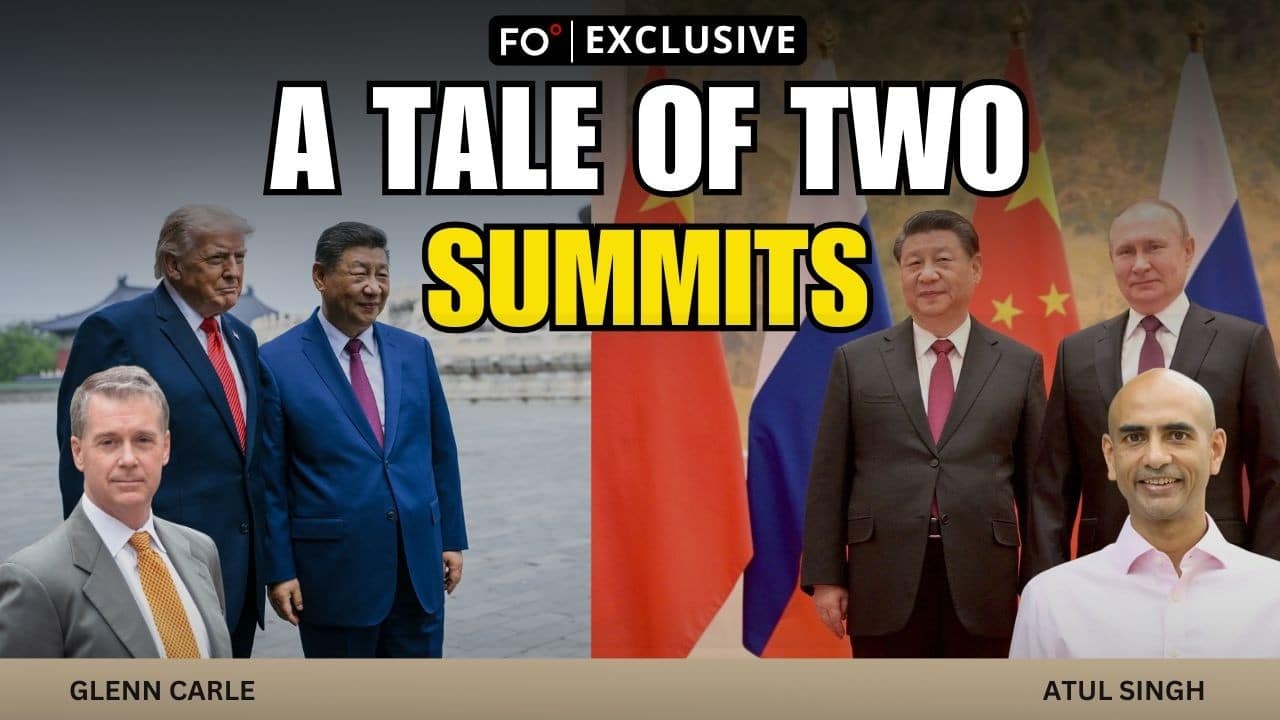
Editor-in-Chief Atul Singh and FOI Senior Partner Glenn Carle, a retired CIA officer who now advises companies, governments and organizations on geopolitical risk, examine the May 2026 summits in Beijing. Chinese President Xi Jinping first played host to US President Donald Trump and then to Russian President Vladimir Putin.
While the White House presents the Trump–Xi meeting as a historic diplomatic success, the reality does not match the rhetoric. Despite Trump taking along a gaggle of CEOs to Beijing, China did not concede much to the US. Similarly, Putin arrived in Moscow very much as a junior partner to Xi.
In a nutshell, years of strategic missteps by the US have helped propel China’s rise.
The Trump–XI summit was more show than substance
Trump’s visit to China was the first for an American president in nine years. The White House Fact Sheet tells us that “President Donald J. Trump Secures Historic Deals with China, Delivering for American Workers, Farmers, and Industry.”
Per this document, “the United States and China should build a constructive relationship of strategic stability on the basis of fairness and reciprocity. President Trump will welcome President Xi for a visit to Washington this fall.”
Furthermore, both “leaders agreed Iran cannot have a nuclear weapon, called to reopen the Strait of Hormuz, and agreed that no country or organization can be allowed to charge tolls.” Trump and Xi also “confirmed their shared goal to denuclearize North Korea.”
Trump and Xi also established two new institutions: a US–China Board of Trade and a US–China Board of Investment. According to the White House, these bodies will provide formal mechanisms for managing trade in non-sensitive goods and discussing investment issues between the world’s two largest economies.
The White House also trumpets a number of wins for American workers and businesses. China pledged to address US concerns regarding rare-earth minerals and related technologies that are critical to advanced manufacturing and supply chains. Beijing also approved an initial purchase of 200 Boeing aircraft, its first commitment to buy American-made Boeing planes since 2017. China also promised to purchase at least $17 billion annually in US agricultural products through 2028, restored market access for American beef producers and resumed poultry imports from states certified free of avian flu.
Glenn responds by saying that Atul has presented the smoke billowing from the chimney of the White House from the squib that fizzled into nothing. He then refers to Dean Acheson, arguably the greatest US secretary of state, who said, diplomats or officials in any negotiations claim they won every argument. Atul points out that the Chinese spin on the summit is very different and painted a picture of Xi being the senior statesman to Trump.
Glenn believes the summit was “sound and fury signifying not quite nothing but not a whole lot.” Trump did not achieve a grand bargain as he had hoped. Neither Taiwan nor trade was addressed in a damp squib. He believes the summit was “a tactical and even strategic win” for China. The US has made far too many strategic mistakes, aiding China’s rise.
Atul points out that China has achieved the biggest and fastest transformation in history. Never before have so many people emerged from poverty, and never before has a country gone from the catastrophes of the Great Leap Forward and the Cultural Revolution to the spectacular success of market reforms and extraordinary economic growth. Deng Xiaoping’s U-turn in 1978 from Mao Zedong’s Marxist orthodoxy was historic. By saying, “it doesn’t matter if a cat is black or white, if it catches mice,” Deng propelled China to its dramatic rise after the humiliations of the 19th century and the disasters of Mao’s communism.
Glenn recalls a very different China from his childhood, when American mothers told their children to clean their plates because millions were going hungry in China. Today, that very country competes at the technological frontier and may become one of the leading powers in space exploration. Regardless of political disagreements with Beijing, Glenn says that the scale of China’s achievement is impossible to ignore.
He also goes on to say that China has transformed from a cat on the back of a porch feeding on scraps from the dinner table of the benevolent United States to a large lion or tiger that might eat the person feeding it. Unsurprisingly, American attitudes have shifted. Also, the US backed China to counter the Soviet Union. As Russia has declined and China has risen, the US has less reason to continue its old China policy.
Yet the US was unable to achieve anything concrete to contain China during this summit. The boards are symbolic and are likely to achieve much. China has now substantially diversified its agricultural imports, buying Argentinian beef and Brazilian soybeans. Prior to the summit, Boeing expected to sell 500, not 200, planes. After the summit, Boeing’s stock fell. Trump promised no more tariffs but the Chinese offered little in return. NVIDIA, the flagship American tech company, offered to sell its most advanced chips but no purchases have materialized yet. The bevy of tech CEOs went like tributaries to the Middle Kingdom and got nothing either.
The Taiwan question, North Korea and more
Trump’s willingness to discuss arms sales to Taiwan was an exercise in American self-restraint on Taiwan. Sadly, the US got nothing conciliatory from China in return. The strategic ambiguity that has been US policy for decades weakened during this summit.
In a nutshell, Trump’s negotiations with Xi followed a pattern. After Trump’s meeting with North Korean Supreme Leader Kim Jong Un, his hermit kingdom has tripled its number of nuclear weapons, improved the quality of its intercontinental ballistic missiles, increased missile numbers and sent dozens of thousands of soldiers to fight in Europe.
Similarly, Trump’s war against Iran has been a catastrophe. The Strait of Hormuz is now closed, which his ceasefire hopes to open in a wobbly and fuzzy way by paying $10–20 billion to Iran. In return, Tehran is likely to agree to much less stringent and less verifiable agreement than the Joint Comprehensive Plan of Action (JCPOA) negotiated by the Obama administration, which Trump abandoned. This tendency to undermine the little that is left of the American-led international order has undermined US strategic interests.
Atul points out that David Mahon, the Beijing-based executive chairman of Mahon China Investment Management Ltd, agrees with Glenn. In Mahon’s words,
“The recent US–China summit in Beijing, though symbolically significant as the first meeting between the two leaders on Chinese soil in nine years, yielded little concrete progress. While both sides emphasized cordiality and trade promises, underlying tensions over Taiwan, Iran and strategic distrust remained unresolved. The visit underscored a cautious, transactional coexistence between the rival powers, with deeper collaboration unlikely given entrenched geopolitical rivalries.”
Putin’s Beijing visit signals China’s growing strength
Atul goes on to discuss Putin’s visit to Beijing by noting that over 40% of the foreign exchange trading in Moscow is now in Chinese renminbi. Glenn responds by posing questions: Where are people going? They are going to Beijing. Why are they going? Because China has the wind in its sails.
Per Glenn, Beijing is now the reference point for both Russia and the US. Russia would not be able to continue its war without China. The US also needs China for trade and critical minerals. Therefore, both Trump and Putin showed up for a summit with Xi.
Atul quotes Mahon saying that “Putin met Xi as a reliable collaborator, confidante and compadre, but in economic and geopolitical terms, a junior, dependent partner.” He goes on to say that the Russia–China relationship is now more strategic. It is similar to the late 19th and early 20th century relationship between Imperial Germany and the Austro–Hungarian Empire. Like the former, China is now the industrial power while Russia is a supplier of fossil fuels. Despite border disputes and historical problems both Beijing and Moscow are locked together for now. China needs Russia’s energy while the latter needs the former’s manufactured goods and money.
[Lee Thompson-Kolar edited this piece.]
The views expressed in this article/video are the author’s own and do not necessarily reflect Fair Observer’s editorial policy.
”
post-content-short=”
Editor-in-Chief Atul Singh and FOI Senior Partner Glenn Carle, a retired CIA officer who now advises companies, governments and organizations on geopolitical risk, examine the May 2026 summits in Beijing. Chinese President Xi Jinping first played host to US President Donald Trump and then to…”
post_summery=”In this section of the May 2026 episode of FO Exclusive, Atul Singh and Glenn Carle examine the May 2026 summits in Beijing. China’s 50-year transformation has altered the global balance of power and the US now has to readjust. In the aftermath of some erratic foreign policy moves by Washington, Beijing is increasingly in the ascendant.”
post-date=”Jun 04, 2026″
post-title=”FO Exclusive: How Beijing is Shaping the Global Order With the Trump and Putin Summits” slug-data=”fo-exclusive-how-beijing-is-shaping-the-global-order-with-the-trump-and-putin-summits”>
post_date=”June 03, 2026 06:03″
pUrl=”https://www.fairobserver.com/video/fo-exclusive-global-lightning-roundup-of-may-2026/” pid=”162777″
post-content=”
Editor-in-Chief Atul Singh and FOI Senior Partner Glenn Carle, a retired CIA officer who now advises companies, governments and organizations on geopolitical risk, recap the most important developments of the month.
Threat of epidemic and the Pope’s view on AI
In Africa, the World Health Organization (WHO) declared an outbreak of Ebola to be a public-health emergency of international concern. The virus kills up to half of those who contract it, with such symptoms as severe diarrhea, vomiting, hemorrhaging and bleeding. Experts believe the epidemic in eastern Democratic Republic of the Congo (DRC) has killed hundreds and infected thousands.
Glenn, who worked in eastern DRC many years ago, recalls it as a place almost beyond the imagination of people living in developed societies. He describes seeing people living with virtually nothing amid a landscape dominated by armed groups, lawlessness and extreme poverty. The only silver lining, he says grimly, is that Ebola’s lethality can limit its spread because infected people often die before transmitting it widely.
Dr. Tedros Adhanom Ghebreyesus, the Director-General of the WHO, said the east of DRC was at the center of a “catastrophic collision of disease and conflict,” with the outbreak in the northeastern Ituri province outpacing the response.
According to Atul, the region’s instability complicates Ebola treatment, preventive vaccination campaigns and other public-health measures. Population displacement and refugee movements further impede efforts to contain the disease.
In Europe, Pope Leo XIV has called for AI to be disarmed in his first encyclical, Magnifica Humanitas (Magnificent Humanity). This has caught attention around the world, including from Silicon Valley in the US. Christopher Olah, cofounder of American AI giant Anthropic, was present when the pope released this encyclical. The encyclical warns that AI poses immense risks in both warfare and politics and argues that the technology must be restrained before it causes broader social harm.
Pope Leo XIV also included one of the strongest, most comprehensive apologies from the Vatican for the Catholic Church’s role in slavery. Many Africans have welcomed the apology. Notably, the pope drew parallels between the historical tragedy of traditional slavery and the emerging threats of “new digital slaveries.”
Atul notes that Pope Francis’s climate encyclical Laudato si’ book generated significant attention but was followed by widespread inaction. Whether Leo’s intervention on AI produces concrete results remains uncertain, Atul points out that the debate has now moved beyond the technological sphere into the religious realm.
Musk and Starmer
In the US, Tesla CEO Elon Musk was in the news for four reasons. First, his facial expressions in Beijing where he went as part of US President Donald Trump’s entourage were captured on camera and caught public attention. Second, Musk lost his courtroom battle with OpenAI and its CEO, Sam Altman. Musk had sought damages from OpenAI for allegedly reneging on a contract with him as a cofounder to run the firm as a non-profit instead of for-profit entity. The jury took just two hours to reject the case. Third, SpaceX’s blockbuster Initial Public Offering has taken off like one of Musk’s rockets. It could raise over $50 billion and value SpaceX at over $1.25 trillion once the company goes public.
Fourth and finally, the 12th test launch of SpaceX’s Starship V3 rocket was largely successful, moving the rocket closer to an operational performance level. It will instantaneously revolutionize space flight and the space industry. It will increase payload capabilities five-fold, while dropping the price to launch a kilogram by two orders of magnitude. What costs $3,000 per kilogram for industry-leading Falcon 9, will cost $100–$500 per kilogram on initial Starship launches, and could drop to as low as $10–20 per kilogram. Furthermore, the craft is designed to be fully-reusable after return flights. Operational use is now perhaps two years away, and when it comes, the V3 could play a key role in returning humans to the Moon and eventually sending them to Mars.
In the UK, British Prime Minister Sir Keir Starmer finds himself in a tricky situation. His center-left Labour Party suffered a heavy defeat in elections in Scotland and Wales and council elections in England. The populist far-right Reform UK party led by Nigel Farage emerged triumphant. Reform UK is on course to be the biggest party in the next general elections in 2029.
Sensing blood in the water, political sharks are circling Starmer. He won a landslide majority in 2024 but this was misleading. Starmer’s Labour Party won fewer votes than it did in the last two elections. Low turnout, Conservative infighting, the rise of Reform UK and the Liberal Democrats’ impressive showing helped Labour in the first-past-the-post system.
Since his 2024 victory, Starmer has failed to ignite the imagination of the party or the country. Cabinet ministers have resigned and a leadership challenge is imminent. His potential rivals now include Manchester Mayor Andy Burnham, known as the King of the North, Angela Rayner, a popular working-class politician, and Wes Streeting, the former health secretary.
Political instability in the UK goes back to the 2016 Brexit vote. Atul mentions that the country, once regarded as one of the world’s most stable parliamentary democracies, now appears fundamentally unsettled.
US–German conflict
The US announced it would be withdrawing 5,000 of the 36,000 American troops stationed in Germany. This came in the aftermath of a comment German Chancellor Friedrich Merz made in front of schoolchildren in April. He remarked, “An entire nation is being humiliated by the Iranian leadership.” Naturally, Trump did not appreciate the remark.
In addition to withdrawing troops, the Trump administration has announced that the US will not be stationing Tomahawks and other mid-range missile systems in Germany, despite a 2024 agreement. The US also imposed a 25% tariff on European carmakers. That hits Germany, famous for its automotive industry, particularly hard.
It is clear that US–Germany ties are deteriorating dramatically. The decisions of the Trump administration also demonstrate that contracts, agreements, treaties and even international law are now increasingly fragile.
Many are calling this fraying of ties a historic rupture. German politicians increasingly believe their country must reduce its dependence on the US and pursue greater strategic autonomy. Merz’s calls for European unity when he won the election in 2025 — “My absolute priority will be to strengthen Europe as quickly as possible so that, step by step, we can really achieve independence from the USA” — ring true today.
Bizarrely, given what appeared to be Trump’s consistent hostility to US troop deployment in Europe, the US president then announced the deployment of 5,000 additional troops to Poland. The shift effectively moves additional American forces closer to the Russian border, raising further questions about NATO’s future direction.
Alberta to leave Canada?
In Canada, the province of Alberta will be conducting a referendum in October on whether to stay with or secede from the country. This western state, east of British Columbia, is Canada’s fourth-largest province. It is roughly the size of Texas, has a population of five million and is abundant in oil and natural gas. Politically, it leans right.
Albertan Premier Danielle Smith announced the referendum on May 21 and supports a unified Canada. However, support for independence has been rising. Canadian Prime Minister Mark Carney, who was the Governor of the Bank of England and observed Brexit closely, has called the referendum “a very dangerous bluff.”
Many Albertans find themselves frustrated with environmental policies that they believe stand in the way of building pipelines and unlocking resources from the oil-rich province. In fact, some Albertans feel they have more in common with the US than Canada.
They also believe Alberta contributes far more to the country than it receives, and that the capital of Ottawa has a disproportionate say in its internal matters. Many analysts use the term “western alienation” to describe the political alienation in western Canadian states. Voters here often feel overlooked and underrepresented by federal politicians in Ottawa.
Atul compares these grievances to feelings of neglect that can emerge in large federal systems elsewhere. Some Americans in states far from Washington, DC, may feel similarly disconnected from national decision-making.
Fossil fuel feuds
Back in Europe, the Netherlands’s leftwing GreenLeft-Labour party, as well as progressive leftists who dominate Amsterdam’s city council, banned the advertising of meat and fossil fuels. This is part of a broader movement in Europe and, to a lesser extent, in the US and Canada.
Supporters of the Amsterdam policy argue that reducing meat consumption, particularly beef, could lower methane emissions and help mitigate humanity’s environmental footprint. This ban could influence other countries. Amsterdam has a long history of pioneering trends, which the rest of the world has later adopted. So, Amsterdam’s new policy could be a bellwether for other parts of the world.
Meanwhile, across the Atlantic, the Trump administration has hit Cuba with an oil blockade, sanctions and now an unprecedented murder indictment against former Cuban President Raúl Castro. Brother of former Cuban President Fidel Castro, the nearly 95-year-old Raúl (his birthday is June 3) served from 2008 to 2018 and holds the title, “Leader of the Cuban Revolution.”
Cuba has been suffering from extensive blackouts for months, caused by chronic fuel shortage. Popular discontent is running high. US Secretary of State Marco Rubio has called Cuba a “national security threat” and said the likelihood of a peaceful agreement is “not high.”
Cuban Foreign Minister Bruno Rodríguez has accused Rubio of trying to “instigate a military aggression” and the Trump administration of “ruthlessly and systematically” attacking Cuba. Cuba’s Communist Party leaders view themselves as the inheritors and continuers of Fidel Castro’s 1959 Cuban Revolution that ousted the pro-US strongman Fulgencio Batista and established “anti-imperialism” as a hallmark of the island’s government in successive decades.
Over the decades, thousands of Cubans have fled to the US. Most oppose the communist regime bitterly. Rubio himself is a Cuban American and is driving the American policy on Cuba.
Some officials within the Trump administration openly hope to remove Cuba’s current leadership and bring the island firmly into Pax Americana. This objective is part of a broader effort to reassert US dominance throughout the Western Hemisphere. This was defined in the 2025 National Security Strategy as the Trump Corollary to the Monroe Doctrine, which has also come to be known as the Donroe Doctrine.
[Lee Thompson-Kolar edited this piece.]
The views expressed in this article/video are the author’s own and do not necessarily reflect Fair Observer’s editorial policy.
”
post-content-short=”
Editor-in-Chief Atul Singh and FOI Senior Partner Glenn Carle, a retired CIA officer who now advises companies, governments and organizations on geopolitical risk, recap the most important developments of the month.Threat of epidemic and the Pope’s view on AIIn Africa, the World Health…”
post_summery=”In this section of the May 2026 episode of FO Exclusive, Atul Singh and Glenn Carle review several of the month’s most important developments such as the Ebola outbreak in the Democratic Republic of Congo and the Pope’s Encyclical on AI to political fragmentation in Western democracies and Elon Musk.”
post-date=”Jun 03, 2026″
post-title=”FO Exclusive: Global Lightning Roundup of May 2026″ slug-data=”fo-exclusive-global-lightning-roundup-of-may-2026″>
post_date=”June 02, 2026 06:17″
pUrl=”https://www.fairobserver.com/world-news/fo-talks-israeli-and-american-air-power-fail-iran-regime-change-as-trump-threatens-nato/” pid=”162764″
post-content=”
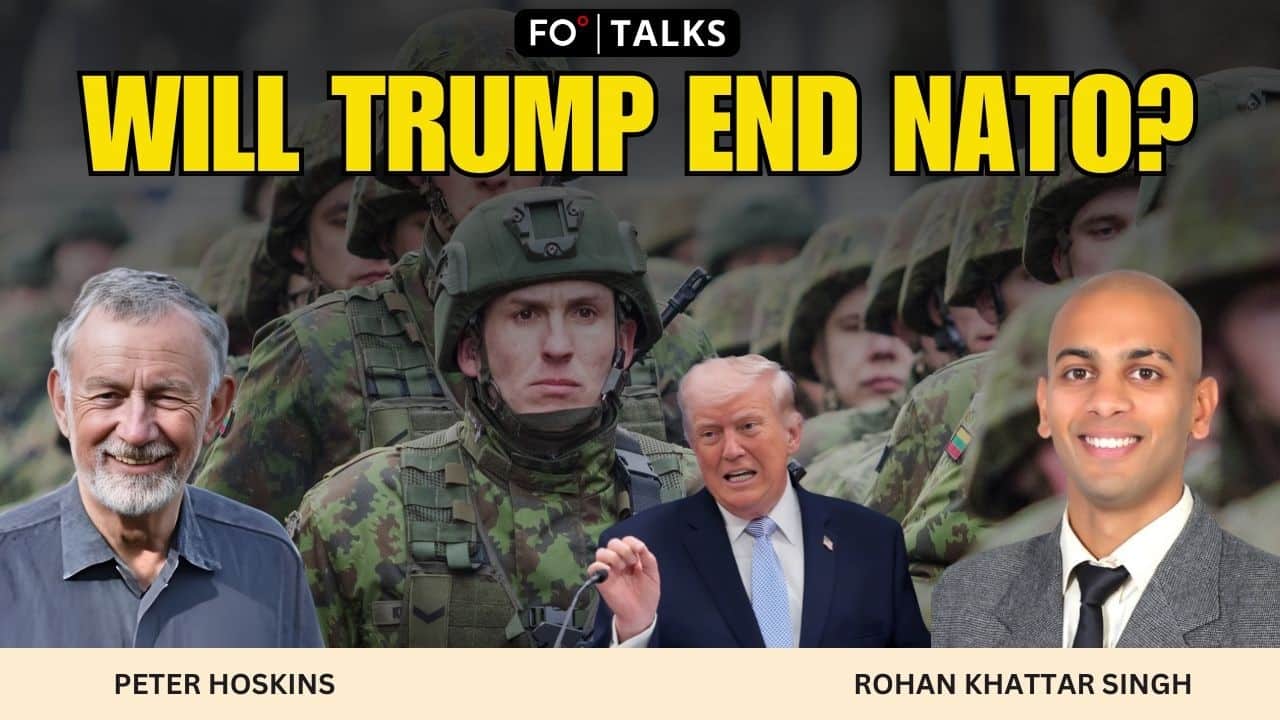
Fair Observer’s Video Producer Rohan Khattar Singh speaks with former Royal Air Force officer Peter Hoskins about a campaign that appears tactically flawless yet strategically ambiguous. The US–Israel air war against Iran showcases extraordinary coordination and firepower, but its political objectives remain unclear and, in some cases, unmet. As the conflict evolves, will America’s overwhelming military capability produce durable political outcomes?
Tactical success, strategic uncertainty
Khattar Singh opens by highlighting the scale and sophistication of the air campaign. Thousands of sorties, advanced aircraft and tightly coordinated support systems point to what Hoskins describes as a “picture perfect” execution from a purely military standpoint. The operation reflects decades of doctrinal development in joint and coalition warfare, where precision, coordination, intelligence, communication and logistics converge.
Yet this technical success sits uneasily alongside uncertain results. Despite repeated claims of destroyed capabilities, Iran continues to be able to launch missiles and drones, indicating that its core military infrastructure remains intact. For Hoskins, this gap between battlefield performance and political outcome is the central problem. The campaign demonstrates what modern air power can do, but also exposes its limits when strategic goals are either unclear or unrealistic.
The limits of air power
The conversation turns to a long-standing debate in military theory: whether air power alone can achieve decisive political change. Hoskins draws on both historical precedent and personal experience to challenge that assumption. “Even as an aviator, I’ve never believed that air power alone can achieve the kind of political goals associated with regime change,” he says.
Air campaigns can degrade infrastructure, destroy weapons and disrupt operations. They can delay or complicate an adversary’s plans. But translating that disruption into regime collapse or lasting deterrence is far more difficult. In the case of Iran, the continued missile salvos suggest that the state retains both capacity and will.
Hoskins is blunt about what would be required to fully eliminate Iran’s capabilities. “There’s only one way you’re going to do that 100%, and that’s with a land invasion,” he notes. However, he emphasizes that such a scenario is highly unlikely. The result is a strategic middle ground: enough force to inflict damage, but not enough to achieve decisive political change.
Asymmetry and adaptation
Khattar Singh shifts the focus to Iran’s response, which highlights a different model of warfare. Lacking a modern air force, Iran has invested heavily in missiles and drones, using them to strike infrastructure across the Gulf. This approach allows it to exert pressure without matching the conventional capabilities of its adversaries.
Hoskins views this as a calculated adaptation rather than a weakness. “They were smart enough to conclude that the best way to do that was through unmanned vehicles… and their ballistic missiles,” he explains. By focusing on systems that are cheaper, harder to intercept and easier to scale, Iran has found a way to remain operationally relevant despite technological disadvantages.
This form of asymmetry complicates the notion of air superiority. Even when one side dominates the skies, the other can still impose costs and disrupt stability. As such, the conflict persists despite clear imbalances in conventional power.
NATO under pressure
Beyond the battlefield, the discussion widens to the political environment shaping the conflict. Khattar Singh raises US President Donald Trump’s repeated criticisms of NATO, including threats to withdraw the United States from the alliance. Hoskins feels such rhetoric undermines a strategically valuable system.
He points out that NATO is not simply a financial burden on the US but a network that enables global reach, shared capabilities and collective defense. European allies contribute not only funding but also operational support, as seen in joint efforts to counter drones and missiles in the Middle East.
Hoskins also stresses the legal and political barriers to a US withdrawal, stating that such a move would face significant resistance. Even so, the rhetoric itself introduces uncertainty, raising questions about the durability of alliances that have long underpinned Western security.
Europe’s position in a shifting landscape
The final part of the discussion examines Europe’s response to overlapping crises. While some observers see deep divisions, Hoskins offers a more measured view. Differences among European states, he says, reflect variations in emphasis rather than fundamental fractures.
European governments remain committed to international law and cautious about entering conflicts with unclear objectives. Yet they are not indifferent to the outcomes of the Iran war or the broader strategic environment. The expansion of NATO to include Finland and Sweden signals a continued willingness to adapt in the face of perceived threats.
Hoskins states that Europe retains both the capacity and the institutional framework to manage its security, particularly through NATO. Even in a scenario where US involvement declines, he believes the alliance could evolve rather than collapse.
A familiar dilemma in modern war
Khattar Singh and Hoskins ultimately return to the central tension of the conflict. Advanced militaries can achieve rapid and impressive tactical results, but those results do not automatically translate into political success. In Iran, as in other recent conflicts, the gap between military action and strategic outcome remains wide.
Hoskins’s assessment tells that this is not a failure of execution but a mismatch between means and ends. Air power can shape the battlefield, but it cannot by itself determine the political future of a state. As long as that gap persists, even the most sophisticated campaigns risk prolonging instability rather than resolving it.
[Lee Thompson-Kolar edited this piece.]
The views expressed in this article/video are the author’s own and do not necessarily reflect Fair Observer’s editorial policy.
”
post-content-short=”
Fair Observer’s Video Producer Rohan Khattar Singh speaks with former Royal Air Force officer Peter Hoskins about a campaign that appears tactically flawless yet strategically ambiguous. The US–Israel air war against Iran showcases extraordinary coordination and firepower, but its political…”
post_summery=”In this episode of FO Talks, Rohan Khattar Singh and Peter Hoskins examine a US–Israeli air campaign against Iran that is tactically impressive but strategically uncertain. Iran can still respond through missiles and drones, highlighting the limits of air power in achieving regime change. They also explore NATO’s relevance and Europe’s capacity to adapt in a shifting security landscape.”
post-date=”Jun 02, 2026″
post-title=”FO Talks: Israeli and American Air Power Fail Iran Regime Change as Trump Threatens NATO” slug-data=”fo-talks-israeli-and-american-air-power-fail-iran-regime-change-as-trump-threatens-nato”>

post_date=”June 01, 2026 05:29″
pUrl=”https://www.fairobserver.com/more/science/fo-talks-work-identity-and-the-job-crisis-no-one-wants-to-fix/” pid=”162748″
post-content=”
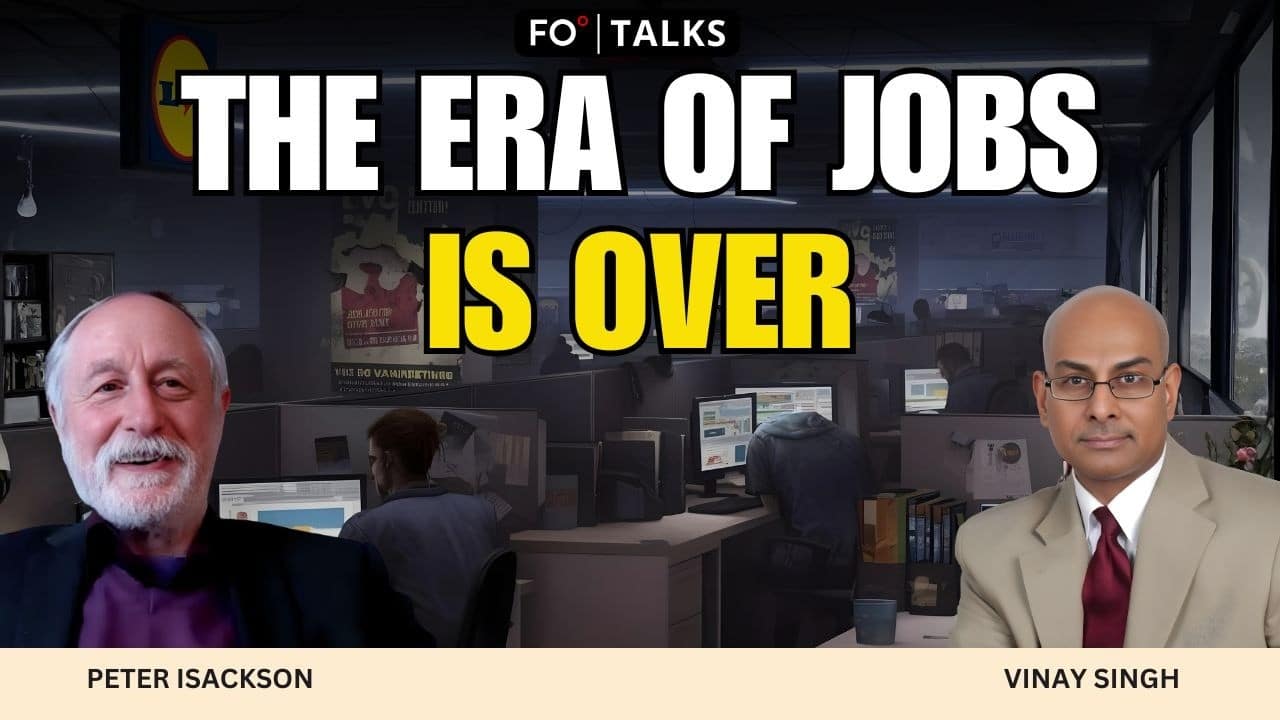
Fair Observer’s Chief Strategy Officer Peter Isackson and Global Civilization Dynamics Founder Vinay Singh discuss a labor crisis that reaches beyond layoffs and automation into something more destabilizing: the slow collapse of the assumptions that once gave work its meaning. As artificial intelligence spreads, salaries stagnate and career paths fragment, the two examine how economic insecurity is reshaping identity, education and trust. This disruption may force a deeper rethink of how societies organize learning, work and collective life.
Work, identity and a culture of anxiety
Singh opens by mentioning two films, No Other Choice (2025) and Send Help (2026), which he sees as cultural reflections of mounting workplace stress. He suggests that stories mixing comedy, horror and desperation resonate because they mirror a real social mood: the sense that stable employment has become elusive even for qualified people. In his view, such films offer a kind of emotional release for audiences who feel trapped in a labor market they cannot control.
Isackson argues that the issue is not just employment in a narrow sense, but the broader role of productive activity in human identity. For over a century, modern societies assumed that a job anchored a person’s place in the world. But the rise of gig work, precarious contracts and unstable income has weakened that link. Simultaneously, wealth has become more concentrated since the 2008 financial crisis, leaving many people with a growing sense of instability and anguish.
Security hollowed out
Singh turns to the economics of the middle class. He cites reporting from institutions such as The Wall Street Journal and RAND that shows wealth moving upward while ordinary workers lose ground. His example is the information technology sector: an Oracle database administrator earning around $120,000 in the early 2000s might earn roughly the same nominal salary today, even though housing, food and other essentials now cost far more. The salary appears stable, but purchasing power has eroded sharply.
That stagnation grows even more unsettling when paired with layoffs. Isackson points to job cuts at major technology firms such as Oracle, Microsoft and Amazon as evidence that insecurity now affects even workers once seen as safely positioned inside the knowledge economy. The problem is not only current income. It is also intergenerational. Parents who once believed they had found a secure place in the system now wonder whether their children will find any comparable path at all.
Degrees, skills and the educational reckoning
A major fault line in the discussion concerns higher education. Singh pushes back against claims that college degrees have broadly lost their value. He sees that argument as exaggerated and short-sighted. Education remains an investment in the mind itself, not just a ticket to a first job. As he puts it, a degree helps turn a young person into a “multidisciplinary thinking machine.” He argues that this broader intellectual formation still matters, and may matter even more as societies confront complex technological and economic change.
Isackson is less convinced that the existing model can survive intact. Traditional educational systems were built for job categories that are now disappearing or being transformed. In that sense, the problem is not learning itself but the institutional structure around it. He is skeptical of fashionable promises around both e-learning and AI, saying much of that enthusiasm is overhyped. Even so, he believes AI could become useful if education is rebuilt around critical thinking rather than credential production.
AI, layoffs and “functional unemployment”
Singh goes on to reference Anthropic CEO Dario Amodei, who has suggested that AI could eventually contribute to unemployment on a massive scale. Singh is struck by how quickly societies are embracing systems that may disrupt millions of livelihoods without any serious collective effort to slow the process or manage its consequences. He insists that individual workers are not to blame for the confusion and instability around them.
Singh also draws attention to a less visible measure of labor distress: functional unemployment. This includes not only people unable to find work, but also those employed full-time while earning below a poverty threshold. Someone who once held a skilled position but now survives through Uber, DoorDash or other low-paid work is still counted as employed, even though their economic life has been fundamentally downgraded. Singh calls attention to the ripple effects of that decline, from cutbacks in daily life to mounting family strain and financial stress.
From private struggle to collective rethink
To conclude the discussion, Isackson states that the crisis extends beyond jobs into a wider collapse of trust in institutions, from government to education to business leadership. Yet he also sees in that crisis the possibility of renewal. If the old framework no longer works, societies may be forced to imagine new forms of human activity, cooperation and value.
Singh ends on a similar note. “The whole house has been brought down,” he says, describing a system whose failures can no longer be hidden. Still, he urges viewers to resist isolation and self-blame. The confusion is real, the disruption is shared and the next model of work will not be shaped by individuals acting alone, but by people learning again how to think and act together.
[Lee Thompson-Kolar edited this piece.]
The views expressed in this article/video are the author’s own and do not necessarily reflect Fair Observer’s editorial policy.
”
post-content-short=”
Fair Observer’s Chief Strategy Officer Peter Isackson and Global Civilization Dynamics Founder Vinay Singh discuss a labor crisis that reaches beyond layoffs and automation into something more destabilizing: the slow collapse of the assumptions that once gave work its meaning. As artificial…”
post_summery=”In this episode of FO Talks, Peter Isackson and Vinay Singh examine how artificial intelligence, layoffs and wage stagnation are eroding job security and the deeper link between work and identity. As degrees lose predictable value and “functional unemployment” rises, trust in institutions weakens. The crisis may force a collective rethink of education, labor and economic systems.”
post-date=”Jun 01, 2026″
post-title=”FO Talks: Work, Identity and the Job Crisis No One Wants to Fix” slug-data=”fo-talks-work-identity-and-the-job-crisis-no-one-wants-to-fix”>

post_date=”May 31, 2026 05:05″
pUrl=”https://www.fairobserver.com/region/asia_pacific/fo-talks-trump-iran-and-uae-kanwal-sibal-explains-indias-diplomatic-balancing-acts/” pid=”162737″
post-content=”
Fair Observer’s Chief Strategy Officer Peter Isackson and former Foreign Secretary of India Kanwal Sibal discuss the widening crisis in West Asia and the difficult strategic choices facing India as the Trump administration escalates confrontation with Iran. Sibal argues that India has more at stake in the region than almost any other major power, with millions of expatriate workers, critical energy dependence and ambitious connectivity projects now threatened by war and instability. As US President Donald Trump’s rhetoric grows more erratic and Gulf monarchies confront an increasingly dangerous security environment, the region is entering a period of profound uncertainty that could reshape the global order.
India’s Gulf dilemma
Sibal begins by outlining why the Gulf sits at the center of India’s strategic thinking. The United Arab Emirates, he explains, has become the “hub” of India’s West Asia policy, with bilateral trade exceeding $70 billion and nearly four million Indians living and working there. Beyond commerce, the relationship now spans defense cooperation, artificial intelligence, green energy and semiconductor development.
These partnerships form part of a broader Indian strategy linking the Gulf to Europe and Africa. Sibal points to the India–Middle East–Europe Economic Corridor (IMEC), announced during India’s G20 presidency, as a major geopolitical initiative that is now stalled by regional conflict and Israel’s deteriorating position in the region.
India is severely exposed to instability. Nearly 10 million people of Indian origin live across West Asia, sending home roughly $40 billion in annual remittances. The region also supplies around half of India’s oil and 60% of its liquefied petroleum gas imports. Any prolonged disruption, Sibal says, threatens India more directly than most other global powers.
Iran, connectivity and strategic balancing
Sibal stresses that India’s relationship with Iran is driven by long-term geopolitical necessity rather than ideology. Before US sanctions, Iran was one of India’s largest oil suppliers, and New Delhi has continued maintaining diplomatic ties despite pressure from Washington.
Two connectivity projects remain especially important. The Chabahar Port project gives India access to Afghanistan and Central Asia while bypassing Pakistan. The International North–South Transport Corridor links India to Russia through Iran and the Caspian Sea, potentially reducing both shipping times and costs.
For Sibal, Iran also matters because it represents a crucial counterweight in the balance between Sunni Gulf monarchies and Shia regional power. India therefore seeks to maintain relations with all sides simultaneously: Iran, the Gulf states, Israel and the United States. That balancing act now severely constrains India’s diplomacy.
Rather than adopting a public position, Sibal supports what he calls “quiet diplomacy” behind the scenes. India’s leadership, he says, has remained in constant contact with regional actors while avoiding overt mediation efforts that could entangle New Delhi in unpredictable American decision-making.
Trump’s diplomacy and Pakistan’s role
Sibal expresses strong skepticism toward Trump’s handling of the crisis. He describes the US president as “extremely erratic” and argues that he repeatedly undermines negotiations through inflammatory rhetoric and maximalist demands.
Sibal is especially critical of Trump’s demand for “unconditional surrender” from Iran, arguing that such language makes meaningful diplomacy nearly impossible. “That’s not negotiation,” Sibal comments. “That’s humiliation.”
Isackson and Sibal also examine why Pakistan has emerged as a key intermediary between Washington and Tehran. Sibal explains that Pakistan’s long border with Iran, large Shia population and Islamic identity make it a more practical interlocutor than India in the current environment. Geography and domestic politics force Islamabad to carefully manage relations with both Saudi Arabia and Iran while avoiding internal instability.
Sibal cautions that India should avoid becoming directly involved in mediation efforts. In his view, attempting to broker negotiations would risk turning India into “a hostage to Trump’s idiosyncrasies and egomania.”
America’s reliability and India’s constraints
Despite his criticism of Washington, Sibal acknowledges that the US remains India’s most important economic and technological partner. Bilateral trade in goods and services has reached roughly $240 billion, and India continues to rely heavily on American investment and advanced technologies.
Simultaneously, Sibal argues that the Trump administration has badly damaged global confidence in the US. Tariffs, attacks on allies and the erosion of international institutions have reinforced the perception that Washington is no longer a dependable strategic partner.
India therefore faces a difficult reality. It cannot fully align with China or Russia, yet it also cannot completely trust the US. Sibal says India must continue “hedging” while recognizing that its options remain constrained by its rivalry with China and its dependence on Western technology.
Within India itself, attitudes toward the US are mixed. Business and technology sectors remain strongly pro-American because of deep links to Silicon Valley, while parts of the political class and broader public remain skeptical of American power and intentions.
Israel, Gulf monarchies and a fractured region
Toward the end of the discussion, Sibal turns to the growing fragmentation inside West Asia itself. Gulf monarchies, he argues, now face a “nightmare” scenario. They fear Iranian dominance, yet US military bases have also made them targets without guaranteeing security.
Sibal believes Israel has benefited strategically from the crisis because international attention has shifted away from Gaza, Lebanon and the West Bank. He argues that Israel continues expanding its regional influence while Arab states remain divided and unable to present a unified front.
Despite growing controversy, India’s partnership with Israel remains strong. Israel is deeply integrated into India’s defense ecosystem, particularly in missile technology, surveillance systems and counterterrorism capabilities. Sibal suggests that Israel may also serve as an indirect channel for certain advanced American technologies unavailable through formal US transfers.
Still, he acknowledges that India’s public positioning has become more difficult as regional polarization intensifies. What once appeared to be a manageable balancing strategy between Israel and the Arab world is becoming increasingly fragile as the wider regional order fractures.
[Lee Thompson-Kolar edited this piece.]
The views expressed in this article/video are the author’s own and do not necessarily reflect Fair Observer’s editorial policy.
”
post-content-short=”
Fair Observer’s Chief Strategy Officer Peter Isackson and former Foreign Secretary of India Kanwal Sibal discuss the widening crisis in West Asia and the difficult strategic choices facing India as the Trump administration escalates confrontation with Iran. Sibal argues that India has more at…”
post_summery=”In this episode of FO Talks, Peter Isackson and Kanwal Sibal discuss the strategic choices facing India as the Iran war destabilizes the region. India has more at stake than most major powers, as it depends on Gulf energy, trade and expatriate communities. US President Donald Trump uses erratic diplomacy, prompting doubts about America’s reliability as a global partner.”
post-date=”May 31, 2026″
post-title=”FO Talks: Trump, Iran and UAE — Kanwal Sibal Explains India’s Diplomatic Balancing Acts” slug-data=”fo-talks-trump-iran-and-uae-kanwal-sibal-explains-indias-diplomatic-balancing-acts”>
post_date=”May 30, 2026 04:20″
pUrl=”https://www.fairobserver.com/politics/fo-talks-decoding-elections-in-indias-west-bengal-assam-tamil-nadu-and-keralam/” pid=”162726″
post-content=”
Fair Observer’s Video Producer Rohan Khattar Singh speaks with FOI Partner and geopolitical analyst Manu Sharma about the 2026 Indian state elections, which reshaped the country’s political map from the northeast to the deep south. They examine the Bharatiya Janata Party (BJP)’s breakthrough in West Bengal and Assam, the collapse of Communist influence in Kerala and the rise of actor Vijay’s Tamilaga Vettri Kazhagam (TVK) party in Tamil Nadu. Indian elections are increasingly driven by infrastructure delivery, aspirational politics and long-term demographic shifts rather than ideology alone.
Rohan and Manu also explore how these regional outcomes could influence neighboring Bangladesh and Sri Lanka as India’s political center of gravity continues to evolve.
A tectonic shift in eastern India
The conversation opens with West Bengal, a state long associated with communist politics and later dominated by Chief Minister Mamata Banerjee’s Trinamool Congress. Manu describes the BJP’s victory as a historic transformation, noting the ideological leap from decades of left-wing politics to a party rooted in Hindutva nationalism. He compares it to “a hardcore atheist communist state” in Europe suddenly aligning with a church-backed movement.
For Manu, the result reflects more than identity politics. He believes the BJP succeeded because voters increasingly judge governments through economic performance and infrastructure delivery rather than ideological loyalty. “The fate is not decided on the battlefield or the ballot box, but on the balance sheet,” he says, pointing to roads, electricity and public services as decisive factors.
Rohan notes the irony that West Bengal produced some of India’s most influential economists and intellectuals while struggling economically for decades. Manu responds that Bengal excelled at theory but failed at implementation. The BJP’s rise represents a broader shift in eastern India’s political and economic center of gravity toward a more development-focused model.
Rohan and Manu also discuss the election’s unusually peaceful polling process. For the first time since Indian independence, no voters were killed during voting in West Bengal, though violence erupted after the results. Manu attributes this to the region’s historically “high-pitched” political culture rather than flaws in the constitutional process itself.
Assam’s stability dividend
In the northeastern state of Assam, the BJP returned to power with an even larger mandate. Rohan highlights two major changes: sweeping infrastructure development and the decline of insurgent violence. Massive bridges over the Brahmaputra River have dramatically reduced travel times, while former militant groups have increasingly entered mainstream politics.
Manu describes Assam’s strategic significance as the meeting point between the Indian and Tibetan-Sinic spheres of influence. The state’s geography, heavy rainfall and vast river systems historically made development difficult, leaving communities isolated from one another. Infrastructure therefore became politically transformative.
He argues that Assam is now benefiting from a “virtuous cycle” in which political stability improves economic performance, which in turn reinforces stability. Former insurgent movements have largely been pacified, and the state increasingly functions as the political and logistical nucleus of India’s northeast.
Rohan notes that the BJP’s next challenge will be employment. Assam’s population is exceptionally young, with nearly two-thirds under the age of 28. The election victory therefore creates expectations that economic development must now translate into jobs and rising living standards.
South India’s political divergence
The speakers contrast the BJP’s northeastern success with its weak performance in southern India. Despite extensive campaigning by Prime Minister Narendra Modi, the party performed poorly in both Tamil Nadu and Kerala.
Manu explains this through the bandwagon effect, arguing that voters in low-trust societies tend to support parties already viewed as viable contenders. In states where the BJP has not yet achieved critical mass, many voters instead choose among established regional players.
Tamil Nadu produced the election’s biggest surprise. Actor Vijay’s TVK party shattered the longstanding duopoly of the Dravida Munnetra Kazhagam and All India Anna Dravida Munnetra Kazhagam parties, emerging as a dominant new force. Rohan says that Vijay successfully captured younger voters through social media, satire and celebrity appeal.
Manu places this within Tamil Nadu’s distinct political culture, where cinema and literature have long shaped leadership. He compares the state to France within the European Union: culturally self-confident, linguistically distinct and deeply attached to its own icons. Actors and writers have historically wielded enormous political influence there.
Simultaneously, Manu praises outgoing Chief Minister MK Stalin for delivering exceptional economic growth. Tamil Nadu achieved some of India’s strongest industrial and manufacturing performance, yet voters still demanded political change. He posits that India’s elections often reveal a disconnect between macroeconomic growth and voter satisfaction because rapid expansion does not always generate broad wage growth or social mobility.
The decline of Indian communism
In Keralam, the Congress-led alliance defeated the Communist Party of India (Marxist), dealing another blow to a movement that once dominated Indian left-wing politics. Rohan jokes that communists now survive mainly in universities, reflecting a broader perception of ideological decline.
Manu argues that Indian communists failed to modernize in the way their Chinese or Vietnamese counterparts did. Rather than adapting to aspirational politics and economic transformation, they remained attached to older Soviet-era frameworks. “They failed to address the core question of human aspirations,” he says.
The result is significant for the Congress Party as well. After weak performances elsewhere, Keralam prevented the party from being completely marginalized nationally. Yet the broader story is less about Congress revival and more about the fading relevance of traditional communist politics in India.
Regional consequences beyond India
Rohan and Manu conclude by examining how the elections affect neighboring countries. Bangladesh closely monitored the outcomes in West Bengal and Assam because both states share borders, cultural and linguistic ties with it.
Manu says that Kolkata’s decisive “rightward turn” could reshape regional dynamics. A stronger and more economically assertive West Bengal may begin pulling economic influence back from Dhaka, while future governments in Kolkata could adopt a tougher stance regarding the treatment of religious minorities in Bangladesh.
Sri Lanka also watched developments in Tamil Nadu carefully because of the island’s long and complicated history with Tamil separatist movements. While Manu does not see any immediate revival of militant politics, he says Colombo will closely observe the rise of Vijay’s new political movement and its potential regional implications.
[Lee Thompson-Kolar edited this piece.]
The views expressed in this article/video are the author’s own and do not necessarily reflect Fair Observer’s editorial policy.
”
post-content-short=”
Fair Observer’s Video Producer Rohan Khattar Singh speaks with FOI Partner and geopolitical analyst Manu Sharma about the 2026 Indian state elections, which reshaped the country’s political map from the northeast to the deep south. They examine the Bharatiya Janata Party (BJP)’s breakthrough…”
post_summery=”In this episode of FO Talks, Rohan Khattar Singh and Manu Sharma examine the 2026 Indian state election results. Looking at the BJP’s gains in West Bengal and Assam, they argue that infrastructure, security and governance outweigh ideology in Indian politics. They also explore Vijay’s disruption of Tamil Nadu’s traditional party system and the decline of communism in Kerala.”
post-date=”May 30, 2026″
post-title=”FO Talks: Decoding Elections in India’s West Bengal, Assam, Tamil Nadu and Keralam” slug-data=”fo-talks-decoding-elections-in-indias-west-bengal-assam-tamil-nadu-and-keralam”>

post_date=”May 29, 2026 05:49″
pUrl=”https://www.fairobserver.com/world-news/fo-talks-decoding-donald-trumps-visit-to-china-and-xi-jinpings-thucydides-trap-remark/” pid=”162712″
post-content=”
Editor-in-Chief Atul Singh and Beijing-based Kiwi investor David Mahon discuss the May 2026 summit between US President Donald Trump and Chinese President Xi Jinping. While the White House presents the meeting as a triumph of transactional deal-making, Mahon believes that the summit’s real significance lies in symbolism rather than substance. The discussion ranges from Taiwan and the unraveling of “Chimerica” to the decline of American primacy and China’s evolving role in the global order.
A summit built on perception
Singh opens by examining the contrasting interpretations of the summit emerging from Washington and Beijing. The White House fact sheet portrays the meeting as a diplomatic and economic success, highlighting agreements on Iran, North Korea, agricultural exports and Boeing aircraft sales. Yet Mahon argues that many of these announcements amount to aspirational talking points rather than binding commitments.
Mahon notes that China has long mastered the art of the memorandum of understanding, producing agreements that outline broad principles without locking either side into concrete obligations. He points to the market’s skeptical response to Trump’s Boeing claims, observing that Boeing shares actually fell after the announcement. Agricultural trade also reflects deeper structural shifts. China’s move toward Brazilian soybeans seems unlikely to reverse because Brazilian products are cheaper and often of higher quality.
More importantly, Mahon says the summit marked a psychological shift in the relationship between the two countries. “They met as equals,” he states, arguing that China no longer approaches the United States as the junior partner in the relationship. That change in perception, rather than the individual deals announced in Beijing, may prove the summit’s lasting significance.
Taiwan and strategic weakness
The conversation then turns to Taiwan, which Singh describes as one of the central fault lines in US–China relations. In Mahon’s view, Taiwan’s importance to Washington stems less from democracy than from its usefulness as leverage against Beijing. He traces the issue back to US President Richard Nixon’s 1972 opening to China and the One China framework that followed.
Mahon dismisses the increasingly common prediction that China plans to invade Taiwan in 2027. He states that Beijing understands the enormous military, economic and political costs such an operation would entail. Taiwan’s geography alone would make an invasion extraordinarily difficult, while any prolonged conflict would threaten China’s access to global trade and finance.
Instead, Mahon interprets China’s military posture as largely reactive. From Beijing’s perspective, the country is surrounded by American alliances and military deployments stretching from Japan to the Philippines. Chinese military exercises and missile development are therefore viewed internally as defensive responses to containment rather than preparations for expansion.
Mahon also suggests that the recent US-led war in Iran has altered Beijing’s assessment of American power. He argues that Xi sees Washington as strategically weakened and increasingly reluctant to sustain major overseas confrontations. Trump’s response to Taiwan during the summit reinforced that perception. “We’re not really going to mess with this,” Mahon paraphrases the president as signaling, a statement he views as highly significant.
The myth of the “China shock”
Singh next raises the “China shock” thesis, the argument that Chinese manufacturing devastated the American working class by hollowing out industrial jobs across the Midwest. Mahon strongly rejects this interpretation.
He believes that American corporations voluntarily moved production to China in search of lower costs and higher profits. According to Mahon, technology, automation and agreements like NAFTA played a far larger role in destroying industrial employment than Chinese trade alone. “It’s a falsehood,” he says of the popular narrative blaming China for America’s industrial decline.
Mahon points to the enormous success American companies enjoyed in the Chinese market over the past three decades. Firms such as General Motors, Coca-Cola and Johnson & Johnson benefited enormously from China’s economic rise, while shareholders profited from lower production costs and expanding consumer markets.
For Mahon, the deeper problem lies within the American economic system itself. The US built an unsustainable model based on debt, deficits and consumption beyond its means. China has become a convenient scapegoat for structural weaknesses that originate domestically.
Asia’s return and the future of the global order
Finally, Singh and Mahon broaden into a debate about global primacy and the future international system. Mahon rejects popular comparisons to the Cold War or the “Thucydides Trap,” as he feels such analogies oversimplify a far more complex transformation. Instead, he sees the current moment as part of Asia’s historical reemergence after centuries of Western dominance.
“Asia is back,” Mahon says. He claims that China has already displaced the US as the central economic force across much of the region. While American military bases remain, he believes Washington’s broader influence is steadily receding.
Simultaneously, Mahon insists that China is not attempting to overthrow the post-1945 international order. Despite criticism over policies in Xinjiang, Tibet and elsewhere, he says that Beijing largely seeks to preserve and reform existing institutions rather than dismantle them. China benefits from stable trade systems, functioning global rules and multilateral organizations like the United Nations and the World Trade Organization.
Mahon concludes that the Beijing summit itself will likely fade from memory. Yet the larger tensions between the US and China will continue shaping global politics for years to come. He predicts a prolonged period of instability in which both powers compete economically and technologically while struggling to adapt to a more multipolar world.
[Lee Thompson-Kolar edited this piece.]
The views expressed in this article/video are the author’s own and do not necessarily reflect Fair Observer’s editorial policy.
”
post-content-short=”
Editor-in-Chief Atul Singh and Beijing-based Kiwi investor David Mahon discuss the May 2026 summit between US President Donald Trump and Chinese President Xi Jinping. While the White House presents the meeting as a triumph of transactional deal-making, Mahon believes that the summit’s real…”
post_summery=”In this episode of FO Talks, Atul Singh and David Mahon discuss the May 2026 Trump–Xi summit and the shifting balance of power between the United States and China. The summit signaled China’s emergence as a near-equal global power while exposing American strategic weakness. The world is moving away from unchallenged American dominance toward a contested multipolar order.”
post-date=”May 29, 2026″
post-title=”FO Talks: Decoding Donald Trump’s Visit to China and Xi Jinping’s Thucydides Trap Remark” slug-data=”fo-talks-decoding-donald-trumps-visit-to-china-and-xi-jinpings-thucydides-trap-remark”>

post_date=”May 28, 2026 05:42″
pUrl=”https://www.fairobserver.com/world-news/fo-talks-can-pakistan-saudi-arabia-turkey-and-indonesia-mediate-the-iran-war/” pid=”162703″
post-content=”
Fair Observer’s Video Producer Rohan Khattar Singh speaks with Abdullah O Hayek, a Middle East analyst and senior contributor at Young Voices, about a ceasefire that appears stable on the surface but remains deeply fragile underneath. The pause in hostilities between the United States, Israel and Iran reflects not resolution, but a temporary alignment of pressures — military fatigue, economic disruption and diplomatic intervention. The central question is not whether the ceasefire holds, but what kind of conflict it is merely postponing.
A ceasefire in name, not in substance
Hayek argues that the current arrangement should not be mistaken for a durable peace. As he puts it, the ceasefire is “fundamentally temporary and transactional rather than… strategic or durable.” It emerged not from resolved disputes but from converging constraints: battlefield exhaustion, global economic strain and mounting diplomatic pressure.
The underlying drivers remain intact. Iran’s nuclear trajectory continues. Israel’s objective of dismantling Iran’s regional network of proxies is unresolved. The US, meanwhile, has intensified coercive measures, including sanctions and an expanded maritime blockade that effectively restricts Iranian trade. Even within the ceasefire framework, conflict persists in other forms. Israeli operations in Lebanon continue, while Iran maintains leverage through asymmetric tools such as naval mines in the Strait of Hormuz.
For Hayek, this produces a situation where the ceasefire holds only in a narrow, technical sense. Beneath it lies what he describes as a pattern of “managed instability,” marked by periodic escalation, signaling and limited confrontation.
Battlefield dominance, strategic ambiguity
Khattar Singh turns to the 41 days of fighting that preceded the ceasefire, highlighting the scale of US and Israeli military operations. The destruction of Iranian military infrastructure was extensive, including the majority of its missile production capacity, naval assets and air force capabilities. Senior leadership figures were also eliminated.
Yet Hayek cautions against equating military success with strategic victory. “Wars of this kind… are decided by whether political objectives and agendas are achieved,” he explains. By that measure, the results are far less clear.
The US entered the conflict without a clearly defined end state. Israel’s stated objective of regime change in Iran remains unmet. Iran, despite suffering heavy losses, has not collapsed. Instead, it has adapted, reframing survival itself as a victory while shifting the conflict into economic and geopolitical domains.
The disruption of the Strait of Hormuz illustrates this shift. By targeting a chokepoint through which roughly a fifth of global energy flows, Iran imposed costs far beyond the battlefield. The result is a conflict that has expanded into global markets, where energy prices, shipping routes and trade flows become instruments of pressure.
The Gulf’s calculus of survival
The war has drawn in the Gulf states not as active participants, but as exposed stakeholders. A significant majority of Iranian strikes targeted Gulf infrastructure, underscoring their vulnerability despite attempts to remain on the sidelines.
Hayek describes their response as a calibrated strategy rooted in survival. They can launch relatively inexpensive drones in large numbers, but interception systems cost exponentially more. Economically, the disruption of the Strait of Hormuz directly threatens their core lifelines in oil and gas exports.
Politically, the Gulf states face a more complex dilemma. Alignment with the US and Israel offers security guarantees, but the war has exposed their limits. Simultaneously, open confrontation with Iran carries unacceptable risks.
The result is a hedging strategy. Gulf governments continue to rely on US partnerships while expanding diplomatic engagement, including support for mediation efforts involving countries such as Pakistan, Turkey and Egypt. Yet they maintain communication channels with Iran, even as tensions persist. This dual approach reflects an effort to contain the conflict rather than resolve it.
Time horizons and political pressure
Khattar Singh shifts the focus to domestic dynamics, contrasting the political constraints faced by Washington and Tel Aviv with Tehran’s longer strategic outlook. Hayek frames this as a clash of time horizons.
Iran operates on what he describes as a doctrine of endurance, where survival and gradual cost imposition are sufficient to claim success. In contrast, the US and Israel face immediate political pressures. Rising energy prices, war fatigue and electoral cycles constrain decision-making in Washington. In Israel, ongoing conflict, civilian casualties and internal political challenges place additional strain on leadership.
This asymmetry complicates the path forward. While Iran can absorb prolonged pressure, its adversaries must demonstrate tangible results within shorter timeframes. The absence of clear political victories raises questions about the sustainability of current strategies.
A region reshaped by instability
Khattar Singh and Hayek conclude by examining how the conflict is altering regional perceptions and alignments. Public sentiment in the Gulf has grown more critical of Israel, which is increasingly viewed as a source of instability. In the US, skepticism is rising, driven less by ideological opposition and more by concerns over cost and strategic clarity.
At the leadership level, however, pragmatism persists. Cooperation with Israel remains conditional and interest-based, while normalization efforts remain tied to unresolved issues such as Palestinian statehood. This divergence between public opinion and elite strategy is becoming a defining feature of the post-war landscape.
Hayek sees no clear winner. Instead, the war has left the region more unstable than before. The ceasefire may pause the violence, but it does not resolve the underlying tensions. If anything, it sets the stage for a conflict that continues in new forms, with escalation controlled not by resolution, but by calculation.
[Lee Thompson-Kolar edited this piece.]
The views expressed in this article/video are the author’s own and do not necessarily reflect Fair Observer’s editorial policy.
”
post-content-short=”
Fair Observer’s Video Producer Rohan Khattar Singh speaks with Abdullah O Hayek, a Middle East analyst and senior contributor at Young Voices, about a ceasefire that appears stable on the surface but remains deeply fragile underneath. The pause in hostilities between the United States, Israel…”
post_summery=”In this episode of FO Talks, Rohan Khattar Singh and Abdullah O Hayek examine the fragile Iran War ceasefire. While the US and Israel achieved tactical gains, neither secured their objectives, allowing Iran to pursue endurance and economic disruption. The regional order has lost further stability, as Gulf states hedge their positions and global energy markets face increased geopolitical risk.”
post-date=”May 28, 2026″
post-title=”FO Talks: Can Pakistan, Saudi Arabia, Turkey and Indonesia Mediate the Iran War?” slug-data=”fo-talks-can-pakistan-saudi-arabia-turkey-and-indonesia-mediate-the-iran-war”>

post_date=”May 22, 2026 06:21″
pUrl=”https://www.fairobserver.com/world-news/fo-talks-the-stalled-tribunal-is-the-icc-afraid-to-prosecute-israeli-pm-benjamin-netanyahu/” pid=”162602″
post-content=”
Fair Observer’s Chief Strategy Officer Peter Isackson and former Swiss diplomat Jean-Daniel Ruch discuss the erosion of international law, the humanitarian catastrophe in Gaza and the weakening authority of international institutions. Drawing on his experience as a former political advisor to the UN Yugoslavia War Crimes Tribunal, Ruch argues that many of the norms designed to regulate conflict and protect civilians are now being openly disregarded by major powers. From the interception of humanitarian flotillas to the intimidation of International Criminal Court officials, the conversation paints a troubling picture of a global order in which legal standards increasingly depend on political power rather than universal principles.
Contested legality
The discussion begins with Israel’s interception of the Sumud humanitarian flotilla in international waters near Crete. Ruch explains that the flotilla consisted of 22 boats carrying 176 activists attempting to draw attention to the worsening humanitarian crisis in Gaza. According to UN estimates, Gaza requires around 600 aid trucks per day, yet only a fraction are currently allowed to enter. Ruch argues that, as an occupying power, Israel has a legal responsibility to ensure the basic needs of the civilian population are met.
Simultaneously, he acknowledges that the legality of the interception itself remains contested. International maritime law protects freedom of navigation on the high seas, while Israel maintains that it is enforcing what it considers a lawful blockade. Ruch suggests the operation’s tactical design was politically calculated. By intercepting the flotilla roughly 1,300 kilometers from Gaza, Israel minimized media visibility and avoided the dramatic confrontations that accompanied earlier flotillas.
For Ruch, however, the deeper issue is not the flotilla itself but the humanitarian conditions that motivated it. He describes the activists’ efforts as stemming from “a very noble intention” to draw attention to suffering that much of the world has begun to normalize. The flotilla becomes less a decisive legal test case than a symbolic reminder of a crisis that many governments and media outlets increasingly treat as background noise.
Politics of justice
Isackson notes that the International Criminal Court (ICC) has accused Israeli Prime Minister Benjamin Netanyahu of war crimes, though it has not formally charged him with genocide. Ruch argues that the ICC’s paralysis reflects immense political pressure placed on its judges and prosecutors.
He points to US sanctions targeting ICC officials, including restrictions that have reportedly prevented some judges from accessing banking services or using credit cards. Ruch also notes that sexual misconduct allegations involving ICC Prosecutor Karim A. A. Khan have further complicated proceedings. Thus, investigations appear to have stalled precisely as evidence has continued to accumulate.
Ruch believes that stronger prosecutors from an earlier generation, such as Carla Del Ponte, would likely have moved more aggressively. He argues that reports from organizations including Amnesty International, Human Rights Watch and Israeli groups such as B’Tselem provide substantial material for expanding charges. Yet he remains skeptical that Netanyahu will ever stand trial, largely because the Israeli leader can avoid traveling to countries obligated to enforce ICC warrants.
Ruch describes the modern Netanyahu as “a very diminished person” compared to the confident political operator he once knew. Drawing on his experience at the Yugoslavia tribunal, he compares Netanyahu’s visible decline to the condition of Ratko Mladić during his later court appearances. Ruch believes that leaders accused of grave crimes often appear transformed by the weight of history and prolonged conflict.
The collapse of international norms
Beyond Gaza, Ruch argues that broader norms governing diplomacy and warfare are rapidly eroding. He cites the killings of negotiators and political envoys, including Hamas leader Ismail Haniyeh and Iranian officials, as evidence that long-standing protections surrounding diplomacy are disappearing.
Historically, emissaries and negotiators were treated as untouchable even during periods of intense conflict. Ruch argues that this principle, once regarded as foundational to international relations, has now been casually discarded. “There is not much appetite for international law in Washington,” he says, linking the shift to a wider embrace of raw power politics.
The speakers also examine the language used to describe different conflicts. Ruch notes that Russia’s invasion of Ukraine in 2022 was widely labeled an “unprovoked aggression,” while the US-led attack on Iran in February was more often described as a “war of choice.” Similarly, Western governments framed Israeli military actions as self-defense while criticizing Iran’s retaliatory strikes without acknowledging Tehran’s own claims under Article 51 of the UN Charter. For Ruch, these distinctions illustrate how legal and moral terminology increasingly reflects geopolitical alignment rather than consistent standards.
Europe’s strategic confusion
Finally, Isackson and Ruch turn to Europe’s struggle for strategic autonomy. Ruch argues that European governments remain politically dependent on Washington even as American policies generate severe economic consequences for Europe itself. The continent’s shift away from Russian pipeline gas toward more expensive American liquefied natural gas has significantly increased household energy costs, particularly in Germany and Italy.
He notes that some European leaders quietly recognize the unsustainability of this arrangement. Yet attempts to develop an independent diplomatic strategy remain tentative and fragmented. Even modest proposals to reopen dialogue with Russia quickly face pressure to remain aligned with Washington.
Isackson criticizes European media for largely reinforcing official policy narratives rather than seriously debating alternatives. Ruch agrees that traditional media institutions are losing influence, especially among younger audiences who increasingly rely on social media. At the same time, he warns that algorithm-driven information environments risk trapping audiences inside ideological echo chambers.
The discussion concludes with reflections on French politics and the emergence of alternative foreign-policy voices. Ruch praises Jean-Luc Mélenchon and Dominique de Villepin for articulating more independent visions of France’s global role, even if neither fully fits within the existing political establishment.
Ultimately, Ruch characterizes the present moment as a turbulent historical transition in which institutions, norms and alliances are all being tested at once. The international system still exists formally, but its underlying rules are becoming harder to enforce as major powers increasingly act according to expediency rather than principle.
[Lee Thompson-Kolar edited this piece.]
The views expressed in this article/video are the author’s own and do not necessarily reflect Fair Observer’s editorial policy.
”
post-content-short=”
Fair Observer’s Chief Strategy Officer Peter Isackson and former Swiss diplomat Jean-Daniel Ruch discuss the erosion of international law, the humanitarian catastrophe in Gaza and the weakening authority of international institutions. Drawing on his experience as a former political advisor to…”
post_summery=”In this episode of FO Talks, Peter Isackson and Jean-Daniel Ruch examine the erosion of international law amid the Gaza war and the Strait of Hormuz crisis. Political pressure has stalled ICC action against Israeli Prime Minister Benjamin Netanyahu, and major powers are systematically breaking long-standing diplomatic norms. Legal standards increasingly depend on geopolitical power rather than universal principles.”
post-date=”May 22, 2026″
post-title=”FO Talks: The Stalled Tribunal — Is the ICC Afraid to Prosecute Israeli PM Benjamin Netanyahu?” slug-data=”fo-talks-the-stalled-tribunal-is-the-icc-afraid-to-prosecute-israeli-pm-benjamin-netanyahu”>

post_date=”May 21, 2026 06:10″
pUrl=”https://www.fairobserver.com/world-news/fo-talks-trumps-iran-jolt-why-the-us-is-threatening-the-uk-over-the-falkland-islands/” pid=”162582″
post-content=”
Fair Observer’s Video Producer Rohan Khattar Singh speaks with Simon Cleobury, Head of Arms Control and Disarmament at the Geneva Centre for Security Policy, about renewed tensions surrounding the Falkland Islands, known in Argentina as Las Malvinas. Following reports that the Trump administration may reconsider Washington’s diplomatic backing for the United Kingdom, the dispute has reentered global debate amid growing strains between US President Donald Trump and UK Prime Minister Keir Starmer over the US war in Iran. Cleobury explains why the islands remain one of the world’s most enduring sovereignty disputes and examines whether Trump’s transactional approach to alliances could destabilize the long-standing US–UK “Special Relationship.”
A dispute rooted in empire and war
Khattar Singh opens by asking why the Falkland Islands remain contested nearly two centuries after Argentina first claimed sovereignty. Cleobury traces the dispute back to the 17th century, noting that the English first landed on the islands in 1690, while the French established the first settlement in 1764 and introduced the name “Malovines,” from which “Las Malvinas” is derived.
After Argentina gained independence from Spain in 1816, Buenos Aires declared sovereignty over the islands in 1820. Britain reasserted control in 1833 and has governed the territory ever since. Cleobury explains that the dispute gained international prominence after World War II, culminating in a 1965 United Nations resolution encouraging peaceful negotiations between London and Buenos Aires.
The conflict escalated dramatically in 1982 when Argentina’s military government invaded the islands. Margaret Thatcher’s government responded by dispatching a naval task force that retook the territory after a ten-week war. Although Britain emerged victorious militarily, the sovereignty dispute itself remained unresolved.
Trump, Iran and diplomatic leverage
According to reports, leaked Pentagon memos suggest the Trump administration is considering diplomatic support for Argentina. Allegedly, the move is linked to White House frustration with Starmer’s reluctance to fully support Washington during the war in Iran.
Cleobury says such a shift would alarm Britain because US diplomatic backing has historically been central to the UK’s international position on the Falklands. He also notes that American military assistance during the 1982 war was widely viewed as crucial to Britain’s success.
Simultaneously, Cleobury doubts the administration will fundamentally abandon London. “I personally don’t think that the US is going to change its position here,” he says, pointing to subsequent efforts by Secretary of State Marco Rubio and King Charles III to calm tensions after the leak became public.
Still, Cleobury believes the Falklands issue has value for Trump as a pressure point. He argues that the White House is less interested in the islands themselves than in using them as leverage against NATO allies unwilling to fully align with US military objectives in Iran. Starmer’s domestic vulnerability, particularly after criticism surrounding the 2025 Chagos Islands agreement with Mauritius, makes the issue politically sensitive for the British government.
The Monroe Doctrine and Trump’s strategy
Khattar Singh raises the possibility that the administration’s thinking reflects a broader effort to revive an expanded version of the Monroe Doctrine, with Washington asserting dominance over the Western Hemisphere.
Cleobury acknowledges that siding more openly with Argentina could improve US standing in parts of Latin America. However, he argues that any gains would likely be outweighed by damage to relations with Britain. “I still take the view that any diplomatic gains with countries of the region wouldn’t outweigh the diplomatic fallout with the UK,” he explains.
He also points to contradictions within the administration’s broader territorial policies. Trump has simultaneously criticized Britain over the Chagos Islands while defending continued UK sovereignty there because of the strategic importance of the Diego Garcia military base. The Falklands do not carry the same military value for Washington.
The discussion highlights how Trump’s foreign policy often blends geopolitical calculation with personal relationships. Khattar Singh suggests Argentine President Javier Milei’s close ties with Trump could strengthen Buenos Aires’ leverage in Washington.
Cleobury agrees that personal rapport matters greatly to Trump but insists the US–UK alliance extends beyond individual leaders. “The relationship between the UK and US, which is often referred to as a special relationship, is fundamentally a very strong relationship,” he says.
The islanders and an unresolved deadlock
Toward the end of the discussion, Khattar Singh emphasizes a frequently overlooked dimension of the dispute: the wishes of the islanders themselves. In a 2013 referendum, 99.8% of Falkland Islanders voted to remain a British Overseas Territory.
Cleobury says Britain’s position rests heavily on the principle of self-determination, but Argentina rejects the referendum as illegitimate because it views British control as a colonial occupation rooted in historical injustice.
That leaves the dispute effectively deadlocked. Cleobury argues that sovereignty questions are ultimately indivisible and that proposals such as joint administration are unlikely to satisfy either side. Even under significant diplomatic pressure, he does not believe Britain would relinquish sovereignty over the islands.
As a result, the Falklands are likely to remain a persistent geopolitical flashpoint.
[Lee Thompson-Kolar edited this piece.]
The views expressed in this article/video are the author’s own and do not necessarily reflect Fair Observer’s editorial policy.
”
post-content-short=”
Fair Observer’s Video Producer Rohan Khattar Singh speaks with Simon Cleobury, Head of Arms Control and Disarmament at the Geneva Centre for Security Policy, about renewed tensions surrounding the Falkland Islands, known in Argentina as Las Malvinas. Following reports that the Trump…”
post_summery=”In this episode of FO Talks, Rohan Khattar Singh and Simon Cleobury discuss renewed tensions over the Falkland Islands after reports that the Trump administration may reconsider US backing for Britain. Cleobury explains the dispute’s historical roots and the pressure facing UK Prime Minister Keir Starmer. This situation is shaped by great-power politics and the islanders’ demand for self-determination.”
post-date=”May 21, 2026″
post-title=”FO Talks: Trump’s Iran Jolt — Why the US Is Threatening the UK Over the Falkland Islands” slug-data=”fo-talks-trumps-iran-jolt-why-the-us-is-threatening-the-uk-over-the-falkland-islands”>

post_date=”May 18, 2026 06:01″
pUrl=”https://www.fairobserver.com/region/asia_pacific/fo-talks-how-quad-members-japan-and-australia-are-now-maximizing-minilateral-cooperation/” pid=”162523″
post-content=”
Fair Observer’s Video Producer Rohan Khattar Singh speaks with Saya Kiba, a professor at Japan’s Kobe City University of Foreign Studies, about Japan’s evolving role in the Indo-Pacific under Prime Minister Sanae Takaichi. As uncertainty clouds the future of the Quad — the Quadrilateral Security Dialogue, a diplomatic partnership between the United States, Australia, India and Japan concerning Indo-Pacific security — Tokyo is strengthening ties with Australia and Southeast Asia through new diplomatic, economic and security initiatives. Kiba explains how Japan’s updated “Free and Open Indo-Pacific” strategy reflects a broader shift toward middle-power cooperation, while controversial discussions about exporting lethal weapons to the Philippines signal another change in Japan’s security policy, with the country slowly moving away from its post-war pacifist stance.
Japan’s middle-power strategy
Khattar Singh opens by asking about Takaichi’s recent five-day tour of Vietnam and Australia, which took place from May 1 to May 5. Kiba says the trip reflects Japan’s effort to deepen both bilateral and multilateral partnerships at a time of growing uncertainty in global politics.
Australia has become especially important as Japan loosens restrictions on arms exports and explores joint defense development projects. Simultaneously, both countries are reassessing the Quad’s future.
Kiba argues that the Quad has lost momentum amid uncertainty surrounding American policy. “The Quad cooperation has actually stopped,” she says, pointing to the failure to hold a planned summit in India last year. In response, she believes countries like Japan and Australia are increasingly relying on middle-power coordination to preserve regional stability even when Washington appears inconsistent.
For Tokyo, Southeast Asia remains equally important. Kiba describes the region as Japan’s “most essential neighboring partner,” particularly during ongoing energy and supply-chain disruptions across the Indo-Pacific.
Updating the Indo-Pacific vision
A major focus of Takaichi’s Vietnam visit was the announcement of an updated version of Japan’s “Free and Open Indo-Pacific” strategy, commonly known as FOIP. Originally introduced by former Prime Minister Shinzo Abe a decade ago, FOIP sought to promote regional cooperation around maritime security, infrastructure and rule-based order.
Kiba explains that the revised framework places greater emphasis on emerging economic and technological challenges. The updated FOIP now includes cooperation on artificial intelligence, supply-chain resilience, renewable energy and public–private investment partnerships.
Japan is not distancing itself from the US despite its growing regional activism. Washington remains Tokyo’s only formal military ally, and Japan continues to coordinate closely with the US government. Instead, the new strategy reflects Japan’s attempt to modernize its regional relationships.
“The updated FOIP is more focusing on the co-creation facing the new challenges together,” Kiba explains. Rather than treating Southeast Asian countries as aid recipients, Japan increasingly frames them as equal partners confronting common problems such as energy insecurity and economic vulnerability.
This shift is also visible in Japan’s “Power Asia” initiative, announced earlier this year. The program seeks to expand regional energy cooperation, particularly around renewable energy and zero-emission technologies. Meanwhile, it links partners such as Australia, India and Southeast Asian states into a broader Indo-Pacific framework.
Australia and the rise of minilateral alliances
Khattar Singh notes that even as the Quad struggles to maintain momentum, bilateral cooperation between Japan and Australia continues to intensify. Kiba says the two countries now share far more aligned strategic concerns than they did in previous decades, especially regarding China’s expanding military presence.
Their cooperation increasingly extends beyond traditional defense issues into “economic security,” including supply chains, critical minerals and energy resilience. Both governments also support deeper engagement with Southeast Asia through new regional frameworks.
Kiba highlights the growing importance of “minilateral” arrangements — smaller coalitions built around specific strategic goals. During a recent visit to Indonesia, Japanese Defense Minister Shinjiro Koizumi and his Indonesian counterpart mentioned trilateral cooperation among Japan, Australia and Indonesia.
For Kiba, these emerging security networks represent one of the most significant developments in Indo-Pacific diplomacy. Instead of relying entirely on large multilateral organizations, middle powers are constructing flexible regional partnerships designed to address practical economic and security concerns.
Japan’s debate over lethal arms exports
The most controversial part of Japan’s new strategy involves defense exports. Khattar Singh asks Kiba about reports that Tokyo may sell lethal weapons, including destroyers, to the Philippines. Such a move would have been politically unthinkable under Japan’s traditional postwar pacifism.
Kiba confirms that recent cabinet decisions have dramatically expanded Japan’s legal ability to export military equipment. “Technically, we can export any kind of the defense equipment,” she says.
However, the process remains politically and bureaucratically difficult. The relaxation of export restrictions occurred through a cabinet decision rather than parliamentary legislation, a process she says has generated domestic criticism.
“Many people criticize, and I agree [with] that point,” Kiba notes. She argues that such a major shift should involve broader democratic debate. Japan and the Philippines have only agreed to begin discussions regarding the possible transfer of Taylorcraft TC-19 aircraft and destroyers. Any final agreement would require extensive parliamentary review, operational planning and legal guarantees concerning transparency, maintenance and non-resale provisions.
Kiba emphasizes that Japan’s bureaucratic safeguards remain extensive. Recipient countries must comply with strict procurement rules and operational restrictions, while both governments would need to negotiate thousands of pages of technical and legal documentation before any transfer could occur.
For now, Japan’s evolving defense policy reflects a country attempting to balance regional security pressures with the institutional constraints of its democratic and pacifist traditions.
[Lee Thompson-Kolar edited this piece.]
The views expressed in this article/video are the author’s own and do not necessarily reflect Fair Observer’s editorial policy.
”
post-content-short=”
Fair Observer’s Video Producer Rohan Khattar Singh speaks with Saya Kiba, a professor at Japan’s Kobe City University of Foreign Studies, about Japan’s evolving role in the Indo-Pacific under Prime Minister Sanae Takaichi. As uncertainty clouds the future of the Quad — the Quadrilateral…”
post_summery=”In this episode of FO Talks, Rohan Khattar Singh and Saya Kiba examine Japan’s role in the Indo-Pacific as uncertainty weakens the Quad. Prime Minister Sanae Takaichi’s FOIP strategy strengthens cooperation with Australia and Southeast Asia on regional security. Japan’s willingness to open discussions on selling destroyers to the Philippines marks a major shift from its traditional post-war pacifist stance.”
post-date=”May 18, 2026″
post-title=”FO Talks: How QUAD Members Japan and Australia Are Now Maximizing Minilateral Cooperation” slug-data=”fo-talks-how-quad-members-japan-and-australia-are-now-maximizing-minilateral-cooperation”>

post_date=”May 17, 2026 06:00″
pUrl=”https://www.fairobserver.com/politics/fo-talks-a-dangerous-divide-why-a-middle-class-breakup-threatens-american-democracy/” pid=”162493″
post-content=”
Kent Jenkins Jr., a former political reporter from The Washington Post turned communications consultant, speaks with author Paul Eckert about the widening fracture inside the American middle class and what it means for the future of democracy. Drawing on his 2026 book, Healing Middle-Class Democracy: Respecting Each Other, Cooperating Fairly, and Sharing Opportunity, Eckert argues that the postwar middle class has split into a prosperous upper tier and a struggling lower tier with increasingly different economic possibilities. Rising housing, healthcare, childcare and education costs have weakened the sense of shared opportunity that once anchored American society. Eckert proposes a broader democratic project built on mutual respect, fairness and investment in opportunity.
A middle class divided
Eckert begins by redefining the middle class through economic dependence on work. Unlike the wealthy, middle-class Americans cannot stop working without risking a major decline in their standard of living. Yet he argues that this broad category no longer shares common economic interests.
He distinguishes between an upper middle class, roughly the top 20% of working-age Americans, and a lower middle class that makes up the next 60%. Since the late 1970s, the upper tier has accumulated far more wealth while the lower tier has struggled with affordability and economic insecurity. “The middle class depends on democracy and democracy depends on the middle class,” Eckert says. Democratic stability weakens when most citizens no longer feel institutions work for them.
The divide becomes visible in daily life. First-time homebuyers increasingly find themselves priced out of the market. Childcare costs force many families into impossible tradeoffs between parenting and employment. Healthcare expenses remain financially disruptive even for insured households, while rising student debt undermines education as a path to mobility. Jenkins notes that Americans who once occupied a relatively unified middle-class world now experience sharply different realities.
Democracy and mutual respect
For Eckert, the economic split carries political consequences because democracy relies on compromise between groups with competing interests. If most Americans lose faith in democratic institutions, those institutions become fragile.
His first proposed remedy is respect. Eckert says that the upper and lower middle classes increasingly live apart socially and geographically, which fuels resentment and misunderstanding. Those at the top may view struggling Americans as irresponsible or lazy, while those below see arrogance and unfair privilege.
He insists both perspectives miss the structural realities shaping opportunity. “Everybody’s working hard, everybody’s ambitious, everybody wants to do the best they can,” he says, even if circumstances produce vastly different outcomes.
Rather than condemning success, Eckert argues that prosperous Americans should retain incentives to innovate and achieve. Simultaneously, society should recognize the unrealized potential inside the lower middle class. Respect, in his framework, means acknowledging the equal dignity of all forms of work and rejecting the assumption that economic outcomes perfectly reflect personal worth.
Fairness, cooperation and opportunity
Eckert’s second pillar, cooperating fairly, draws heavily from political philosopher John Rawls. He revisits Rawls’s “veil of ignorance” thought experiment, which asks people to imagine designing society without knowing where they or their children would end up within it.
The exercise, Eckert argues, reveals why democratic societies must balance individual freedom with collective responsibility. Inequality will always exist because talent, health, upbringing and opportunity differ. Yet fairness requires ensuring that those born into difficult circumstances still have meaningful chances to improve their lives.
That principle leads directly to Eckert’s third pillar: sharing opportunity. He carefully distinguishes this from simple redistribution. While some redistribution may be necessary, he argues that long-term democratic stability depends more on expanding people’s ability to generate prosperity themselves.
Education sits at the center of this strategy. Eckert advocates a continuous pipeline beginning with preschool and extending through vocational training, community colleges and universities. He emphasizes that four-year college degrees should not remain the only respected path to advancement. Vocational education, entrepreneurship and technical skills can also create mobility and economic security.
Artificial intelligence intensifies the urgency of these reforms. AI-driven disruption may soon affect upper-middle-class professionals as much as manufacturing workers. Instead of slowing innovation, Eckert argues that education systems should help workers adapt to emerging industries and technologies.
Philosophy, experience and democratic hope
Jenkins notes that Eckert’s argument stands apart from the anger and polarization dominating contemporary politics. Eckert explains that his approach emerges partly from personal experience. Raised in lower-middle-class Indiana, he later entered elite academic and political institutions, giving him firsthand exposure to both sides of America’s class divide.
His thinking also draws from philosophers including Rawls, John Dewey and Jürgen Habermas. Dewey emphasized mutual respect and challenged the historic bias against manual labor. Habermas focused on honest communication and democratic negotiation in the aftermath of Nazi Germany. Rawls provided the framework for fairness and social cooperation.
Eckert acknowledges that his vision may appear idealistic in a deeply polarized political climate. Yet he argues that democratic societies need ideals precisely because daily politics so often falls short. “The American dream can be just a hopeless fantasy or an empty aspiration,” he says. “It can also be a reality.”
The discussion closes on a cautiously optimistic note. Eckert believes that investing in the unrealized potential of the lower middle class could increase national productivity while preserving prosperity for those already succeeding. Democracy, in his view, remains the only system capable of balancing both goals at once.
[Lee Thompson-Kolar edited this piece.]
The views expressed in this article/video are the author’s own and do not necessarily reflect Fair Observer’s editorial policy.
”
post-content-short=”
Kent Jenkins Jr., a former political reporter from The Washington Post turned communications consultant, speaks with author Paul Eckert about the widening fracture inside the American middle class and what it means for the future of democracy. Drawing on his 2026 book, Healing Middle-Class…”
post_summery=”In this episode of FO Talks, Kent Jenkins Jr. and Paul Eckert discuss the growing divide between America’s upper and lower middle classes. Rising costs in housing, healthcare, childcare and education have eroded shared economic opportunity, while social separation between classes fuels resentment and distrust. Eckert proposes rebuilding democracy through mutual respect, cooperation and investment in education and opportunity.”
post-date=”May 17, 2026″
post-title=”FO Talks: A Dangerous Divide — Why a Middle-Class Breakup Threatens American Democracy” slug-data=”fo-talks-a-dangerous-divide-why-a-middle-class-breakup-threatens-american-democracy”>


post_date=”May 16, 2026 04:38″
pUrl=”https://www.fairobserver.com/world-news/fo-talks-why-the-us-could-abandon-the-uk-and-back-argentina-in-the-falkland-islands-dispute/” pid=”162500″
post-content=”
Fair Observer’s Video Producer Rohan Khattar Singh and Argentine international-relations analyst Ricardo Vanella discuss renewed geopolitical attention surrounding the Falkland Islands, known in Argentina as the Islas Malvinas. Following reports that the Trump administration may reconsider Washington’s diplomatic backing for the United Kingdom after Britain refused to support the US war in Iran, Argentina may now have a renewed diplomatic opportunity to explain its long-standing sovereignty claim with seriousness, restraint and strategic patience. Vanella argues that while Argentinian President Javier Milei’s close ties with US President Donald Trump may provide Argentina with unusual access in Washington, Buenos Aires must avoid overreading tactical signals from the White House. Instead of confrontation, he proposes a long-term South Atlantic framework centered on diplomacy, investment and trust-building between Argentina and the UK.
A dispute shaped by history and identity
Vanella begins by explaining why he refers to the islands as the Malvinas rather than the Falklands. For Argentina, he says, the issue is tied not only to sovereignty but also to history, identity and constitutional principle. Argentina views the islands as territory occupied by Britain since 1833, while the UK argues that sovereignty rests on long-term administration and the wishes of the islanders themselves.
The dispute remains emotionally and politically charged because it combines colonial history, international law and national identity. Khattar Singh notes how naming itself becomes a geopolitical tool, comparing the issue to disputes over geographic terminology elsewhere in the world.
Although Argentina lost the Falklands War in 1982, Vanella stresses that democratic governments since then have pursued the issue through diplomacy rather than force. “This is not about war,” he says. “This is about law, history, diplomacy and an unresolved sovereignty dispute.”
Trump, Milei and a changing geopolitical landscape
The immediate trigger for the conversation is a reported Pentagon memo suggesting the Trump administration may reconsider US diplomatic support for Britain regarding the islands. According to the report, the shift emerged partly because London refused to openly back Washington during the US confrontation with Iran.
Khattar Singh connects this possibility to what he describes as a revived “Monroe Doctrine” approach in Trump’s foreign policy, where Washington seeks to tighten influence over the Western Hemisphere and limit the role of rival powers, including European states. Argentina’s growing ideological alignment with the Trump administration has therefore attracted international attention.
Vanella urges caution. While Milei’s relationship with Trump may improve Argentina’s access in Washington, he warns against treating internal US debates as a definitive policy shift. “Access is not the same as a policy change,” he explains.
He argues that Argentina should use the moment carefully by combining political access with serious diplomacy. Legal arguments, regional support, multilateral engagement and strategic patience remain more important than personal relationships between leaders. As Vanella puts it, “Personal chemistry helps. It does not replace statecraft.” Vanella emphasizes that Washington has historically acknowledged the dispute while stopping short of formally backing Argentine sovereignty.
A shared South Atlantic vision
Vanella proposes what he describes as a long-term South Atlantic framework — a shared vision built around cooperation, investment, connectivity and trust-building. If both sides continue insisting only on their maximum demands, the dispute could remain frozen for another century.
His proposal centers on practical cooperation before any final sovereignty settlement. Britain could increase investments in Patagonia and Tierra del Fuego in sectors such as logistics, fisheries, energy and scientific research. Argentina, meanwhile, could strengthen its commercial and economic presence in London while building deeper ties with British institutions and businesses.
Vanella believes such a framework could gradually reduce mistrust while creating mutual economic incentives. “Diplomacy sometimes requires imagination, patience and very long horizons,” he says.
Importantly, he draws a firm line against any military approach. Argentina, he argues, must reject the possibility of armed confrontation entirely because another war would be “disastrous morally, strategically and diplomatically.” Instead, Buenos Aires should focus on strengthening economic credibility, regional partnerships and diplomatic influence. The serious Argentine position, he says, should be “firm but peaceful: no war, no adventurism, only diplomacy and statecraft.”
Self-determination, colonialism and global support
Khattar Singh raises the central contradiction in the dispute: Argentina describes the islands as a colonial holdover, while Britain argues that the islanders overwhelmingly support remaining a British Overseas Territory. In the 2013 referendum, nearly 99% of voters backed continued British rule.
Vanella responds that Argentina views the issue differently because much of the international community still treats the dispute as unresolved. Latin American organizations and many countries in the Global South continue supporting negotiations between Buenos Aires and London, even if not all explicitly endorse Argentina’s sovereignty claim.
He also notes that countries such as India have historically shown diplomatic sympathy toward Argentina’s position, including the use of the name “Malvinas” in official contexts. Yet symbolic support alone, he says, is insufficient. Argentina must prove itself “consistent,” “credible” and “reliable” over time if it wants major powers to take its diplomatic strategy seriously.
The “big club” of geopolitics
In the final section, Vanella frames the dispute within what he calls the global “big club” of powerful states. The US may dominate the system, he says, but the UK remains a crucial part of its infrastructure and alliances. Because of this, Argentina should avoid assuming Washington will dramatically abandon Britain.
Instead, Vanella believes Buenos Aires should pursue gradual trust-building with both the US and the UK while remaining active in multilateral institutions, including the United Nations, where long-term diplomatic opportunities may emerge.
Ultimately, Vanella argues that only a shared South Atlantic strategy can break the diplomatic deadlock. A long-term framework based on trade, investment, connectivity and cooperation may not immediately solve the sovereignty dispute, but it could create the trust necessary for meaningful negotiations later. In Vanella’s view, Argentina should remain firm in principle, peaceful in method and creative in strategy.
[Lee Thompson-Kolar edited this piece.]
The views expressed in this article/video are the author’s own and do not necessarily reflect Fair Observer’s editorial policy.
”
post-content-short=”
Fair Observer’s Video Producer Rohan Khattar Singh and Argentine international-relations analyst Ricardo Vanella discuss renewed geopolitical attention surrounding the Falkland Islands, known in Argentina as the Islas Malvinas. Following reports that the Trump administration may reconsider…”
post_summery=”In this episode of FO Talks, Rohan Khattar Singh and Ricardo Vanella discuss renewed geopolitical tensions surrounding the Falkland Islands after reports suggest Trump may reconsider supporting Britain. Argentina shouldn’t overinterpret signals from Washington, but pursue patient diplomacy grounded in international law. Vanella proposes a South Atlantic framework based on investment and trust-building between Argentina and the UK.”
post-date=”May 16, 2026″
post-title=”FO Talks: Why the US Could Abandon the UK and Back Argentina in the Falkland Islands Dispute” slug-data=”fo-talks-why-the-us-could-abandon-the-uk-and-back-argentina-in-the-falkland-islands-dispute”>

post_date=”May 15, 2026 06:44″
pUrl=”https://www.fairobserver.com/video/fo-talks-making-sense-of-us-policy-towards-cuba-under-obama-biden-and-trump/” pid=”162465″
post-content=”
Fair Observer Contributing Editor Laura Pavón Aramburú speaks with American University Professor William M. LeoGrande about the rapid deterioration of US–Cuba relations under US President Donald Trump. They examine how Washington’s tightening of its long-standing embargo, combined with new pressure on countries supplying oil to Cuba, has deepened the island’s humanitarian and economic crisis. LeoGrande contrasts the current strategy of coercion with US President Barack Obama’s earlier engagement policy, arguing that decades of sanctions have failed to produce meaningful political change. Is the United States pursuing realistic diplomacy or repeating a regime-change strategy that has repeatedly failed elsewhere?
From engagement to economic strangulation
Aramburú opens by revisiting the Obama administration’s normalization efforts, which included restoring diplomatic relations, loosening travel restrictions and removing Cuba from the list of state sponsors of terrorism. LeoGrande notes that the two governments signed 22 bilateral agreements during Obama’s final years in office, reflecting an attempt to build cooperation around mutual interests.
Today, he says, the relationship has deteriorated dramatically. “The situation today in the bilateral relationship is probably as bad as it has ever been,” LeoGrande states. Alongside the traditional embargo imposed in 1962, the Trump administration has added new pressure through secondary sanctions targeting countries that export oil to Cuba, and foreign firms doing business in Cuba.
According to LeoGrande, Mexico, Algeria and Angola all halted shipments after Washington threatened economic retaliation. Russia remains willing to provide oil, but not enough to offset the losses. This has resulted in a worsening energy crisis that has disrupted transportation, electricity production and industrial activity across the island.
LeoGrande argues that the contrast between Obama and Trump reflects two fundamentally different theories of change. Obama believed greater engagement would gradually encourage economic and political opening. Trump’s approach, by contrast, seeks to “strangle the Cuban economy” until Havana accepts US terms.
Oil, leverage and the limits of regime change
The conversation then broadens into a larger debate about US regime-change strategies. Aramburú compares Cuba to recent US confrontations with Venezuela and Iran, questioning whether Washington’s objectives are clearly defined or driven by a broader ideological hostility toward socialism and anti-American governments.
LeoGrande points to Venezuela as an example of inconsistency. The US publicly pursued regime change while Venezuelan President Nicolás Maduro held office, yet Washington later appeared willing to work with the post-Maduro government so long as American oil companies regained access to the Venezuelan energy sector.
A similar logic may exist in Cuba. Current negotiations reportedly focus heavily on economic questions, including property claims, foreign investment and access to Cuba’s strategic minerals. Yet political demands remain a major obstacle, particularly calls from US Secretary of State Marco Rubio for leadership change in Havana.
For Cuban officials, sovereignty remains non-negotiable. LeoGrande argues that negotiations could succeed if they remain focused on economic normalization, but they are unlikely to survive any attempt by Washington to dictate Cuba’s political system.
A society under pressure
The discussion also explores the severe humanitarian effects of Cuba’s energy shortages. LeoGrande describes hospitals struggling to maintain electricity, factories closing for parts of the week and public transportation nearly collapsing because of fuel scarcity. Farmers often cannot move crops to market, further worsening food shortages.
Simultaneously, Cuba’s own economic failures have compounded the crisis. LeoGrande notes that the government delayed market reforms for years and became overly dependent on tourism. Attempts to unify Cuba’s currency system in 2021 also contributed to inflation and instability.
Even traditional pillars of the economy are weakening. Cuba’s sugar sector, once central to national identity and exports, has deteriorated so badly that the country recently had to import sugar. Cuba now needs major foreign investment to rebuild critical industries and modernize infrastructure.
Still, LeoGrande highlights some areas of resilience. China has supplied solar technology that is helping Cuba slowly expand renewable energy production, while the island’s biotechnology sector continues to demonstrate significant scientific capacity despite sanctions.
Generational divides and the Cuban diaspora
Aramburú raises the question of whether internal political change could eventually emerge from younger generations. LeoGrande describes a growing divide between older Cubans who remember the revolution’s early years more positively and younger Cubans whose experience has been dominated by austerity and economic stagnation.
Yet he remains skeptical that widespread unrest will produce regime collapse. “There’s no organized opposition,” LeoGrande explains, arguing that many critics eventually emigrate rather than build sustained movements inside Cuba. Dissatisfaction is widespread, but the state still retains strong institutional control.
The Cuban diaspora remains another major political force, especially in Florida. Cuban Americans have historically exercised outsized influence over US policy because of their concentration in a key electoral state and their strong focus on Cuba-related issues.
However, the community itself has become increasingly divided. Some supported Obama’s normalization efforts, while others continue backing a hard-line embargo strategy. Trump’s immigration policies have also created tensions by ending many of the special protections historically granted to Cuban migrants.
Negotiation or collapse?
The conversation concludes by considering possible future scenarios. LeoGrande argues that a direct US invasion of Cuba remains highly unlikely. Such an operation would alienate parts of Trump’s political base, impose enormous economic burdens on Washington and potentially trigger a prolonged guerrilla conflict.
Instead, he believes negotiations remain the only realistic path forward. “The only option for the United States to get something that it wants from the situation is to sit down at the negotiating table with the Cuban government,” he says.
Still, continued economic pressure risks producing another migration crisis similar to the Mariel boatlift or the 1994 raft exodus. For LeoGrande, the deeper tragedy is that ordinary Cubans continue paying the highest price for a geopolitical conflict that has lasted more than six decades.
[Lee Thompson-Kolar edited this piece.]
The views expressed in this article/video are the author’s own and do not necessarily reflect Fair Observer’s editorial policy.
”
post-content-short=”
Fair Observer Contributing Editor Laura Pavón Aramburú speaks with American University Professor William M. LeoGrande about the rapid deterioration of US–Cuba relations under US President Donald Trump. They examine how Washington’s tightening of its long-standing embargo, combined with new…”
post_summery=”In this episode of FO Talks, Laura Pavón Aramburú and William M. LeoGrande examine how US President Donald Trump’s oil restrictions have pushed US–Cuba relations to a low point. The strategy of economic coercion has deepened Cuba’s humanitarian crisis without producing political change, while exposing the limits of regime-change policies seen in Venezuela. What is Cuba’s path forward?”
post-date=”May 15, 2026″
post-title=”FO Talks: Making Sense of US Policy Towards Cuba Under Obama, Biden and Trump” slug-data=”fo-talks-making-sense-of-us-policy-towards-cuba-under-obama-biden-and-trump”>

post_date=”May 14, 2026 06:02″
pUrl=”https://www.fairobserver.com/business/fo-talks-inside-metas-ai-surveillance-tracking-keystrokes-and-clicks-to-replace-you/” pid=”162447″
post-content=”
Fair Observer’s Chief Strategy Officer Peter Isackson and Global Civilization Dynamics Founder Vinay Singh discuss a variety of tech subjects, starting with Meta’s decision to track employee keystrokes and mouse movements in order to train AI systems that can “replicate” human work. From there, Isackson and Singh widen the lens, arguing that the same logic driving automation may also undermine the consumer economy on which Western capitalism depends. Modern societies are optimizing for efficiency and consumption while eroding the human capacities — trust, attention and critical thinking — needed to sustain civilization itself.
From workers to data points
Singh opens with reports that Meta is increasing surveillance of employees by monitoring keyboard activity and mouse movements to improve AI agents. The company presents the move as a technical necessity, arguing that AI systems still struggle with many small human tasks. Yet both speakers see the development as symbolic of a deeper shift in management culture.
Isackson argues that workers are increasingly treated not as members of a productive community but as objects to be optimized. He compares the trend to a modern version of Charlie Chaplin’s Modern Times, where human beings become extensions of machines rather than the reverse.
Singh remains skeptical of claims that humans will simply “monitor” AI systems while retaining stable employment. He predicts that companies will eventually reduce headcounts dramatically, leaving only a handful of people supervising vast networks of automated agents. More troubling for him is the wider corporate tendency to imitate whatever large technology firms do. He warns that many executives now assume that if Meta or another tech giant adopts a model, every industry should follow it regardless of whether it fits their own business realities.
Isackson notes that boards, venture capital firms and financial actors often reinforce this pressure. Because they are removed from day-to-day production, they reward short-term efficiency gains without considering how workplace culture or human motivation may deteriorate over time.
The AI layoff trap
Isackson and Singh then turn to an economics paper describing what researchers call the “AI Layoff Trap.” The paper argues that firms are automating labor faster than the broader economy can absorb the consequences, creating a destructive feedback loop. Companies benefit individually from layoffs, but collectively they weaken consumer demand across society.
To illustrate the idea, Singh introduces his “three brothers” analogy. One brother owns a phone company, another a grocery chain and the third a car dealership. When the phone company lays off workers to cut costs, those unemployed workers spend less on groceries. The grocery business then suffers and cuts its own workforce. Those additional layoffs reduce spending on phones and cars, eventually harming the original company that initiated the cuts.
Singh calls this a “circular dynamic” that exposes how interconnected economic systems really are. What appears rational at the level of one corporation becomes destructive at the level of society.
Isackson connects the argument to Henry Ford’s realization that workers needed enough income to buy the products they produced. He notes that the US economy remains overwhelmingly consumer-driven, making large-scale demand destruction particularly dangerous. “When you start doing things that are focused on the logic of production,” he warns, “you may be undermining” the consumer system itself.
Both speakers argue that short-term thinking has become embedded in corporate culture. Firms focus narrowly on immediate efficiency gains while ignoring the wider social consequences of mass automation.
A crisis of trust
The conversation then shifts from economics to politics and social cohesion. Singh cites polling from Harvard Kennedy School showing that only 19% of young Americans trust the federal government to do the right thing most or all of the time. Trust in Congress, the presidency and the Supreme Court is similarly low.
For Singh, the numbers reflect growing financial insecurity and what he describes as a “crisis of community.” Younger generations increasingly struggle to see stable pathways into adulthood, employment or social belonging.
Isackson argues that the phenomenon extends beyond the United States. In Europe, citizens may still trust state institutions more because of stronger welfare systems, but confidence is eroding there as well. He also points to collapsing trust in mainstream media, which historically helped define shared expectations and social norms.
Singh believes generational disconnect worsens the problem. Younger people, he argues, often fail to learn resilience from older generations who experienced earlier economic crises such as the dot-com collapse or the 2008 recession. Social media has weakened those intergenerational relationships and replaced lived experience with digital interaction.
“Digital Doritos” and the loss of attention
The final section explores the cognitive consequences of constant digital consumption. Singh references studies linking short-form video platforms such as TikTok and Instagram to reduced attention spans and weaker concentration. Other research suggests that even the mere presence of a smartphone can impair cognitive performance.
Drawing on author Cal Newport’s idea of “Digital Doritos,” Isackson and Singh compare low-value online content to junk food for the mind. Isackson argues that the solution requires more than personal discipline. “We have to learn how to achieve balance,” he says. Societies must rethink education and culture rather than simply asking individuals to use their phones less.
He argues that the humanities remain essential because they expose people to history, literature and unfamiliar perspectives that cultivate deeper thinking. Standardized education systems increasingly prioritize measurable productivity instead of intellectual breadth or reflection.
Singh closes with an anecdote about watching children at a restaurant sit silently with headsets and tablets instead of interacting with one another. For him, the scene captures the broader danger of replacing lived human experience with digital immersion. The concern is not simply distraction, but the possibility that societies are losing the very habits of thought and social connection that make innovation, trust and civilization possible.
[Lee Thompson-Kolar edited this piece.]
The views expressed in this article/video are the author’s own and do not necessarily reflect Fair Observer’s editorial policy.
”
post-content-short=”
Fair Observer’s Chief Strategy Officer Peter Isackson and Global Civilization Dynamics Founder Vinay Singh discuss a variety of tech subjects, starting with Meta’s decision to track employee keystrokes and mouse movements in order to train AI systems that can “replicate” human work. From…”
post_summery=”In this episode of FO Talks, Peter Isackson and Vinay Singh examine how AI-driven workplace surveillance treats workers merely as data to optimize, not people to develop. Rapid automation risks triggering an “AI layoff trap,” where companies destroy the demand their own economies depend upon. Short-form Internet content is weakening critical thinking, attention spans and lived human experience.”
post-date=”May 14, 2026″
post-title=”FO Talks: Inside Meta’s AI Surveillance: Tracking Keystrokes and Clicks to Replace You?” slug-data=”fo-talks-inside-metas-ai-surveillance-tracking-keystrokes-and-clicks-to-replace-you”>

post_date=”May 13, 2026 06:58″
pUrl=”https://www.fairobserver.com/world-news/middle-east-news/fo-talks-the-iran-war-could-crash-the-global-economy-heres-how/” pid=”162442″
post-content=”
Editor-in-Chief Atul Singh and FOI Partner and geopolitical analyst Manu Sharma discuss how the Iran war reaches far beyond the battlefield into everyday economic life. What began as a military conflict in the Gulf has quickly spread through shipping lanes to fuel markets, agriculture, finance and trade. The war will raise the cost of fuel, travel, transport, fertilizers, food, medicine, industrial inputs and borrowing across much of the world.
A regional war with global consequences
Atul opens by asking Manu to map the immediate, medium-term and long-term implications of the conflict, along with its effects across different regions. Manu frames the crisis along both time and space, noting that what started as a regional war is already becoming something much larger. As he puts it, “we are seeing this grand convergence” as military disruption in one part of the world begins to reshape economic life in other parts of the world.
The most immediate shock comes through the Strait of Hormuz, one of the world’s most important energy chokepoints. Before the conflict, roughly 140 ships passed through the strait each day. Now traffic has almost completely stopped. That matters for crude oil, gasoline, jet fuel, petrochemicals and industrial inputs that move through the chokepoint.
The closed chokepoint has led to major consequencees. Air travel becomes more expensive as jet fuel supplies tighten. Hydrocarbon byproducts such as sulfur, lubricants, asphalt, plastics and chemical derivatives also grow scarcer. Since modern medicine depends heavily on these inputs, a prolonged conflict could drive up medical costs and disrupt pharmaceutical production. The first phase of the crisis hits energy, transport and the basic materials that support modern economies.
From fuel shock to food shock
As the discussion moves into the medium term, Manu explains how shortages in energy and industrial inputs begin to spread downstream. If fertilizer supplies remain constrained during the spring planting season, the effects will show themselves months later in weaker harvests and rising food prices. Modern agriculture, Atul notes, depends on both fuel and fertilizers. When both come under pressure at once, food shortages are inevitable.
The closed chokepoint also makes the Gulf monarchies especially vulnerable because they import almost all of their food. They also depend on steady flows of revenue from hydrocarbons to maintain social stability. If food becomes scarce and welfare systems come under strain, governments may have to sell their assets to stay in power.
The Iran war has made the investment climate highly uncertain. A “flight to safety” into hard assets such as precious metals and agricultural land is likely. This flight will be caused by the decline in normal economic activity because of the supply shock. It will also be exacerbated by declining confidence in institutions. Equities represent confidence in future growth. If that confidence weakens, capital retreats toward harder assets that appear more direct and less dependent on intermediaries. The result is a lower-trust global economy, marked by caution, volatility and a reordering of trade and investment patterns.
Stagflation and the strain on the dollar system
Looking further ahead, Atul asks what the world might look like five years from now if the conflict continues and critical infrastructure across the Gulf suffers sustained destruction. Manu sketches a grim scenario in which energy production capacity is damaged on a large scale, leading to long-lasting shortages and high input costs. That, in turn, creates the classic ingredients of stagflation: slower growth combined with persistent inflation.
Atul reminds viewers that the world experienced similar inflationary shocks after the 1973 Arab oil embargo and again after the 1979 Iranian Revolution. Manu sees the current war as a possible third Iran-linked stagflationary episode, one that could once again shake the foundations of the global economy.
This also raises deeper questions about the petrodollar system. Atul explains the historical bargain at its core: US security guarantees in exchange for a dollar-based oil order. Manu replies that if the United States cannot protect infrastructure in the Persian Gulf and keep shipping going through the Strait of Hormuz, then Gulf states may begin rethinking the currency architecture tied to that security relationship. Manu does not predict the end of the dollar, but he does suggest that its position could come under greater strain if the war exposes the limits of American protection.
Asia and Africa are exposed
The regional discussion begins with East and Southeast Asia, which Manu describes as the industrial engine of the world. The economies in this region depend heavily on Gulf energy and raw materials. If those flows are disrupted, output falls, finished goods become scarcer and inflation rises globally. Cheap electronics, clothes and household goods no longer remain so cheap. Western consumers feel the loss through a lower standard of living, but the effect within Asia may be even more politically significant.
Manu notes that many East Asian states built social stability on a promise of rising incomes and steady growth. If that growth model falters, long-suppressed political volatility could return. He stresses that these societies have a history of rapid and dramatic political change, a reality many outside observers underestimate.
South Asia appears even more vulnerable. Countries across the region depend heavily on remittances from Gulf workers and on imported energy. The Iran war has hit South Asia with a double whammy: rising import costs and falling external income. Manu is particularly pessimistic about pressure on the Indian rupee. India is stronger than it was during the 1991 balance-of-payments crisis, thanks to its services sector and wider diaspora, but will face increasing strains. Manu also warns that the region could face a mix of inflation, capital outflows and political strain.
In contrast to Asia, Africa is a continent rich in resources. Political structures are weak though. Manu sees intensifying competition for African resources with outside powers, private military actors and regional players jockeying to gain a greater share of the pie. Resource politics, proxy conflict and coercive competition all become more likely.
Europe’s bind and America’s test
For Europe, the war compounds an already difficult situation. After reducing reliance on Russian gas, many European economies now face further energy stress, inflationary pressure and rising borrowing costs. Manu believes Europe is also spending political capital by being associated with the US in a broader Western bloc whose credibility has weakened in the eyes of much of the world.
Atul closes by turning to the US. If Washington prevails decisively, its strategic and financial position may hold. If it fails to control the Strait of Hormuz or the war ends in stalemate, much larger questions emerge about the dollar, American power and the future of the global order. Should the US fail to prevail, the economic system that has shaped daily life across the world for decades will crumble.
[Lee Thompson-Kolar edited this piece.]
The views expressed in this article/video are the author’s own and do not necessarily reflect Fair Observer’s editorial policy.
”
post-content-short=”
Editor-in-Chief Atul Singh and FOI Partner and geopolitical analyst Manu Sharma discuss how the Iran war reaches far beyond the battlefield into everyday economic life. What began as a military conflict in the Gulf has quickly spread through shipping lanes to fuel markets, agriculture, finance and…”
post_summery=”In this episode of FO Talks, Atul Singh and Manu Sharma examine how the Iran war is triggering a global economic chain reaction, thanks to the blockade of the Strait of Hormuz through which about 20% of global oil and gas pass. This supply-side energy shock has spread into food systems, financial markets and regional economies. The specter of stagflation has returned after the 1970s, raising questions about the dollar-based global financial system.”
post-date=”May 13, 2026″
post-title=”FO Talks: The Iran War Could Crash the Global Economy, Here’s How” slug-data=”fo-talks-the-iran-war-could-crash-the-global-economy-heres-how”>
post_date=”May 12, 2026 06:13″
pUrl=”https://www.fairobserver.com/world-news/fo-talks-the-elon-musk-factor-why-has-trump-snubbed-south-africa-from-the-g20/” pid=”162425″
post-content=”
Fair Observer’s Video Producer Rohan Khattar Singh speaks with Martin Plaut, a journalist, academic and author, about the deepening rupture between the Trump administration and South Africa. They examine why Washington barred South Africa from the 2026 G20 summit in Miami, Florida, and how decades of ANC foreign policy have collided with US President Donald Trump’s worldview. Plaut views the dispute as not simply about one diplomatic incident, but ideological alignment, domestic politics and competing visions of the global order. Can South Africa preserve its BRICS-oriented identity while remaining economically dependent on the United States?
A long-brewing rupture
Plaut argues that tensions between Washington and Pretoria predate Trump, rooted in the African National Congress (ANC)’s longstanding “third-worldist” foreign policy outlook. During the anti-apartheid struggle, both the Soviet Union and China supported the ANC, creating political loyalties that still shape South African diplomacy today. Pretoria continues to pursue close ties with Russia and China while promoting a multipolar world order through forums such as BRICS.
Khattar Singh highlights several recent flashpoints. South African military officials visited Iran, and Pretoria participated in joint naval exercises alongside Iran, Russia and China. For Plaut, these actions became impossible to separate from Trump’s confrontational posture toward the Iranian capital of Tehran. He suggests that the White House increasingly views South Africa not as a neutral middle power, but as a state drifting toward America’s strategic rivals.
The decision to exclude South Africa from the G20 therefore reflects more than personal animosity. Plaut believes that it signals growing American frustration with Pretoria’s geopolitical positioning and with what Washington sees as persistent anti-Western instincts inside the ANC.
Trump, Musk and the white farmer narrative
The discussion then shifts to the highly charged politics surrounding white South African farmers. Plaut explains that Trump’s relationship with South African President Cyril Ramaphosa deteriorated sharply after a White House meeting in which Trump confronted him with images of murdered farmers and allegations of anti-white discrimination.
Plaut acknowledges that violent crime in South Africa is severe and often brutal. However, he stresses that white farmers are not uniquely targeted compared to other vulnerable groups. Khattar Singh notes that available statistics show most farm murder victims in recent years have been black South Africans, complicating the narrative circulating on social media.
Plaut says that the issue resonates with Trump because it fits into a broader MAGA-era cultural framework. “What is the MAGA movement? It’s Make White America Great Again,” he says.
Tesla CEO Elon Musk also looms over the conversation. Musk, who was born in South Africa, has repeatedly amplified claims about attacks on white farmers through X. Plaut believes Musk and a circle of wealthy South African expatriates exert more influence over Trump’s understanding of the country than traditional diplomatic channels. “They just drip feed this stuff into his ear whenever they have the opportunity,” Plaut says.
The dispute also intersects with business interests. Musk reportedly wants to expand Starlink operations in South Africa but opposes Black Economic Empowerment policies requiring foreign firms to partner with black South Africans.
Israel, the ICJ and competing worldviews
Another major source of friction is South Africa’s genocide case against Israel at the International Court of Justice. Plaut describes the move as a significant irritant for Washington, particularly given the Trump administration’s skepticism toward international institutions.
For many South Africans, support for the Palestinian cause fits naturally within the ANC’s anti-colonial political identity. Yet Plaut notes that divisions persist within South Africa itself. Some conservative white South Africans identify strongly with Israel and view themselves as similarly isolated within a hostile regional environment.
The broader disagreement reflects competing attitudes toward global governance. Plaut argues that while much of the world still relies on institutions built after World War II, Trump increasingly favors personal diplomacy and transactional bilateral relationships over multilateral frameworks.
Khattar Singh raises the larger question of whether Africa itself is being sidelined. South Africa was the continent’s sole G20 representative for decades before the African Union joined the grouping in 2024. Plaut rejects the idea of a coordinated American strategy against Africa, instead portraying Trump’s approach as highly personal and improvisational.
South Africa’s declining dominance
Plaut repeatedly returns to South Africa’s internal problems. Ordinary citizens care less about G20 access than about failing infrastructure, unemployment and rising crime. Johannesburg has faced prolonged water shortages and rolling electricity outages, while youth unemployment has climbed to catastrophic levels.
“Sixty percent of young people under 25 are unemployed,” Plaut says. “It is just horrific.”
These weaknesses are eroding South Africa’s claim to continental leadership. Khattar Singh points to the growing prominence of countries such as Egypt, Kenya, Nigeria and Ethiopia. Plaut agrees that other African powers are increasingly “punching above their weight,” even as divisions inside the African Union make unified continental leadership difficult.
Simultaneously, the ANC itself is weakening politically. After losing its outright majority, the party now governs through coalition arrangements and faces mounting electoral pressure at the local level. Plaut compares its trajectory to other historic liberation movements that dominated politics after independence before gradually declining.
Can the relationship be repaired?
To repair relations with Washington, Ramaphosa has appointed Ralph Meyer as ambassador to the US. A former National Party politician who later helped negotiate the end of apartheid, Meyer is an experienced statesman capable of calming tensions after the previous ambassador accused Trump of leading a white supremacist movement.
Yet Plaut warns that waiting for Trump to leave office would be a mistake. American concerns about South Africa’s strategic orientation extend beyond one administration. Pretoria’s economic interests remain rooted to the US even as parts of the ANC remain emotionally and ideologically aligned with Russia and China.
The result is a country caught between competing worlds: politically drawn toward multipolarity, economically dependent on the West and increasingly uncertain of its own position within Africa.
[Lee Thompson-Kolar edited this piece.]
The views expressed in this article/video are the author’s own and do not necessarily reflect Fair Observer’s editorial policy.
”
post-content-short=”
Fair Observer’s Video Producer Rohan Khattar Singh speaks with Martin Plaut, a journalist, academic and author, about the deepening rupture between the Trump administration and South Africa. They examine why Washington barred South Africa from the 2026 G20 summit in Miami, Florida, and how…”
post_summery=”In this episode of FO Talks, Rohan Khattar Singh and Martin Plaut examine why the Trump administration barred South Africa from the 2026 G20 summit. They explore South Africa’s ties with Russia, China and Iran, Elon Musk’s influence and politics surrounding white farmer violence. South Africa must balance its commitment to multipolarity with its economic dependence on the US.”
post-date=”May 12, 2026″
post-title=”FO Talks: The Elon Musk Factor — Why Has Trump Snubbed South Africa from the G20?” slug-data=”fo-talks-the-elon-musk-factor-why-has-trump-snubbed-south-africa-from-the-g20″>

post_date=”May 10, 2026 05:36″
pUrl=”https://www.fairobserver.com/world-news/fo-exclusive-us-iran-double-blockade-of-hormuz-threatens-global-economy/” pid=”162383″
post-content=”
Editor-in-Chief Atul Singh and FOI Senior Partner Glenn Carle, a retired CIA officer who now advises companies, governments and organizations on geopolitical risk, examine a conflict that has spilled far beyond the battlefield. The US–Israel–Iran war, anchored in a “double blockade” of the Strait of Hormuz, has ruptured the global resource, financial and security architecture. Crucially, this disruption extends beyond Hormuz to a second chokepoint at Bab al-Mandab, where Houthi threats have compounded shipping risks and insurance costs, effectively turning a regional crisis into a multi-node global supply shock.
An unwinnable standoff
The US and Iran are now in a military and diplomatic impasse. Iran blocked the Strait of Hormuz while the US Navy countered by restricting access to Iranian ports. The result has become an economic war of attrition rather than a decisive military contest. Negotiations continued intermittently in Pakistan, which is painting itself as a new neutral Switzerland for peace negotiations. However, both Iran and the US treat the negotiations as positioning exercises rather than genuine attempts at resolution.
Glenn argues that the structure of the conflict makes escalation unlikely. Neither a US invasion nor a prolonged Iranian blockade is sustainable. Economic pressures constrain both sides: Tehran cannot endure extended isolation, while Washington cannot justify the political and financial costs of indefinite deployment. A negotiated outcome is therefore likely, even if neither side formally acknowledges this.
Glenn expects a settlement resembling a diluted version of the 2015 nuclear agreement, with Iran accepting inspections while retaining its right to nuclear technology, and the strait reopening under conditions that implicitly increase Iranian influence. Both sides, he suggests, will declare victory. The underlying reality, however, is less ambiguous: The balance of leverage in the Gulf has shifted.
The supply shock that breaks the system
For Atul, the deeper story lies in the economic consequences. He calls the crisis the most severe supply-side shock since the 1970s, which has disrupted energy flows, industrial inputs and shipping routes. Hormuz’s closure has constrained not only oil and gas exports but also critical materials such as helium, aluminum and fertilizers. This has created a ripple effect across many supply chains, from semiconductors to agriculture.
The crisis has caused a breakdown between financial pricing and physical reality. Industry sources report that actual delivery prices exceeded benchmark prices by 20% or more, revealing a failure in market price discovery. This disconnect, Atul suggests, reflects a deeper structural flaw: Financial “screen prices” are increasingly driven by algorithms and interest rate expectations, while real-world scarcity is determined by physical delivery constraints.
War-risk insurance for transit through the Persian Gulf (if available), the extra costs of diverting around the African continent, port congestion, sanctions, variable freight rates, and differing grades of crude mean that European or Asian buyers may pay substantially more per barrel than North American buyers.
Similar price differentials are now in place for refined products. For instance, at over $200 per barrel, the average price of jet fuel is ~$40 higher in Asia than in North America. Jet fuel in Asia was, on average, cheaper than in the US before the war. Already, almost every one of the world’s major airlines has canceled flights due to the shortage and rising costs of jet fuel. In turn, this has led to a decrease in tourism, particularly to places like Thailand and Japan, because of the increase in air ticket prices.
At the household level, shortages of liquefied petroleum gas have caused restaurants and bakeries to shut down across South Asia. Aluminum shortages have caused cola cans to disappear. Supply chains for consumer goods are in disarray. Helium shortages have begun to affect semiconductor production. Across South, Southeast and East Asia, rising input costs have driven inflation and not only suppressed but also destroyed demand. Stagflation, the combination of stagnation and inflation, has already hit Asia.
A ceasefire will not end the supply shock. It will continue and cause much pain. There are silver linings, though. The supply shock is accelerating structural change, pushing the global economy to be less reliant on oil and gas for its energy needs. Solar panels, batteries and electric vehicles already have a higher demand.
The reverse flow of capital
Importantly, the Hormuz Crisis has led to what Atul terms the “Reverse Gulf Stream.” For decades, countries of the Persian Gulf sold oil, gas, fertilizers and other commodities denominated in dollars. These Gulf states invested this money in the West. In a nutshell, capital flowed from the Persian Gulf to the West, boosting financial markets and other asset prices. Now, that flow of capital has stopped.
Gulf states run generous welfare states. They now face revenue shortfalls and rising domestic costs. Some have requested dollar swap lines from the US, a move Atul describes as a “canary in the coal mine,” signaling stress even among the most financially resilient states like the UAE. This is a signal of financial stress even among historically wealthy states. There is a chance that they might sell assets they hold in the West to tide them over hard times.
The Gulf’s sovereign wealth funds, managing an estimated $5–6 trillion in assets, may be forced into large-scale liquidations. These pressures operate through multiple channels: equity sell-offs in Western markets, reduced investment in AI and technology sectors, declining purchases of US Treasuries and feedback loops in which falling asset prices force further liquidation.
In addition, Gulf countries are no longer pricing and paying everything in dollars. Alternative payment systems such as China’s CIPS have gained traction. Iran has charged transit fees in yuan, euros and cryptocurrencies, while many countries have purchased energy using non-dollar currencies. The implications of these developments extend far beyond the Persian Gulf. Reduced demand for dollars has weakened the foundations of the petrodollar system itself.
Experienced investors in our circle argue that bond markets are starting to recognize increased financial risks. Market yields on ten-year US Treasury securities have increased from 3.97% on February 27 to 4.35% on April 28. These investors expect bond yields to rise further. The US is spending a lot of money on the Iran war at a time when American debt has crossed $39 trillion. The “exorbitant privilege” that allows the US to borrow money at lower interest rates will become less exorbitant because of the growing loss of trust in the competence of the American government and the strength of the US. Furthermore, neither the Gulf countries nor America’s East Asian allies can keep buying US debt when their earnings drop. Our investor sources are convinced that bond yields will rise because of the war. Some even expect a 15-20% correction in equity markets within a few weeks.
Financial markets, long buoyed by liquidity, have begun to confront the constraints of the real economy. Atul warns that a “reverse contagion” could emerge, in which shortages in the physical economy trigger corrections in the prices of financial assets. The adjustment, delayed but inevitable, would reshape global capital flows. A “Reverse Gulf Stream” could emerge where capital does not flow from the Persian Gulf to the West but reverses direction and goes back to the Gulf countries.
A fractured security order
The conflict has also accelerated the fragmentation of global alliances. Glenn describes the United States as a “strategic loser,” noting that Iran has emerged with greater regional influence despite sustaining military damage. The regime has consolidated into what he characterizes as a garrison state dominated by the Islamic Revolutionary Guard Corps (IRGC), strengthening its capacity to extract leverage from control of the strait.
Confidence in US security guarantees has eroded. European leaders have openly criticized Washington’s strategy, while countries such as Spain and Italy have distanced themselves from the conflict. Note that Italy is led by Giorgia Meloni, a leader of the right who had good relations with US President Donald Trump. NATO, already strained, is further strained by the rift between Europe and the US, calling its long-term viability into question. For this reason, Europe has increased defense spending and coordination, signaling a shift toward greater autonomy from the US and a preparation for a post-NATO future.
A similar pattern has unfolded in East Asia. Japan, South Korea and Taiwan have deepened cooperation. These countries question US reliability after American forces and military equipment in the region have been redeployed to the Middle East. They regard Barack Obama’s Asia Pivot and Trump’s China focus as aspirational efforts by a superpower that is still fundamentally mired in the Middle East.
The Gulf states themselves are increasingly looking to external partners such as Pakistan for both diplomatic mediation and potential security support. Not only do these states face a threat from Iran but they also fear popular unrest at home. Hence, they are diversifying away from exclusive reliance on the US.
Across regions, allies have begun to hedge, investing in their own capabilities rather than relying on American protection. This realignment reflects a broader transformation. The US role as guarantor of global trade routes — central to its post-World War II dominance — has appeared less certain. As Atul notes, the inability to secure key chokepoints challenges the very foundation of American hegemony. At its heyday, the UK was able to keep the Strait of Gibraltar, the Suez Canal, the Bab al-Mandeb, the Strait of Hormuz and the Strait of Malacca open. That is the standard for a global superpower and that is the standard the US is failing to meet.
The Hormuz Crisis of 2026 is for the US what the Suez Crisis of 1956 was for the UK. Just as Suez demonstrated the limits of British power, Hormuz is revealing the limits of American might.
Technology, energy and the new balance of power
Amid these disruptions, structural shifts have accelerated. The transition to renewable energy has gained momentum as countries seek to reduce dependence on vulnerable supply chains. Glenn estimates that the timeline for renewables to dominate global electricity production could advance by five to six years.
China has stood out as a primary beneficiary. Its leadership in electric vehicles, solar technology and battery production puts Chinese companies in pole position to capitalize on this transition. Even in the US, electric vehicle sales have already gone up because of higher gas prices.
The war has also showcased the ongoing revolution in military technology. Cheap drones, costing tens of thousands of dollars, have threatened assets worth billions. This asymmetry has undermined traditional power projection, reducing the effectiveness of aircraft carriers and other capital-intensive systems. As Glenn illustrates, even highly effective defense systems can be overwhelmed by asymmetric warfare. Destroying 98 out of 100 incoming drones still leaves two capable of inflicting catastrophic damage at a fraction of the cost of the systems they target. The result has been a leveling effect. Regional actors have gained relative strength while superpowers have faced higher costs and greater vulnerability.
In a nutshell, the old order is now dead. The resource, financial and security architectures that shaped the post-World War II world are crumbling. What is emerging is not yet a coherent new system, but a world in transition — more fragmented, more competitive and less predictable than the one it is replacing.
[Lee Thompson-Kolar edited this piece.]
The views expressed in this article/video are the author’s own and do not necessarily reflect Fair Observer’s editorial policy.
”
post-content-short=”
Editor-in-Chief Atul Singh and FOI Senior Partner Glenn Carle, a retired CIA officer who now advises companies, governments and organizations on geopolitical risk, examine a conflict that has spilled far beyond the battlefield. The US–Israel–Iran war, anchored in a “double blockade” of the…”
post_summery=”In this section of the April 2026 episode of FO Exclusive, Atul Singh and Glenn Carle argue that the Iran war has triggered a massive supply shock to the economy. Oil, gas, fertilizers and industrial inputs are scarce, causing shortages and price rises in the real economy. In fact, the resource, financial and security architectures of the post-World War II era are crumbling as the limits of American power become visible to the entire world.”
post-date=”May 10, 2026″
post-title=”FO Exclusive: US–Iran Double Blockade of Hormuz Threatens Global Economy” slug-data=”fo-exclusive-us-iran-double-blockade-of-hormuz-threatens-global-economy”>